Airbnb investing financing has become one of the most important topics for real estate investors heading into 2026. With short‑term rentals (STRs) continuing to outperform many traditional long‑term rentals, investors are increasingly looking for mortgage strategies that support cash‑flow‑positive Airbnb acquisitions. Understanding how lenders evaluate STR properties—and how financing impacts returns—is essential before making a purchase.
Why Airbnb Investing Continues to Grow in 2026
Despite regulatory shifts in some cities, the short‑term rental market remains strong. According to AirDNA’s 2025 U.S. Short‑Term Rental Outlook, national STR demand grew 7.8% year‑over‑year, and average daily rates increased 3.2% heading into 2026. Investor interest remains high because:
STRs often generate 20–40% higher gross rental income than comparable long‑term rentals in the same market.
Remote work and flexible travel trends continue to support year‑round occupancy.
Many secondary and tertiary markets have seen rising tourism and fewer regulatory restrictions.
However, higher potential returns also come with more complex financing requirements.
Why Mortgage Financing Matters More for Airbnb Investors
Financing an Airbnb is not the same as financing a primary residence or even a traditional rental. Lenders view STRs as higher‑risk assets because income can fluctuate seasonally and depends on market demand. This means:
Higher down payment requirements
Stricter underwriting
More emphasis on projected rental income
Different loan programs compared to long‑term rentals
Choosing the right mortgage structure can significantly impact cash flow, break‑even occupancy, and long‑term ROI.
How Lenders Evaluate Airbnb Properties
Property Use Classification
Lenders classify STR properties as:
Second homes (borrower uses the property part‑time)
This classification affects interest rates, down payments, and underwriting standards.
Income Analysis
Airbnb income is variable, so lenders may use:
Historical STR income (Airbnb/Vrbo statements)
Appraiser‑generated STR income schedules
Market‑based projections from tools like AirDNA
DSCR calculations based on projected monthly income
Most DSCR lenders in 2025–2026 require a minimum DSCR of 1.0–1.1.
Risk-Based Pricing
Because STRs carry higher perceived risk, Airbnb‑friendly loans typically have interest rates 0.5%–1.25% higher than standard investment property loans.
How Interest Rates, Down Payments, and Terms Affect Cash Flow
Interest Rates
As of early 2026, average investment property mortgage rates range from 7.1% to 8.4%, depending on credit score, loan type, and DSCR strength. Even a 0.25% rate change can shift monthly cash flow significantly.
Down Payments
Typical requirements include:
Second home loans: 10–15% down
Conventional investment loans: 20–25% down
zDSCR loans: 15–30% down
Higher down payments often improve DSCR and increase approval odds.
Loan Terms
Common loan structures for Airbnb investors:
30‑year fixed loans for predictable payments
Interest‑only DSCR loans for maximum cash flow
Interest‑only periods can improve DSCR by 20–35%, making qualification easier.
Traditional Investment Loans vs. Airbnb-Friendly Loan Programs
Conventional Loans
Pros:
Lower rates
Lower fees
Cons:
Harder to qualify using STR income
Stricter DTI requirements
DSCR Loans
Pros:
Qualification based on property income
Airbnb income allowed
Faster approvals
Cons:
Higher rates
Larger down payments
Possible prepayment penalties
Second Home Loans
Pros:
Lower down payments
Lower rates than DSCR loans
Cons:
Borrower must occupy the property part‑time
Some lenders restrict STR usage
How Rental Income Is Evaluated for Mortgage Qualification
Lenders may use:
Actual Airbnb statements (12–24 months preferred)
Appraiser‑generated STR income schedules
Market rent estimates (for DSCR loans)
Most lenders apply a 10–25% vacancy factor to STR income to account for seasonality.
Key Risks Investors Must Understand Before Financing an Airbnb
Airbnb investing can be lucrative, but investors must understand:
Regulatory volatility: Over 200 U.S. cities updated STR rules between 2024–2025.
Seasonal income swings: Occupancy can vary 20–50% between peak and off‑peak seasons.
Higher operating costs: Furnishing, cleaning, utilities, and management fees can reduce net income by 30–45%.
Financing risk: DSCR loans may require higher reserves if income projections fall short.
Regulatory, Zoning, and Market Factors That Impact Loan Approval
Lenders increasingly review:
Local STR ordinances
Permit requirements
HOA restrictions
Market saturation
Zoning compliance
A property in a restricted or oversaturated market may face stricter underwriting or reduced loan amounts.
Internal Linking Opportunities
This article naturally supports internal links to:
Want personalized assistance? Visit our 'Contact Us' tab and leave your information with one of our experts.
About Us
A group of like-minded seasoned veterans came together to create a company with an employee-focused culture. A culture that values its members both personally and professionally and a company built on the idea that the customer comes first!
We do not share data with third parties for marketing/promotional purposes.
By submitting your phone number to Level Mortgage, you are authorizing a representative of our company to send you text messages and notifications. Message frequency may vary. Message/data rates apply. Reply STOP to unsubscribe to a message sent from us, and HELP to receive help.
What to Know About Single Unit vs. Multifamily Investing
Florida’s real estate market continues to attract investors nationwide, but choosing between single-unit and multifamily properties requires a strategic understanding of mortgage financing, rental dynamics, and long-term wealth potential. This guide breaks down the key differences, benefits, and risks of each investment type—backed by 2025 data and mortgage loan insights.
Single-Unit vs. Multifamily: What’s the Difference?
– Single-unit properties refer to standalone homes, townhouses, or condos designed for one household.
– Multifamily properties include duplexes, triplexes, quadplexes, and apartment buildings with two or more rental units.
Both asset classes offer income potential, but they differ significantly in financing structure, scalability, and risk exposure.
Mortgage Loan Structures: Key Differences
1. Single-Unit Financing
Loan Type: Conventional, FHA, VA, and USDA loans are widely available.
Down Payment: Typically 3%–20% depending on loan type and credit profile.
Interest Rates: Slightly lower than multifamily loans due to reduced risk.
Florida’s population surged 8.5% between 2020 and 2024, driven by retirees, remote workers, and international migration. This growth fuels rental demand across both single and multifamily sectors.
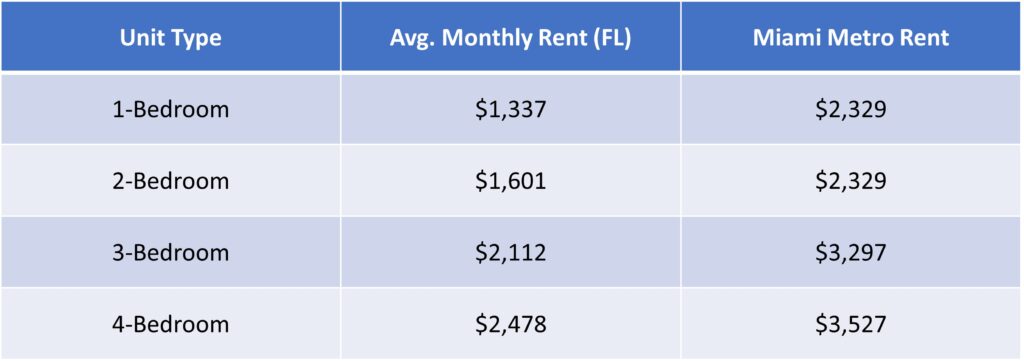
Rental Rates:
Median Home Price (FL): $410,400
Investment Performance & Wealth Building
Multifamily Advantages
– Economies of Scale: One roof, multiple rents. A quadplex renting at $2,000/unit generates $8,000/month. With $5,500 debt service, DSCR = 1.45.
– Risk Diversification: Vacancy in one unit doesn’t eliminate income.
– Institutional Appeal: Easier to scale portfolios and attract capital.
Single-Unit Advantages
– Lower Entry Barriers: Easier for first-time investors.
– Appreciation Potential: Strong in suburban areas with limited inventory.
– Simpler Financing: More lenders, lower rates, and easier underwriting.
– Resale Flexibility: Easier to sell to owner-occupants.
DSCR Loans: A Game-Changer for Multifamily
DSCR (Debt Service Coverage Ratio) = Gross Rental Income ÷ Debt Obligations
– Most lenders require DSCR > 1.1 or 1.2.
– Example: Triplex renting at $1,800/unit = $5,400/month. Debt service = $4,000 → DSCR = 1.35.
– Benefits:
– No personal income verification.
– Ideal for self-employed investors.
– Strong cushion against vacancies.
Regional Investment Hotspots
North Florida (e.g., Jacksonville, Pensacola)
– Lower purchase prices.
– High rent-to-price ratios.
– Rent growth: 4%–6% annually.
Central Florida (e.g., Orlando)
– Balanced appreciation.
– Tourism-driven rental demand.
South Florida (e.g., Miami, Fort Lauderdale)
– High rents.
– Strong demand from international tenants.
Final Thoughts
Choosing between single-unit and multifamily investing in Florida depends on your financial goals, risk tolerance, and mortgage strategy. Single-family homes offer simplicity and appreciation, while multifamily properties deliver scalability and income stability—especially when paired with DSCR loans.
For investors seeking long-term cash flow and portfolio growth, multifamily assets in Florida’s thriving rental markets may offer the edge in 2025.
Want personalized assistance? Visit our 'Contact Us' tab and leave your information with one of our experts.
About Us
A group of like-minded seasoned veterans came together to create a company with an employee-focused culture. A culture that values its members both personally and professionally and a company built on the idea that the customer comes first!
We do not share data with third parties for marketing/promotional purposes.
By submitting your phone number to Level Mortgage, you are authorizing a representative of our company to send you text messages and notifications. Message frequency may vary. Message/data rates apply. Reply STOP to unsubscribe to a message sent from us, and HELP to receive help.