Florida’s real estate market has always been dynamic, shaped by migration trends, weather risks, and national economic conditions. As we move into 2026, many buyers and sellers are asking the same question: Will home prices drop? To answer this, let’s break down the latest data, regional variations, and the broader economic forces at play.
– Statewide Home Values: The average Florida home value is $374,697, down 5.4% year-over-year as of October 2025.
– Median Sale Price: Across Florida, the median sale price is $408,400, a slight 0.39% decline compared to last year.
– Inventory Growth: Active listings rose 38.4% year-over-year, pushing months of supply to 5.5 months, a sign of a more balanced market.
– Mortgage Rates: The 30-year fixed mortgage averaged 6.64% in 2025, with forecasts suggesting a modest decline toward 6% in 2026, improving affordability.
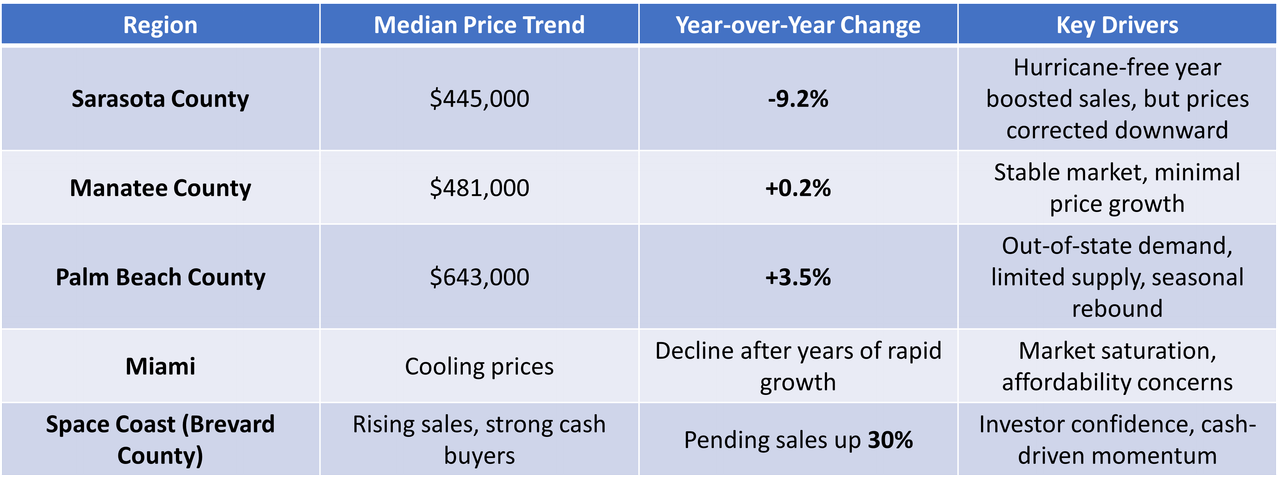
Florida’s housing market is not uniform. Different counties show very different trajectories:
– Rising Inventory: With listings up nearly 40% statewide, buyers have more choices, reducing bidding wars.
– Insurance Costs: Florida’s notoriously high homeowners insurance premiums are discouraging buyers, especially in hurricane-prone areas.
– Affordability Ceiling: After years of double-digit growth, many markets (like Miami) have simply become too expensive, leading to cooling prices.
– Longer Time on Market: Homes now average 83 days on market, up from 70 days last year, signaling slower demand.
Strong Migration: Florida continues to attract new residents, retirees, and investors, sustaining demand.
Cash Buyers: In areas like the Space Coast, cash purchases surged, insulating the market from mortgage rate fluctuations.
Mortgage Rate Relief: Slight declines in rates (from 6.64% to ~6%) could re-energize buyers in 2026.
Regional Resilience: Counties like Palm Beach and Manatee show steady or rising prices, proving that not all markets are weakening.
Experts describe the U.S. housing market as entering a “two-speed” phase:
– Growth Regions: Areas with strong migration (Palm Beach, Space Coast) will likely see modest price increases.
– Correction Regions: Overheated markets (Miami, Sarasota) may continue to decline or flatten.

Florida’s market is unlikely to “crash.” Instead, expect regional divergence: some counties will cool, while others remain competitive.
Experts describe the U.S. housing market as entering a “two-speed” phase:
– Growth Regions: Areas with strong migration (Palm Beach, Space Coast) will likely see modest price increases.
– Correction Regions: Overheated markets (Miami, Sarasota) may continue to decline or flatten.
Florida’s market is unlikely to “crash.” Instead, expect regional divergence: some counties will cool, while others remain competitive.
So, will home prices drop? The answer is nuanced. Yes, in some regions—Sarasota and Miami are already seeing declines. No, in others—Palm Beach and the Space Coast continue to rise. Florida’s housing market in 2026 will be defined by regional divergence, inventory growth, and affordability pressures.
For buyers, this means opportunity. For sellers, it means adjusting expectations. And for the market overall, it means a shift toward balance after years of volatility.
Want personalized assistance? Visit our 'Contact Us' tab and leave your information with one of our experts.
United States
We do not share data with third parties for marketing/promotional purposes.
By submitting your phone number to Level Mortgage, you are authorizing a representative of our company to send you text messages and notifications. Message frequency may vary. Message/data rates apply. Reply STOP to unsubscribe to a message sent from us, and HELP to receive help.
Copyright © 2025 Level Mortgage LLC | NMLS # 2703136 An Equal Housing Lender