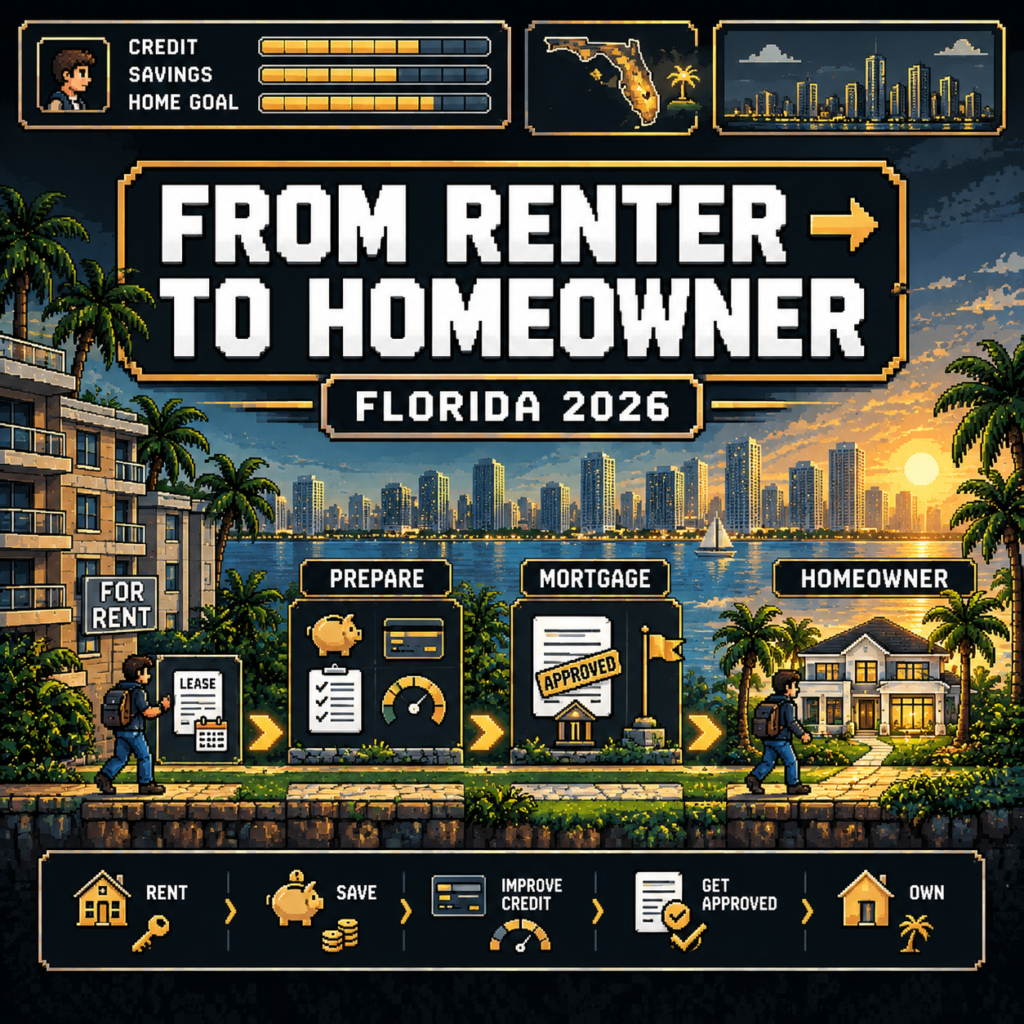
From Renter to Homeowner: Mastering the Lease Transition in Florida (2026)
Deciding whether to sign another lease or take the leap into homeownership is one of the most significant financial choices a renter can face. For many Florida residents, the arrival of a lease renewal notice serves as a natural checkpoint. Navigating this transition requires strategic timing, careful financial evaluation, and an understanding of current market dynamics. By preparing ahead of time, renters can position themselves to secure favorable financing and successfully step into homeownership.
When Should Renters Start Planning to Buy a Home?
Start Before Your Lease Renewal Date
Waiting until thirty days before your lease expires to think about buying a home is a recipe for unnecessary stress. Landlords typically require sixty to ninety days of notice before a lease ends. If you intend to transition from renting to owning, you should begin mapping out your strategy at least six months prior to your lease expiration date. This window gives you adequate time to review your credit profile, build necessary savings, and speak with a lending professional without feeling rushed by a looming moving deadline.
Why Timing Matters for Mortgage Preparation
Mortgage underwriting relies heavily on verified financial history. Lenders look for steady income, consistent employment records, and clean credit reports. Giving yourself a multi-month runway allows you to resolve minor credit report errors, pay down revolving balances, and optimize your debt-to-income ratio. Proper timing ensures that when you find the right property, your financial profile is completely mortgage-ready.
What Renters Need to Do Before Applying for a Mortgage
Review Your Credit
Your credit score directly influences the mortgage interest rate you receive. Most conventional loan programs require a minimum credit score of 620, while government-backed options like FHA loans may accept scores starting at 580 with a three and a half percent down payment. Reviewing your credit reports early allows you to address any inaccuracies and take steps to improve your standing before submitting formal loan applications.
Calculate Your Debt-to-Income Ratio
Mortgage lenders examine your debt-to-income ratio to determine how much housing payment you can comfortably manage. This ratio compares your monthly debt obligations, including car loans, student loans, and credit card minimums, to your gross monthly income. Keeping your debt-to-income ratio within acceptable lender thresholds is essential for successful first-time homebuyer mortgage options.
Build Your Down Payment and Closing-Cost Funds
Purchasing a home involves more than just a down payment. Buyers must also account for closing costs, which typically range from two to five percent of the purchase price. Accumulating a dedicated savings buffer well in advance ensures you are fully prepared for these upfront financial obligations.
Understanding the Florida Homebuying Market in 2026
Home Prices and Inventory
The Florida real estate landscape continues to experience a healthy rebalancing phase. Recent figures show that the median single-family home price in Florida hovers around $415,000, reflecting stable growth compared to previous years according to 2026 Florida housing market data. Meanwhile, housing inventory has adjusted, creating a more balanced environment where buyers have clearer opportunities to negotiate and find properties that align with their long-term goals.
Mortgage Rates and Affordability
Interest rates remain a central consideration for buyers navigating today’s economic climate. Average 30-year fixed mortgage rates hover near 6.95 percent, while 15-year fixed options average closer to 6.28 percent. Because mortgage rates directly impact monthly buying power, prospective homeowners should evaluate their budget carefully and explore various Florida mortgage programs to optimize their monthly payment structure.
From Rent Payment to Mortgage Payment
Transitioning renters often assume that moving from a $2,500 monthly rent payment means they can easily afford a $2,500 mortgage payment. However, a monthly mortgage payment comprises several distinct components. Beyond principal and interest, homeowners must budget for property taxes, homeowners insurance, private mortgage insurance if putting down less than twenty percent, and potential homeowners association or condominium fees. Evaluating the complete monthly housing cost ensures there are no surprises after closing.
Florida Programs That May Help First-Time Buyers
First-time buyers in the Sunshine State have access to several specialized support initiatives. For example, the Florida Hometown Heroes Program provides eligible full-time workers with up to $35,000 in down payment and closing cost assistance through a zero-interest, 30-year deferred second mortgage. Exploring these state and local resources with a knowledgeable professional can significantly reduce your upfront cash requirements.
Your Lease-to-Homeownership Timeline
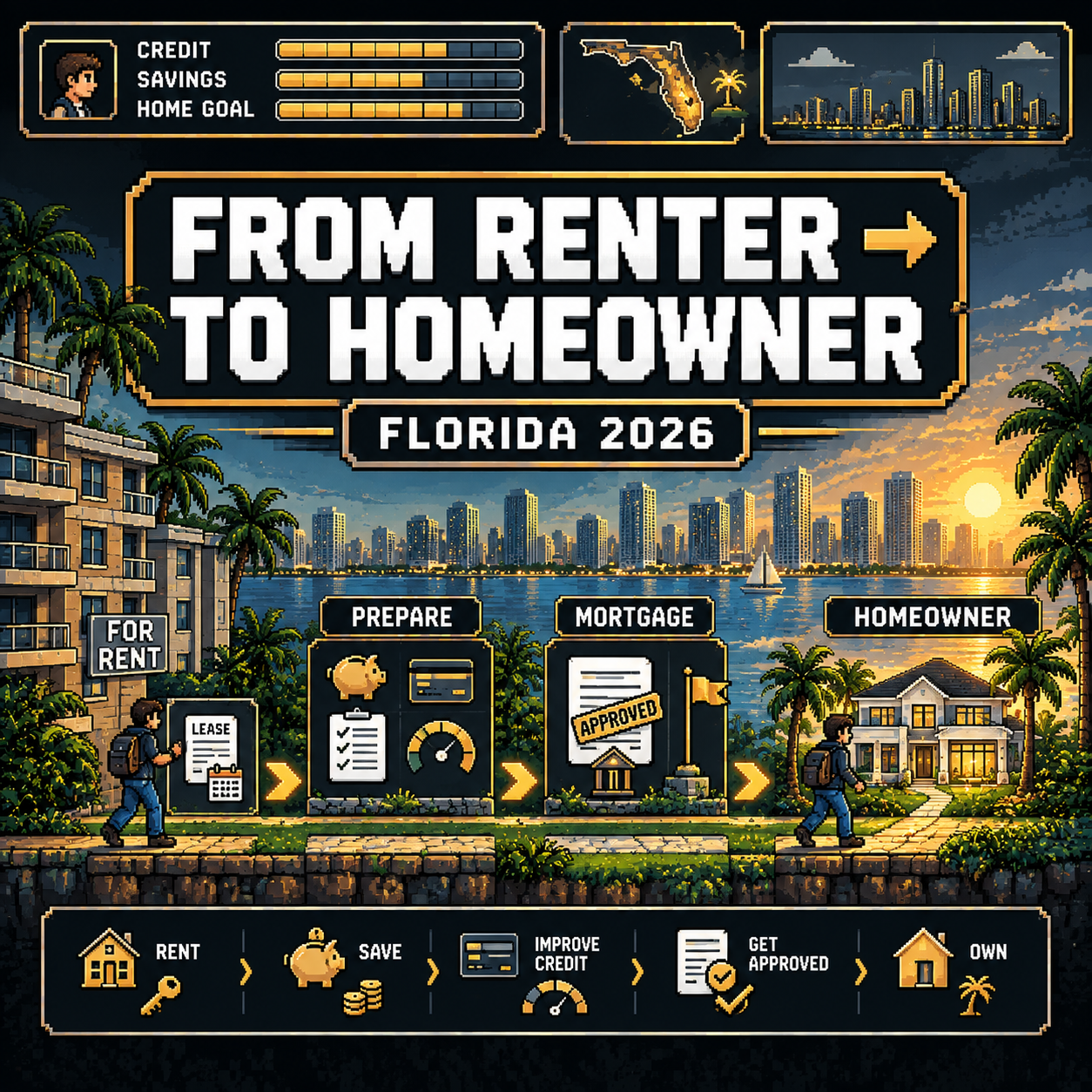
A structured timeline keeps your transition organized:
Six to twelve months before lease expiration: Review credit reports, pay down revolving balances, build savings, and establish a realistic purchase budget.
Three to six months before lease expiration: Consult with a mortgage specialist, explore financing options, and secure mortgage pre-approval.
One to three months before lease expiration: Begin actively touring homes, coordinate your purchase closing date with your lease end, and finalize your loan documents.
Should You Renew Your Lease or Prepare to Buy?
Deciding between another year of renting and buying a home depends on a careful assessment of your personal circumstances. Evaluate how long you plan to stay in the area, your current savings, job stability, and local housing inventory. If you value long-term stability, building equity, and customizing your living space, preparing to buy is a compelling path forward.
Final Takeaway
Mastering the lease transition from renting to owning requires foresight, financial preparation, and expert guidance. By understanding your credit, evaluating total housing costs, and exploring available assistance programs, you can approach your lease expiration with confidence. To learn more about your financing options or to start your credit and mortgage preparation, contact LevelMTG today to speak with an experienced mortgage professional.
Want personalized assistance? Visit our 'Contact Us' tab and leave your information with one of our experts.
About Us
A group of like-minded seasoned veterans came together to create a company with an employee-focused culture. A culture that values its members both personally and professionally and a company built on the idea that the customer comes first!
We do not share data with third parties for marketing/promotional purposes.
By submitting your phone number to Level Mortgage, you are authorizing a representative of our company to send you text messages and notifications. Message frequency may vary. Message/data rates apply. Reply STOP to unsubscribe to a message sent from us, and HELP to receive help.
Ready to Buy a Home but Worried About a Down Payment?
Many prospective buyers assume that purchasing a property requires saving a massive cash pile. This belief stops many renters from exploring their options. Saving twenty percent of a home purchase price can take years or even decades in a competitive housing market. Fortunately, modern lending standards and state-level programs mean that a large cash savings account is no longer a strict prerequisite for homeownership.
The amount of cash required to buy a home depends on several variables. Your chosen loan program, credit profile, property type, occupancy plans, and household income all shape your initial capital needs. Evaluating your total cash-to-close requirement rather than focusing solely on the down payment provides a clearer picture of your readiness.
Do You Really Need 20% Down to Buy a Home?
The traditional rule suggesting a twenty percent down payment is a helpful savings benchmark, but it is rarely a mandatory requirement. Putting down twenty percent eliminates private mortgage insurance on conventional loans, but many buyers choose lower down payments to preserve their savings.
Lower down payments result in a higher loan balance and monthly mortgage insurance premiums, which adjusts your monthly payment. Balancing your available cash reserves with your monthly housing budget is essential. You do not need to empty your bank accounts to secure a competitive financing structure.
Low Down Payment Mortgage Options in 2026
Qualified borrowers can access several mortgage paths that feature low down payment requirements.
FHA Loans
Backed by the Federal Housing Administration, FHA loans accommodate lower credit profiles and flexible debt parameters. They require a minimum down payment of 3.5 percent for qualifying borrowers. FHA loans include upfront and monthly mortgage insurance premiums, which remain active for the life of the loan in most cases. Understanding FHA Loans and reviewing guidelines via 2026 FHA Mortgage Requirements helps clarify how these guidelines affect your monthly obligations.
Conventional Loans
Conventional financing offers flexible underwriting for buyers with solid credit histories. Many conventional programs permit down payments as low as 3 percent for first-time buyers. Private mortgage insurance applies when putting down less than 20 percent, but borrowers can often cancel this insurance once they reach sufficient equity. Reviewing Conventional Loans provides insight into standard qualification benchmarks.
VA Loans
Eligible veterans, active-duty servicemembers, and surviving spouses can access VA financing with zero down payment options. VA loans do not require monthly mortgage insurance and offer competitive interest rates. VA eligibility is not restricted to first-time buyers, making it one of the most powerful tools available for those who have served. Learn more through VA Loans and official guidelines at 2026 VA Home Loan Requirements.
USDA Loans
For buyers exploring eligible rural or suburban areas across Florida, USDA loans offer zero down payment financing. These loans feature strict geographic eligibility maps and household income caps, ensuring they serve moderate-income households purchasing primary residences in designated communities, verified via 2026 USDA Home Loan Requirements.
Down Payment Assistance Programs in Florida
Down payment assistance programs help eligible buyers reduce the out-of-pocket cash required at closing. Assistance can originate from state housing agencies, county governments, city initiatives, or qualified nonprofits.
The Florida Housing Finance Corporation provides structured programs that pair first-mortgage financing with secondary assistance. It is important to note that assistance is not always a free grant. Programs can be structured as deferred second mortgages, forgivable loans, or repayable loans that require future settlement.
Florida Housing Down Payment Assistance
Current Florida Housing offerings include first-mortgage options paired with secondary assistance like the HFA Preferred and HFA Advantage programs. These can often be paired with second-mortgage assistance providing 3, 4, or 5 percent of the total first mortgage amount, subject to program guidelines and underwriting criteria via [EXTERNAL LINK: 2026 Florida Housing Homebuyer Program Requirements.
Hometown Heroes
The Florida Hometown Heroes program assists working professionals, including educators, healthcare workers, police officers, and firefighters, with purchasing a primary home. Qualifying borrowers can receive assistance ranging from a minimum of $10,000 up to 5 percent of the first mortgage amount, capped at $35,000. This assistance is structured as a zero-interest, non-amortizing, 30-year repayable second mortgage. Reviewing First-Time Homebuyer Programs and learning more through 2026 Florida Hometown Heroes Program Requirements helps buyers understand occupational and income limits.
What If You Have Some Savings, But Not Enough?
Buyers do not have to choose between saving for years and buying immediately. Several tactical approaches bridge the gap. You can combine modest personal savings with down payment assistance or a low-down-payment loan. In certain transactions, buyers can also negotiate seller concessions to cover a portion of closing costs.
Exhausting all your savings to meet a high down payment leaves you vulnerable. Maintaining appropriate cash reserves after closing protects you against unexpected home repairs or financial emergencies.
Remember, the Down Payment Is Not Your Only Upfront Cost
Focusing entirely on the down payment overlooks other essential closing expenses. Your total cash-to-close includes loan origination fees, appraisal charges, title searches, homeowners insurance escrows, property taxes, and initial HOA dues. Evaluating all these factors alongside Closing Costs Guide ensures you arrive at closing day fully prepared.
How Much Should You Actually Save Before Buying?
The ideal savings target varies by household. Instead of aiming for an arbitrary figure, calculate a safe cash cushion that covers your down payment, estimated closing costs, moving expenses, and post-closing emergency reserves. Securing Mortgage Pre-Approval early in the process helps you determine exact numbers based on your financial profile.
How to Find Out Which Option Is Right for You
Navigating low-down-payment options requires a structured approach:
Review your credit reports and check for accuracy.
Calculate your monthly debt-to-income ratio.
Determine your comfortable monthly housing payment.
Estimate your available liquid cash reserves.
Explore state and local down payment assistance programs.
Compare FHA, conventional, VA, and USDA financing terms.
Consult a licensed mortgage professional to review your options.
Final Thoughts
Not having a twenty percent down payment saved does not mean you cannot buy a home. Multiple financing structures and assistance initiatives exist to make homeownership attainable for qualified buyers. The right strategy balances your upfront cash outlay, monthly payment comfort, mortgage insurance costs, and long-term financial stability.
Ready to explore your options? Connect with Level Mortgage today to speak with an experienced loan officer and review what financing strategies align with your goals.
Want personalized assistance? Visit our 'Contact Us' tab and leave your information with one of our experts.
About Us
A group of like-minded seasoned veterans came together to create a company with an employee-focused culture. A culture that values its members both personally and professionally and a company built on the idea that the customer comes first!
We do not share data with third parties for marketing/promotional purposes.
By submitting your phone number to Level Mortgage, you are authorizing a representative of our company to send you text messages and notifications. Message frequency may vary. Message/data rates apply. Reply STOP to unsubscribe to a message sent from us, and HELP to receive help.
Will Your Credit Score Stop You From Buying a Home in Florida?
Many potential homebuyers in Florida feel anxious about their credit history. They often worry that a single digit on a report will permanently lock them out of the housing market. If you are asking whether your credit score will prevent you from buying a home, the short answer is that while your credit health is significant, it is rarely the only factor that determines your eligibility.
Mortgage qualification involves a comprehensive review of your financial profile. While lenders look at your credit score, they also evaluate your income, debt levels, assets, and the type of loan program you choose. Because different mortgage products have different guidelines, a score that might be disqualifying for one loan could be perfectly acceptable for another.
What Credit Score Do You Need to Buy a Home in Florida in 2026?
There is no single magic number required to purchase property in the state. Requirements often fluctuate based on the specific loan program and the individual lender. Trusted 2026 Mortgage Credit Score Data provides a breakdown of how various profiles move through the approval process.
Conventional Loans
Conventional mortgages generally favor higher credit scores. While some lenders may accept scores as low as 620, borrowers with scores in the mid-700s often receive the most competitive pricing. Credit Score Requirements for Buying a Home can help you understand where your profile stands.
FHA Loans
FHA loans remain a popular choice for Florida residents because they often offer more flexibility. For borrowers who meet certain criteria, scores as low as 580 may allow for a down payment as low as 3.5 percent. Some lenders may even work with lower scores if there are compensating factors in your financial file, as outlined in 2026 FHA Credit Requirements.
VA Loans
Veterans and active military personnel often enjoy the most flexible lending options. There is no federally mandated minimum credit score for a VA loan, though individual lenders set their own requirements based on their internal risk policies. You can learn more about how these guidelines function in 2026 VA Loan Guidelines.
USDA Loans
For buyers looking in eligible rural or suburban areas, USDA loans offer a pathway to homeownership with no down payment. These programs typically look for a stable credit history, often targeting a score of 640 or higher to streamline the underwriting process.
Does a Higher Credit Score Mean a Lower Mortgage Rate?
Yes, your score influences your interest rate through a process called risk-based pricing. Lenders use loan-level pricing adjustments to calculate the risk of a loan. A higher credit score signals lower risk, which can lead to a lower interest rate and a smaller monthly payment.
For example, a borrower with a 760 score might secure a rate that results in a lower monthly obligation compared to a borrower with a 660 score. Over the life of a loan, this difference can amount to thousands of dollars in interest savings. Understanding these variables is key when reviewing Mortgage Pre-approval options.
What If Your Credit Score Is Below the Typical Requirement?
If your score is not quite where you want it to be, you are not out of options. You can take proactive steps to improve your profile before applying for a loan.
Check Your Credit Report
Obtain your free credit reports from the major bureaus. Look for inaccuracies, such as incorrect balances or accounts that do not belong to you, and dispute them immediately.
Pay Down Credit Card Balances
High credit utilization is a common reason for lower scores. Reducing your balances relative to your limits can have a positive impact on your score.
Avoid New Credit
Applying for new loans or credit cards right before a mortgage application can trigger hard inquiries and lower your score. It is best to keep your financial profile stable during the home search.
Manage Debt
Lenders look at your debt-to-income ratio. Reducing your existing debt obligations can strengthen your overall application and improve your borrowing power.
Your Credit Score Isn't the Only Thing Lenders Look At
A credit score is just one piece of the puzzle. Lenders also review your income stability, your employment history, and your liquid assets. If your score is lower, you might compensate by having a larger down payment or lower overall monthly debt obligations. FHA Loans can often accommodate borrowers who have a strong payment history despite a lower numerical score.
How Florida's 2026 Housing Market Changes the Conversation
The Florida market in 2026 remains competitive. With shifting home prices and fluctuating inventory, buyers must be prepared. 2026 Florida Housing Market Datasuggests that demand remains steady, meaning buyers should know their budget and their borrowing capacity early. Getting a clear picture of your finances is the first step toward finding a home that fits your lifestyle. You can read more about the current landscape in First-time Homebuyers guides.
When Should You Check Your Credit Before Buying?
You should check your credit long before you begin touring properties. Reviewing your reports six months to a year in advance allows you time to correct errors or pay down debts. Speaking with a mortgage professional at Level Mortgage can help you determine if you are ready or if you need more time to prepare your profile.
The Bottom Line
A lower-than-perfect credit score does not automatically disqualify you from buying a home in Florida. With careful planning and the right loan program, many families reach their goal of homeownership every year.
If you are concerned about your financing, we invite you to reach out to our team. At Level Mortgage, we help you review your financial profile, explain your options, and identify the loan programs that match your goals. Start your journey by learning more about Florida Mortgage Programs and see how we can assist you.
Want personalized assistance? Visit our 'Contact Us' tab and leave your information with one of our experts.
About Us
A group of like-minded seasoned veterans came together to create a company with an employee-focused culture. A culture that values its members both personally and professionally and a company built on the idea that the customer comes first!
We do not share data with third parties for marketing/promotional purposes.
By submitting your phone number to Level Mortgage, you are authorizing a representative of our company to send you text messages and notifications. Message frequency may vary. Message/data rates apply. Reply STOP to unsubscribe to a message sent from us, and HELP to receive help.
Should You Talk to a Lender or Real Estate Agent First?
Embarking on the journey to buy a home is an exciting milestone, but it often brings a common dilemma. Should you call a real estate agent to start touring dreamy neighborhoods, or should you sit down with a mortgage lender to discuss numbers?
While both professionals are essential to a successful purchase, the order in which you contact them matters. Understanding the ideal sequence can save you time, protect your financial boundaries, and strengthen your negotiating power. Level Mortgage is here to help you navigate this decision with absolute confidence.
Why the First Step Matters
The sequence of your initial steps dictates the flow of your entire home search. Consulting a professional too early without a clear plan can lead to misaligned expectations, heartbreak over homes outside your financial reach, or lost opportunities in fast-moving markets.
National Housing Market Report highlights that current inventory dynamics require buyers to move with clarity and speed. When you align your financing before touring properties, your budget planning becomes concrete, your negotiating power rises, and your closing timeline stays on track.
What Does a Mortgage Lender Do?
Determines Your Buying Power
A mortgage lender evaluates your financial profile to determine how much home you can comfortably afford. This process involves a comprehensive look at your income verification, credit score evaluation, and debt-to-income ratio.
Through mortgage pre-approval, a lender calculates your estimated monthly payment and loan program eligibility. Understanding a realistic budget upfront helps buyers avoid disappointment and focus only on properties they can secure. You can start exploring your baseline numbers by checking out our Mortgage Calculator.
Explains Available Loan Programs
Lenders do more than check credit scores. They match you with the right mortgage vehicle for your specific situation. This includes reviewing conventional loans, FHA loans, VA loans, USDA loans, jumbo loans, and down payment assistance programs. Accessing the right financing strategy can significantly expand your purchasing opportunities, especially if you qualify for specialized options like our FHA Loan Guide or VA Loan Programs.
What Does a Real Estate Agent Do?
Finds the Right Property
Once your financing parameters are established, a real estate agent takes the lead on property searches. They provide invaluable neighborhood guidance, perform comparative market analysis, schedule home tours, and help you craft a winning offer strategy.
Guides the Transaction
An experienced real estate agent acts as your advocate through complex negotiations. They coordinate home inspections, navigate appraisal challenges, handle contract negotiations, and manage every detail up to the final closing table.
Should You Speak With the Lender First?
While you can technically start your journey with either professional, many industry experts strongly recommend beginning with a mortgage consultation.
Starting with a lender offers several distinct benefits:
Understanding Affordability: You shop with exact numbers rather than guesses.
Strengthening Offers: Sellers take you seriously when you bring a pre-approval letter.
Faster Home Search: You avoid wasting time on homes that do not fit your financial framework.
Increased Confidence: Financial clarity reduces stress throughout the search.
Avoiding Financing Surprises: Any credit or income hurdles are ironed out before you fall in love with a property.
If you are a first-time buyer wanting a foundational overview of the entire path, our First-Time Homebuyer Guide provides a comprehensive roadmap.
How Mortgage Pre-Approval Strengthens Your Position
Stronger Purchase Offers
Sellers and listing agents view pre-approved buyers as serious, qualified candidates. In competitive environments, a verified pre-approval letter gives your offer priority over unvetted buyers.
Faster Decision Making
Knowing your exact financing limits means you can write an offer immediately when the right home hits the market. Hesitation can cost you a property in fast-paced conditions.
Competitive Markets
Mortgage Application Statistics shows that pre-approval volume shifts alongside market adjustments, proving that prepared buyers consistently secure better positioning. To see where rates stand today, review our Current Mortgage Rates.
Why Your Lender and Agent Should Work Together
A successful purchase relies heavily on collaboration between your mortgage lender, real estate agent, title company, and insurance provider. When your lender and agent communicate seamlessly, you experience better communication, fewer transactional delays, and a vastly smoother closing process.
Homebuying Trends in 2026
Current market conditions in 2026 emphasize the need for early preparation. [EXTERNAL SOURCE LINK: Homebuyer Trends Report] indicates that while buyer demand remains steady, shifts in inventory and regional pricing require disciplined budgeting. Mortgage Rate Analysis points to a stabilizing rate environment, making proactive financial alignment more rewarding than ever. Furthermore, Housing Affordability Study notes that first-time homebuyer activity is adapting through creative financing and strategic planning.
Final Thoughts
Deciding whether to talk to a lender or real estate agent first comes down to preparation. While both professionals play indispensable roles, beginning your journey with a mortgage lender provides the financial clarity you need to shop effectively. When your lender and agent collaborate seamlessly, your entire homebuying experience transforms into a smooth, confident journey.
Ready to start your homebuying journey the right way?
Contact Level Mortgage today for expert mortgage pre-approval, personalized financing guidance, and comprehensive loan program comparisons. Let us help you build a winning homebuying strategy from day one.
Want personalized assistance? Visit our 'Contact Us' tab and leave your information with one of our experts.
About Us
A group of like-minded seasoned veterans came together to create a company with an employee-focused culture. A culture that values its members both personally and professionally and a company built on the idea that the customer comes first!
We do not share data with third parties for marketing/promotional purposes.
By submitting your phone number to Level Mortgage, you are authorizing a representative of our company to send you text messages and notifications. Message frequency may vary. Message/data rates apply. Reply STOP to unsubscribe to a message sent from us, and HELP to receive help.
For many veterans, active-duty service members, and military families, the VA loan is a cornerstone of financial stability. It offers competitive terms and accessibility that are unmatched in the private market. However, when it comes time to either buy a new home or lower the interest rate on an existing one, a common question arises: do VA refinance rates differ from purchase rates?
The answer is rarely a simple yes or no. Pricing in the mortgage industry is dynamic, and understanding why these rates fluctuate is key to making the best financial decision for your family in 2026.
Understanding VA Loans
A VA loan is a mortgage program guaranteed by the Department of Veterans Affairs. It is designed to provide veterans, service members, and surviving spouses with favorable terms, including the ability to purchase a home with no down payment and no private mortgage insurance.
It is important to clarify that the VA does not lend the money itself. Instead, private lenders, such as Level Mortgage, issue the loans, and the VA provides a guarantee against default. Because lenders set the terms based on market conditions, the Department of Veterans Affairs does not directly set the interest rates you see in advertisements.
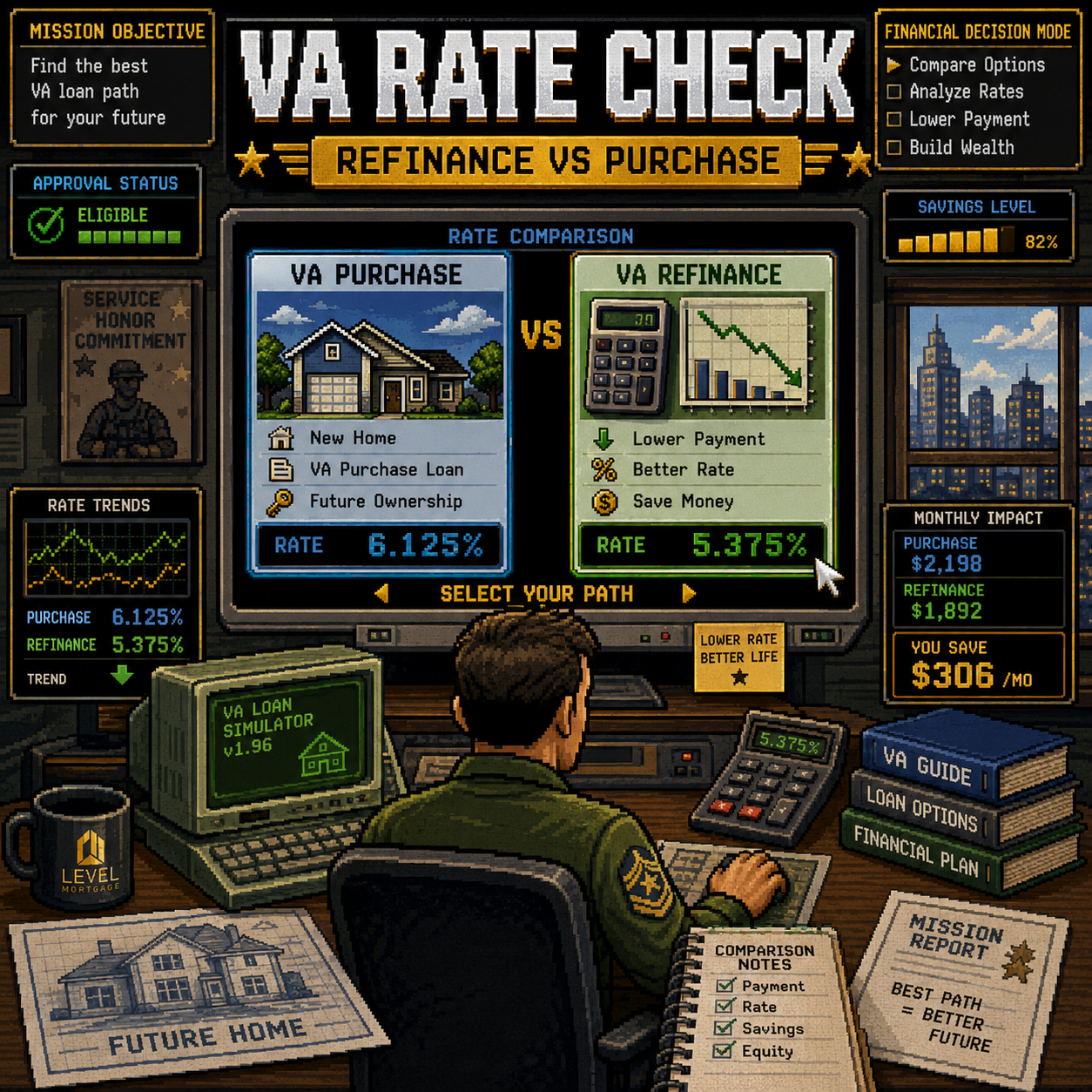
Are VA Refinance Rates Different from Purchase Rates?
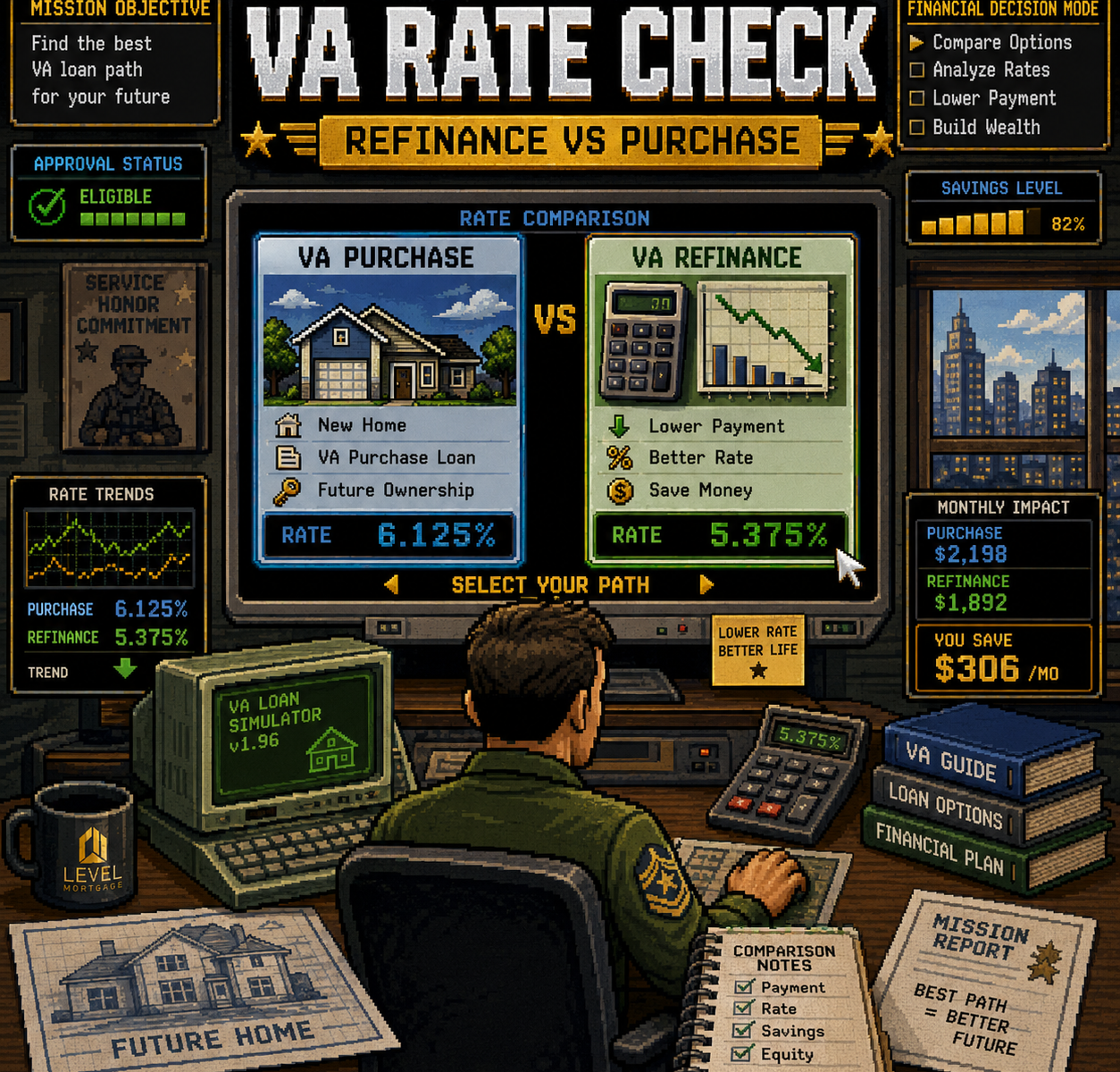
In short, there is no permanent pricing rule that dictates one must be higher than the other. Sometimes, you may find that purchase rates are lower due to specific market incentives. In other scenarios, refinance rates, particularly for streamlined programs, might be more competitive.
The reality is that your rate depends on the specific product, the lender, and the economic climate at the moment you apply. There is no industry-wide mandate forcing a price gap between a new purchase and a refinance.
What Determines VA Mortgage Rates?
Market Interest Rates
VA mortgage rates are primarily influenced by the broader bond market, specifically mortgage-backed securities. Factors such as Treasury yields, inflation reports, and Federal Reserve policy decisions dictate the “base” cost of borrowing. When investors are concerned about inflation or economic instability, rates across the board typically rise. Inflation and Economic Outlook provides further context on how these macro trends impact everyday borrowing costs.
Borrower Qualifications
Your individual financial profile is just as important as the market. Lenders evaluate your credit score, debt-to-income ratio, occupancy status, and total financial reserves. A borrower with a pristine credit profile often secures a lower rate, regardless of whether they are purchasing or refinancing.
Loan Type
The specific VA product you choose carries its own pricing logic:
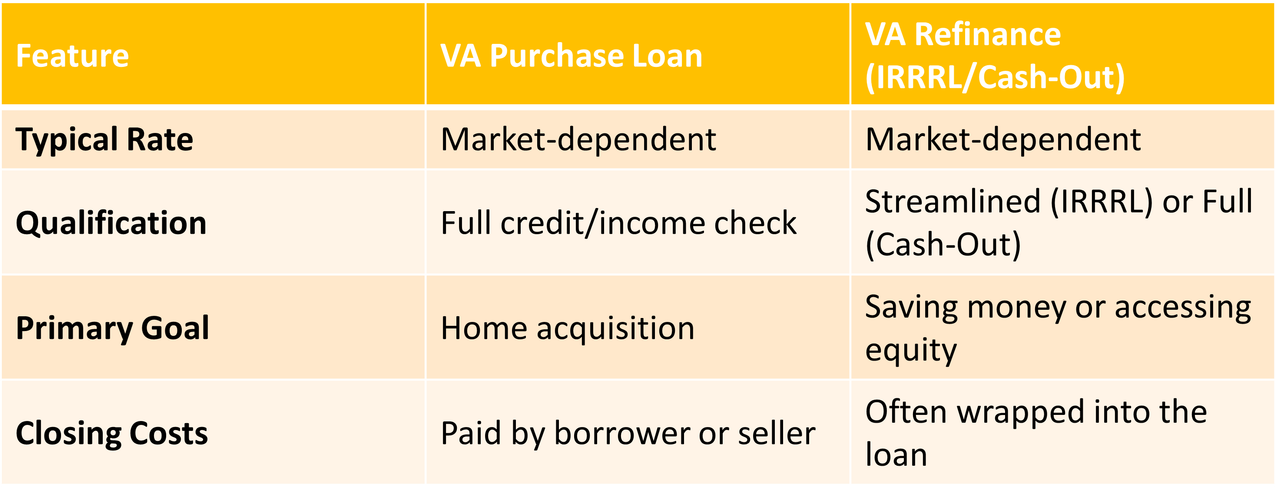
VA Purchase Loan: Often priced competitively to attract new buyers.
VA Interest Rate Reduction Refinance Loan (IRRRL): Sometimes referred to as a streamline refinance, these loans are designed to reduce your rate with minimal paperwork.
VA Cash-Out Refinance: Because this loan allows you to access home equity, it is often treated with slightly different risk parameters by lenders, which can impact the interest rate.
When Does Refinancing Make Sense?
Refinancing is a strategic tool, not an automatic win. It generally makes sense when your goal is to:
Lower Your Monthly Payment: Even a small drop in rate can save you significant money over the life of your loan.
Switch from Adjustable to Fixed Rate: If you have an adjustable-rate mortgage, moving to a fixed rate can provide long-term payment stability.
Access Home Equity: A cash-out refinance can help consolidate high-interest debt or fund necessary home improvements.
Shorten Your Loan Term: You might choose to refinance from a 30-year term to a 15-year term to build equity faster.
You can run your own numbers using our Mortgage Calculator to see how these adjustments affect your monthly output.
Current VA Mortgage Market in 2026
As we move through 2026, the mortgage environment remains focused on affordability. Mortgage Rate Trends indicates that while volatility has moderated compared to recent years, the market remains highly sensitive to economic data. Refinance activity has picked up as borrowers look for ways to optimize their monthly budgets amid persistent inflation and housing price pressures. VA Mortgage Market Report suggests that veterans who actively monitor their loan options are finding success in lowering their payments.
Should Veterans Refinance in 2026?
Refinancing in 2026 is a balance of immediate relief versus long-term cost. Before you proceed, consider the closing costs and the time it takes to break even on those expenses. If you plan to move within a few years, the cost of the refinance might outweigh the savings. However, if you are in your “forever home” and rates have dipped, the math often supports a refinance.
Always look at your loan term. Extending a loan term to get a lower payment might reduce your cash flow today but increase the total interest paid over the life of the loan. Housing Finance Statisticssupports the need for a thorough break-even analysis before committing to any refinance strategy.
VA Purchase Loan vs VA Refinance Comparison
For those looking to buy their first home, our Home Buying Guide is a great resource to start your journey.
Common Misconceptions About VA Mortgage Rates
VA Always Offers the Lowest Rate: While VA loans are excellent, rates are still set by lenders. It pays to compare.
Refinancing Automatically Saves Money: You must account for closing costs and the length of your loan.
VA Refinance Has No Costs: While some costs can be financed, there are still administrative, appraisal, and funding fees involved.
How Level Mortgage Helps Veterans Choose the Right Strategy
At Level Mortgage, we understand that VA lending is more than just a transaction. It is a tool to secure your future. We provide personalized mortgage analysis to help you decide if a purchase loan is your best path or if your current loan can be improved via a refinance. We monitor Mortgage Rate Trends daily so that when the right opportunity arrives, you are ready to act. You can review your current standing by exploring our VA Loan Programs.
Final Thoughts
VA refinance rates and purchase rates both move with the market, and there is no guarantee that one will always be lower than the other. The right choice depends on your financial goals, your current interest rate, and the economic landscape of 2026. Whether you are using a VA Refinance or exploring a VA Cash-Out Refinance, professional guidance ensures you don’t leave money on the table.
Ready to evaluate your VA loan options?
Don’t navigate the market alone. Contact Level Mortgage today for a personalized refinance evaluation or purchase loan guidance. We are committed to providing military families with the clarity and support they deserve. Connect with us to get your Mortgage Pre-Approval started today.
Want personalized assistance? Visit our 'Contact Us' tab and leave your information with one of our experts.
About Us
A group of like-minded seasoned veterans came together to create a company with an employee-focused culture. A culture that values its members both personally and professionally and a company built on the idea that the customer comes first!
We do not share data with third parties for marketing/promotional purposes.
By submitting your phone number to Level Mortgage, you are authorizing a representative of our company to send you text messages and notifications. Message frequency may vary. Message/data rates apply. Reply STOP to unsubscribe to a message sent from us, and HELP to receive help.
Jumbo Loans Explained: When They Make Sense and How They Work
In the world of luxury real estate, standard mortgage products often fall short. When you are looking to purchase a high-value property that exceeds the standard limits set for government-backed mortgages, you enter the territory of jumbo loans. These financial tools are essential for professionals, investors, and families looking to secure financing for premium real estate.
As we navigate the 2026 market, jumbo financing has become a sophisticated instrument for those managing high-net-worth portfolios. At Level Mortgage, we specialize in helping borrowers navigate these complex loan structures to find the best possible terms for their luxury acquisitions.
What Is a Jumbo Loan?
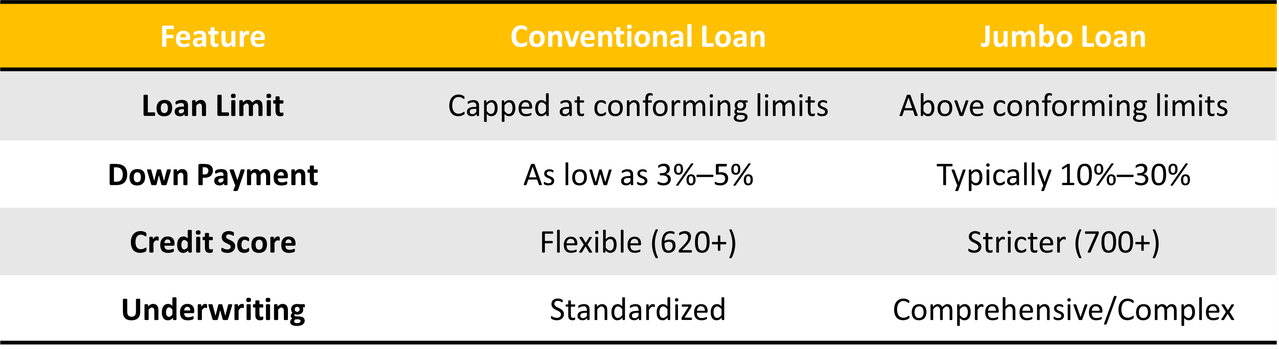
A jumbo loan is a mortgage that exceeds the conforming loan limits established by federal housing authorities. Because these loans cannot be purchased or guaranteed by standard government-sponsored entities, they are considered “non-conforming.”
In 2026, conforming loan limits have been adjusted to reflect ongoing changes in the national housing market. When your financing needs cross these thresholds, you move into the jumbo category. These loans exist specifically to provide liquidity for the luxury market, allowing borrowers to finance expensive homes without being forced to pay exclusively in cash. Unlike conventional loans, jumbo mortgages are held by the lenders who originate them, which is why underwriting standards are often more rigorous. You can learn more about our specific Jumbo Loan Programs to see how these limits apply to your search.
How Jumbo Loans Work
Jumbo loans are structured differently than standard residential mortgages to account for the increased financial exposure to the lender.
Loan Amounts Above Conforming Limits
In 2026, the threshold for a jumbo classification begins the moment your loan amount exceeds the current national conforming limit. In high-cost areas, these limits are often scaled higher, but once you surpass them, your loan is treated as a jumbo product. Financing a high-value property requires a structural approach that accounts for the unique nature of luxury asset valuation.
Interest Rates and Risk Factors
Historically, jumbo loans often carried higher interest rates than conventional loans due to the perceived risk of larger loan amounts. However, in the current market, that gap has narrowed. Mortgage Rate Trends Report indicates that for borrowers with strong credit profiles, jumbo rates are often highly competitive. Lenders use risk-based pricing, meaning your specific financial picture plays a larger role in your final rate than it might with a government-backed loan.
Down Payment Requirements
Down payment expectations for jumbo loans in 2026 are generally more substantial than the low-down-payment options seen in conventional lending. While standards vary by borrower profile, a down payment ranging from 10% to 30% is common. Furthermore, lenders often look for “asset-based underwriting,” meaning they want to see your full financial picture, not just your salary.
Who Qualifies for a Jumbo Loan in 2026?
Lenders are more conservative when underwriting jumbo loans because the financial stakes are higher.
Credit Score Requirements
Expect higher credit score expectations. While a 620 score might suffice for some government-backed loans, jumbo lending in 2026 frequently looks for scores in the 700 to 740 range or higher to ensure the best pricing.
Income Verification
Documentation is exhaustive. Because many jumbo borrowers are self-employed or have complex compensation structures, lenders require meticulous proof of income. Expect to provide two years of tax returns, bank statements, and often a profit and loss statement if you own your business.
Debt-to-Income Ratio
Jumbo lenders generally enforce a more conservative debt-to-income (DTI) ratio. They want to ensure that your luxury purchase does not overextend your monthly budget, especially in light of the high taxes and insurance costs associated with high-value homes.
Asset Reserves
This is a critical differentiator. Jumbo lenders often require borrowers to hold significant “cash reserves” in their accounts. This represents an amount, often equal to 6 to 12 months of mortgage payments, that remains untouched in your account after the loan closes.
When Does a Jumbo Loan Make Sense?
Buying Luxury or High-Value Homes
If you are buying in a high-cost market or seeking a property with unique features that push the price point above conforming limits, a jumbo loan is often your only financing option. It allows you to enter the Luxury Home Financing space while keeping your own capital deployed elsewhere.
Avoiding Multiple Loan Structures
Some borrowers try to avoid jumbo loans by using “piggyback” loans, which involve taking out two separate mortgages to keep the first under the conforming limit. A single jumbo loan is almost always simpler, cleaner, and easier to manage long-term.
Investment Property Strategy
High-end rental properties or luxury vacation homes are often financed with jumbo products. If you are diversifying your portfolio, a jumbo mortgage can be a strategic way to leverage real estate as an asset class. Explore our Investment Property Loansfor more on this strategy.
Benefits of Jumbo Loans
Higher Borrowing Capacity: Finance homes that fall well above standard price limits.
Flexible Property Options: Use financing for non-standard, premium real estate.
Competitive Rates: For high-credit-tier borrowers, rates can be exceptionally attractive.
Simplified Financing: Manage one loan rather than complex, multiple-loan structures.
Risks and Considerations of Jumbo Loans
Stricter Qualification: The underwriting process is deep and requires significant documentation.
Larger Down Payments: Expect to tie up more cash upfront compared to conventional loans.
Sensitivity to Market Conditions: Jumbo lenders can change their appetite for risk quickly, so having your Mortgage Pre-Approval early is essential.
Total Cost of Ownership: Beyond the loan, luxury homes come with higher property taxes and insurance premiums that must be factored into your budget.
Jumbo Loan Market Trends in 2026
The demand for luxury real estate in 2026 remains resilient, driven by high-net-worth buyers who prioritize primary residence quality. According to Luxury Real Estate Data, prices in the premium segment have continued to see steady growth, outperforming lower-tier segments in many urban markets. Jumbo Loan Market Report data indicates that lenders have become more comfortable with high-balance loans as property values have remained stable, making now an opportune time for those with strong financial profiles to explore their options.
Jumbo Loan vs Conventional Loan Comparison
Common Mistakes When Applying for Jumbo Loans
Underestimating Reserve Requirements: Failing to keep enough cash liquid to satisfy lender requirements.
Overextending Budget: Not accounting for the taxes and insurance of a luxury property.
Not Comparing Lenders: Not all jumbo lenders offer the same terms or underwriting flexibility.
How Level Mortgage Helps Jumbo Borrowers
At Level Mortgage, we specialize in high-value property financing. We offer personalized jumbo loan structuring that considers your full financial picture. We don’t just process a file; we create a strategy that optimizes your rate and balances your cash flow. Whether you are an entrepreneur with complex income or a high-net-worth investor, we provide the guidance necessary to navigate the jumbo lending landscape with confidence. If you are just starting, use our Loan Calculator to get a sense of your potential payments.
Final Thoughts
Jumbo loans are sophisticated tools that enable you to leverage your wealth for high-value real estate. While the qualification process is more rigorous than standard lending, the benefits of securing premium financing for the right property are undeniable. By preparing your financial documentation and partnering with an expert, you can turn your luxury home aspirations into reality.
Want personalized assistance? Visit our 'Contact Us' tab and leave your information with one of our experts.
About Us
A group of like-minded seasoned veterans came together to create a company with an employee-focused culture. A culture that values its members both personally and professionally and a company built on the idea that the customer comes first!
We do not share data with third parties for marketing/promotional purposes.
By submitting your phone number to Level Mortgage, you are authorizing a representative of our company to send you text messages and notifications. Message frequency may vary. Message/data rates apply. Reply STOP to unsubscribe to a message sent from us, and HELP to receive help.
Pay Off Your Mortgage Early or Invest? How to Make the Right Financial Move
One of the most common debates among homeowners is whether to funnel extra funds into paying off their mortgage or to deploy that capital into the investment markets. Both paths offer distinct benefits. Paying down debt provides a sense of security and guaranteed returns in the form of interest savings. Investing, on the other hand, offers the potential for higher long-term wealth growth through the power of compounding.
At Level Mortgage, we believe there is no universal right answer. The decision depends entirely on your financial goals, your risk tolerance, your time horizon, and your current mortgage terms. This guide will help you weigh the trade-offs so you can make an informed decision for your unique situation.
The Real Question: Debt Freedom or Wealth Growth?
Choosing between debt repayment and investing is a balancing act. Paying off your mortgage faster essentially “earns” you a return equal to your mortgage interest rate. It is a guaranteed, tax-free return on your money. However, by putting all your extra cash into your home, you may be missing out on higher historical returns in the stock market or other real estate opportunities.
To decide, you must look at your financial life as a whole. Are you prioritizing immediate peace of mind, or are you focused on maximizing your net worth over the next twenty years? Your mortgage rate, your age, and your proximity to retirement are all critical data points in this calculation.
The Benefits of Paying Off Your Mortgage Early
Guaranteed Interest Savings
Every dollar you pay toward your principal reduces the balance upon which your interest is calculated. This creates a compounding effect of interest savings that can save you thousands of dollars over the remaining life of your loan. If you have a high-interest mortgage, this “return” on your money is substantial.
Financial Security and Peace of Mind
For many, the psychological weight of a mortgage is a primary source of stress. Eliminating that monthly obligation provides unparalleled peace of mind. Once your mortgage is paid off, your monthly cash flow increases significantly, providing a buffer against economic downturns or changes in employment.
Building Home Equity Faster
Paying down your principal builds your home equity at an accelerated rate. This increases your net worth and gives you more options for future borrowing, such as using Home Equity Loans to fund major life goals or renovations.
The Benefits of Investing Instead of Paying Off Your Mortgage
Potential Higher Returns
Historical market data often shows that diversified investment portfolios provide returns that exceed current mortgage interest rates. When you pay off a 6% mortgage, your return is exactly 6%. When you invest in a diversified strategy, your long-term potential may be higher, though it comes with more volatility.
The Power of Compound Growth
Investing early allows your money to work for you over decades. Even small monthly contributions can grow into significant wealth because of the time advantage. Investment Market Performance Data highlights how long-term market participation can outperform simple debt repayment, especially for younger homeowners.
Maintaining Liquidity
Money paid into a mortgage is often “trapped” in the home until you sell or refinance. Money in a brokerage account or investment fund remains liquid. In an emergency, it is much easier to access investment funds than it is to pull equity out of your home.
What 2026 Mortgage Rates Mean for This Decision
The 2026 mortgage rate environment is a major factor in your decision. According to recent financial data, mortgage rates have settled into a range that makes the choice more complex than it was during the era of sub-3% rates.
If your current mortgage rate is low, the “cost” of keeping that debt is minimal, and investing those extra funds often makes mathematical sense. If your rate is higher, the “guaranteed return” of paying down your principal becomes much more attractive. Mortgage Rate Data confirms that current rates remain elevated compared to the early 2020s, which is prompting many homeowners to prioritize debt reduction.
Mortgage Interest Rate vs Investment Return: How to Compare
When comparing your mortgage rate to potential investment returns, consider the following:
The “After-Tax” Return: Mortgage interest can sometimes be tax-deductible, which lowers the effective cost of the debt. Conversely, investment gains may be subject to capital gains taxes.
Risk and Volatility: Paying off your mortgage carries zero risk. Investing carries the risk of market loss.
Investment Timeline: The longer your timeline, the more likely you are to ride out market volatility to achieve higher average returns.
Situations Where Paying Off Your Mortgage May Make More Sense
Near Retirement: Many retirees prefer to enter their post-work years without a mortgage payment to minimize monthly expenses.
Low Risk Preference: If you lose sleep over debt, the emotional benefit of being “debt-free” is worth more than any potential market gain.
High Mortgage Interest Rate: If your rate is significantly higher than 6%, paying down the balance provides a robust and risk-free return.
Situations Where Investing May Be the Better Choice
Younger Homeowners: With a multi-decade time horizon, you have the luxury of time to recover from market cycles and benefit from compound growth.
Strong Emergency Savings: If you already have a fully funded emergency reserve, you can afford to take on the market risk associated with investing.
Access to Employer Benefits: If your employer offers a 401(k) match, that is an immediate 100% return on your money. You should always maximize this before paying extra on your mortgage.
A Balanced Strategy: Can You Do Both?
Financial planning is rarely an “either/or” situation. Many homeowners find success by adopting a balanced approach. You can allocate 50% of your extra cash to principal reduction and 50% to a diversified investment account. This allows you to build home equity while simultaneously growing your liquid wealth. This keeps your financial life diversified and flexible.
How Level Mortgage Helps You Make Smarter Mortgage Decisions
At Level Mortgage, we don’t just see a loan; we see a component of your long-term wealth strategy. We help you evaluate your current mortgage terms, run projections on potential Refinance Options, and compare how different payment strategies affect your long-term net worth.
If you are a first-time buyer exploring your options, our First-Time Home Buyer Guide offers a clear roadmap. If you are a seasoned homeowner looking to optimize your debt, we can walk you through the math and help you determine whether your mortgage strategy is aligned with your future goals.
Want personalized assistance? Visit our 'Contact Us' tab and leave your information with one of our experts.
About Us
A group of like-minded seasoned veterans came together to create a company with an employee-focused culture. A culture that values its members both personally and professionally and a company built on the idea that the customer comes first!
We do not share data with third parties for marketing/promotional purposes.
By submitting your phone number to Level Mortgage, you are authorizing a representative of our company to send you text messages and notifications. Message frequency may vary. Message/data rates apply. Reply STOP to unsubscribe to a message sent from us, and HELP to receive help.
Adjustable-Rate Loans Explained: How They Work & When to Get One
Navigating the mortgage landscape in 2026 requires more than just checking the daily interest rates. It involves understanding the tools available to maximize your purchasing power and align your financing with your lifestyle goals. One of the most misunderstood yet potentially powerful tools in a borrower’s arsenal is the Adjustable-Rate Mortgage (ARM). While fixed-rate loans are the industry standard, ARMs offer unique features that may serve specific financial strategies. This guide will help you understand how these loans function and how to determine if one is right for your unique situation.
What Is an Adjustable-Rate Mortgage (ARM)?
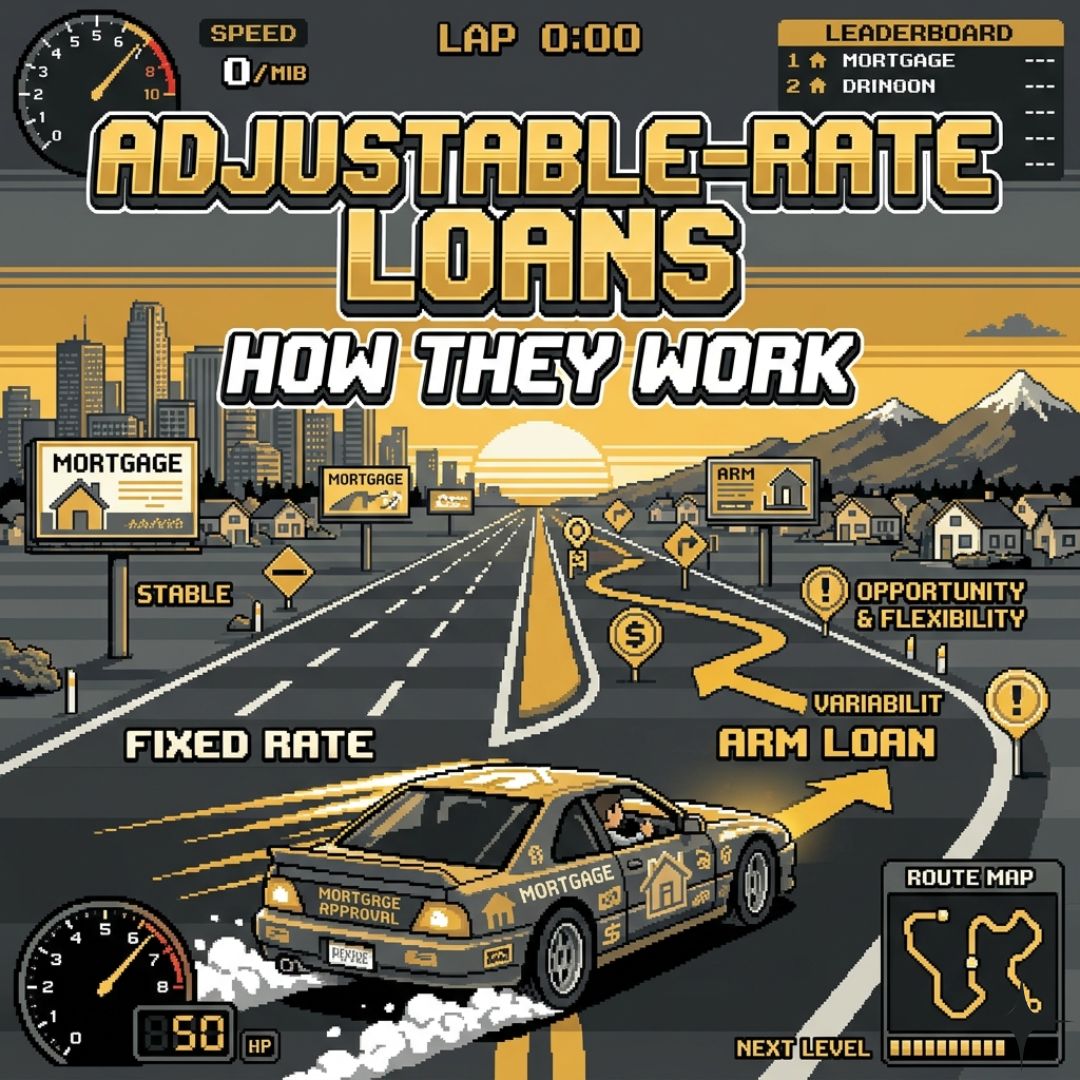
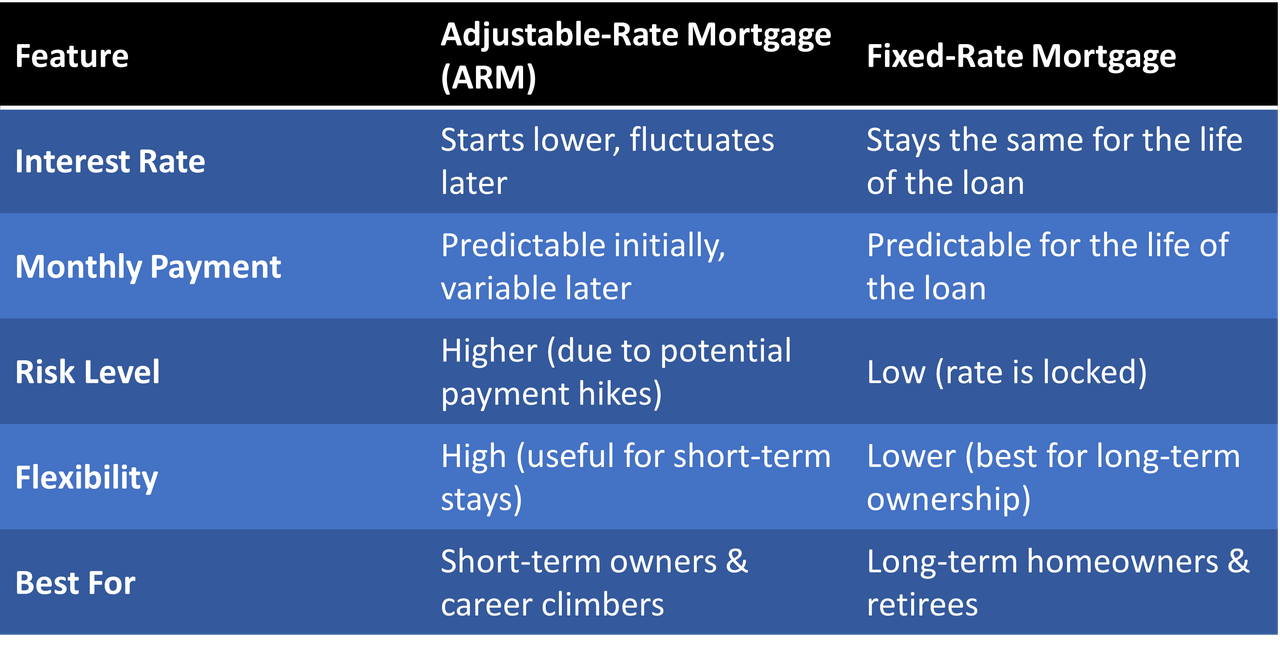
An Adjustable-Rate Mortgage is a home loan with an interest rate that can fluctuate over the life of the loan. Unlike a fixed-rate mortgage, where your interest rate and principal and interest payments remain constant for the entire term, an ARM features an initial period of stability followed by a period where the rate adjusts based on market conditions.
Lenders offer ARMs because they provide flexibility for borrowers who do not plan to stay in their homes for 30 years. The rate on an ARM is typically tied to an index, which is a benchmark interest rate that reflects general market conditions. When you add a margin, which is a set percentage determined by the lender, you arrive at the fully indexed rate that determines your payment during the adjustment period.
How Adjustable-Rate Mortgages Work
Understanding an ARM requires looking beyond the initial rate. These loans are built on a specific structure that dictates when and how your payment changes.
The Initial Fixed-Rate Period
Every ARM has an initial period where the interest rate is fixed. This is often represented by two numbers, such as a 5/1 ARM or a 7/1 ARM. The first number represents the years the rate remains fixed. The second number indicates how often the rate can adjust after that period ends. For example, in a 5/1 ARM, your rate is locked for five years. After that, the rate can adjust once every year.
The Adjustment Period
Once the initial fixed period expires, the loan enters the adjustment period. During this time, the lender recalculates your interest rate based on current market indexes. If market rates have risen, your payment may increase. Conversely, if rates have fallen, your payment could decrease. This period continues for the remainder of the loan term, which is typically 30 years.
Rate Caps and Borrower Protections
To protect borrowers from wild fluctuations, ARMs include rate caps.
Initial Adjustment Cap: Limits how much the rate can increase the first time it adjusts.
Periodic Cap: Limits how much the rate can increase from one adjustment period to the next.
Lifetime Cap: Sets a maximum limit on how high the interest rate can rise over the entire life of the loan.
These caps are vital safeguards that prevent your monthly payment from becoming unexpectedly unmanageable.
Why Some Buyers Choose ARMs in 2026
In 2026, the housing market presents unique challenges regarding affordability. Mortgage Rate Trends Report indicates that while rates have stabilized, they remain at a level that pressures the monthly budgets of many homebuyers. Consequently, borrowers are looking for financing options that provide a lower entry point.
Many buyers are exploring ARMs because the initial interest rate is often lower than the rate offered on a traditional fixed-rate loan. This can result in lower monthly payments, which helps borrowers qualify for a higher loan amount. As noted in Housing Affordability Report, strategic financing is becoming a key component for homebuyers looking to enter competitive markets without overextending their monthly cash flow.
Potential Benefits of an Adjustable-Rate Mortgage
Lower Initial Interest Rates
The primary draw of an ARM is the initial lower interest rate. For buyers who plan to move within a few years, this can lead to substantial savings.
Lower Monthly Payments
Lower rates translate directly to lower monthly obligations. This extra breathing room in your budget can be used to pay down other high-interest debt or save for future home maintenance.
Increased Buying Power
Because your initial monthly payment is lower, your debt-to-income ratio may look more favorable to a lender. This can allow you to purchase a home that might have been out of reach under a fixed-rate loan.
Savings for Short-Term Homeowners
If you know you will be in the home for less than the duration of the fixed period, an ARM can be a mathematically superior choice. You capture the lower rate during your entire ownership period and sell or refinance before the first adjustment ever occurs.
Risks Homebuyers Should Understand
While ARMs offer advantages, they carry inherent risks that should not be overlooked.
Future Payment Increases
The most significant risk is the uncertainty of future payments. If market rates rise significantly by the time your adjustment period begins, your monthly housing expense could climb.
Interest Rate Volatility
Market conditions can change rapidly. ARM Market Statistics shows that while ARMs are a stable tool, they are still subject to broader economic shifts that can impact interest rates unexpectedly.
Budgeting Challenges
For homeowners who prefer predictable finances, the variable nature of an ARM can cause stress. It requires a more disciplined approach to financial planning compared to a fixed-rate loan.
When an ARM May Make Sense
An ARM is often a strategic choice rather than a risky gamble. It may make sense if:
You plan to relocate: If you are in a career that requires frequent moves, a 5/1 or 7/1 ARM allows you to take advantage of lower rates for the short time you plan to own the home.
You expect income growth: If you are an early-career professional expecting your salary to increase significantly over the next few years, an ARM can help you manage your budget now, with the peace of mind that you will be able to handle potential payment increases later.
You plan to refinance: If you intend to refinance into a fixed-rate mortgage within a few years, an ARM can bridge the gap.
For those who need long-term stability, a Fixed-Rate Mortgage Guide is generally the safer recommendation. Retirees or those on fixed incomes should carefully consider the risks of payment fluctuations before choosing an ARM.
ARM vs Fixed Mortgage: A Side-by-Side Comparison
How Level Mortgage Helps Borrowers Choose the Right Loan
At Level Mortgage, we do not believe in one-size-fits-all financing. We act as your mortgage planners, not just loan processors. We perform comprehensive loan comparison analysis to show you exactly how different products will affect your monthly budget and long-term wealth.
Whether you are applying for Mortgage Pre-Approval or just beginning to navigate the Home Buying Process, our goal is to provide clarity. We want you to feel confident that your mortgage is a strategic asset, not a burden. From evaluating Loan Programs to guiding you through our First-Time Homebuyer Guide, we are here to ensure you understand every aspect of your financial commitment.
Final Thoughts
Adjustable-rate mortgages are sophisticated financial instruments that, when used strategically, can provide significant advantages in affordability and purchasing power. However, they are not suitable for every borrower. The decision to choose an ARM should be based on your unique timeline, your financial flexibility, and your tolerance for market changes. As we look at the Mortgage Industry Forecast for the remainder of 2026, it is clear that borrowers who take the time to evaluate their options will be in the best position to succeed. Connect with Level Mortgage today to begin your loan comparison and find the financing strategy that aligns with your future.
Want personalized assistance? Visit our 'Contact Us' tab and leave your information with one of our experts.
About Us
A group of like-minded seasoned veterans came together to create a company with an employee-focused culture. A culture that values its members both personally and professionally and a company built on the idea that the customer comes first!
We do not share data with third parties for marketing/promotional purposes.
By submitting your phone number to Level Mortgage, you are authorizing a representative of our company to send you text messages and notifications. Message frequency may vary. Message/data rates apply. Reply STOP to unsubscribe to a message sent from us, and HELP to receive help.
What You Need to Know Before Refinancing Your Mortgage
Refinancing your home is one of the most significant financial maneuvers you can perform. As the mortgage landscape shifts in 2026, many homeowners are reevaluating their long-term strategies. Whether you are looking to lower your monthly payments, consolidate high-interest debt, or access your home equity, the decision requires more than just a quick look at interest rates. It demands a comprehensive view of your financial health and long-term goals.
At Level Mortgage, we believe that an informed decision is the only way to proceed. This guide will help you understand the mechanics, costs, and considerations involved in the refinancing process in today’s market.
What Is Mortgage Refinancing?
At its core, refinancing is the process of replacing your existing mortgage with a new loan. When you refinance, you are essentially paying off your current loan and establishing a new one, typically with different terms, interest rates, or loan structures.
In 2026, the process remains relatively straightforward, but the strategic implications are heightened by current economic conditions. Most homeowners refinance to achieve specific financial objectives, such as reducing monthly overhead, shortening their payoff timeline, or extracting cash for other investments. Understanding these mechanics is the first step toward determining if the timing is right for your unique situation. You can learn more about our Mortgage Refinance Programs to see which options align with your goals.
Why Homeowners Refinance
This is the most common motivation. By securing a lower interest rate, you can reduce the amount of interest paid over the life of your loan, which lowers your monthly commitment.In the current 2026 interest rate environment, even a modest reduction in your rate can lead to significant savings over the long term.
Lower Monthly Payments
This is the most common motivation. By securing a lower interest rate, you can reduce the amount of interest paid over the life of your loan, which lowers your monthly commitment.In the current 2026 interest rate environment, even a modest reduction in your rate can lead to significant savings over the long term.
Access Home Equity
If your home has appreciated in value, you may have substantial “tappable” equity. A cash-out refinance allows you to replace your current loan with a larger one and receive the difference in cash. This is frequently used to fund home improvements, pay off high-interest consumer debt, or invest in other assets.Suggests that homeowners currently hold near-record levels of equity, making this a popular route for those looking to leverage their property.
Shorten the Loan Term
Some homeowners choose to refinance from a 30-year mortgage to a 15-year or 20-year term. While this may increase your monthly payment, it significantly reduces the total interest paid over the life of the loan and helps you build equity at an accelerated pace.
Switch Loan Types
You might decide to move from an adjustable-rate mortgage (ARM) to a fixed-rate loan to gain payment stability. Alternatively, some homeowners with FHA or VA loans may seek to refinance into a conventional loan to remove mortgage insurance premiums. If you are exploring this, reviewing [Loan Programs] is a great starting point.
Current Refinance Market Conditions in 2026
The mortgage market in 2026 is defined by a stabilization of rates following the volatility of previous years. Mortgage Rate Trends Report indicates that rates have settled into a more predictable range, though they remain higher than the historic lows seen during the pandemic.
Recent lending statistics indicate that refinance activity is rising as homeowners adjust to this new reality.With many U.S. homeowners sitting on substantial home equity, the ability to tap into those funds has become a major driver of market volume.However, because most homeowners currently have interest rates well below today’s market levels, the “lock-in effect” remains a significant factor in decision-making. You must carefully weigh the cost of moving to a higher rate against the benefits of your specific refinance goals.
How Much Does It Cost to Refinance?
Refinancing is not free. It involves closing costs similar to those you paid when you first purchased your home.
Typical Closing Costs
In 2026, closing costs for a refinance typically range between 2% and 6% of the new loan amount. These fees cover a variety of services, including:
Origination fees: Charged by the lender for processing the new loan.
Appraisal costs: To verify the current market value of your property.
Title fees: To ensure the property title is clean and protected.
Recording fees: Government charges for filing the new mortgage documents.
Calculating Your Break-Even Point
To determine if a refinance is worthwhile, you must calculate your break-even point. This is the amount of time it takes for your monthly savings to cover the total closing costs of the loan.
Example: If your refinance costs $5,000 and saves you $200 per month, your break-even point is 25 months. If you plan to move before that time, the refinance may not be mathematically advantageous. A [INTERNAL LINK: Mortgage Calculator] can help you visualize these numbers.
Qualification Requirements for Refinancing
Lenders look for specific markers of financial stability when evaluating a refinance application.
Credit Score: While standards vary, a higher credit score generally unlocks the best interest rates. Consumer Lending Statisticssuggest that maintaining a score above 700 is typically necessary to access the most competitive pricing.
Debt-to-Income Ratio: Lenders want to see that your total monthly debt payments, including the new mortgage, do not exceed a certain percentage of your gross monthly income.
Home Equity Position: Most lenders require a minimum amount of equity, often represented by a maximum loan-to-value (LTV) ratio.
Income Verification: Expect to provide recent pay stubs, W-2s, or tax returns to prove your ability to repay the loan.
When Refinancing Might Not Make Sense
Refinancing is not a universal solution. It may not be the right choice if:
You plan to move soon: If you sell your home before reaching the break-even point, you will likely lose money on the transaction.
The interest rate spread is too small: If the difference between your current rate and the new rate is negligible, the closing costs may outweigh the savings.
You are resetting your loan term: If you are 20 years into a 30-year mortgage and refinance into a new 30-year loan, you may end up paying significantly more in interest over time, even with a lower payment.
How Level Mortgage Helps Homeowners Make Smarter Refinance Decisions
Refinancing is not a one-size-fits-all product. At Level Mortgage, we act as your strategic partner. We offer personalized mortgage reviews to analyze your current debt structure, your long-term housing plans, and your financial goals. We perform cost-benefit evaluations to ensure that any move you make actually puts you in a stronger position.
Whether you are debating between FHA Loans, VA Loans, or conventional options, we provide the clarity you need to navigate the 2026 market with confidence. We focus on education first, ensuring you understand exactly how your loan strategy impacts your household budget.
Final Thoughts
Refinancing can be an incredibly powerful tool for managing your finances, but it requires careful planning. It is about more than just finding a lower rate; it is about ensuring the structure of your debt aligns with your life goals. As you navigate the 2026 market, remember that professional guidance is an asset. By taking the time to evaluate costs, timing, and long-term impact, you can secure a mortgage strategy that supports your financial well-being for years to come.
Ready to see if refinancing makes sense for your goals?
The best decisions are made with data and expert guidance. Connect with Level Mortgage today for a personalized refinance analysis. We will compare your current mortgage against today’s options and help you determine if a refinance is the strategic move you need.
Want personalized assistance? Visit our 'Contact Us' tab and leave your information with one of our experts.
About Us
A group of like-minded seasoned veterans came together to create a company with an employee-focused culture. A culture that values its members both personally and professionally and a company built on the idea that the customer comes first!
We do not share data with third parties for marketing/promotional purposes.
By submitting your phone number to Level Mortgage, you are authorizing a representative of our company to send you text messages and notifications. Message frequency may vary. Message/data rates apply. Reply STOP to unsubscribe to a message sent from us, and HELP to receive help.
VA Loan Offers: What Home Sellers Really Need to Know
When you list your home for sale, receiving multiple offers is an exciting milestone. Among those purchase contracts, you might find an offer from a buyer utilizing a VA loan. For decades, a cloud of misunderstanding has surrounded this specific financing type, causing some sellers to hesitate.
As a home seller, understanding the true mechanics of VA financing can prevent you from passing up an excellent, secure transaction. Buyers who earn these benefits through military service are often some of the most reliable borrowers in the market. Let’s explore what a VA loan offer actually means for your bottom line.
Why Some Sellers Hesitate When They See a VA Loan Offer
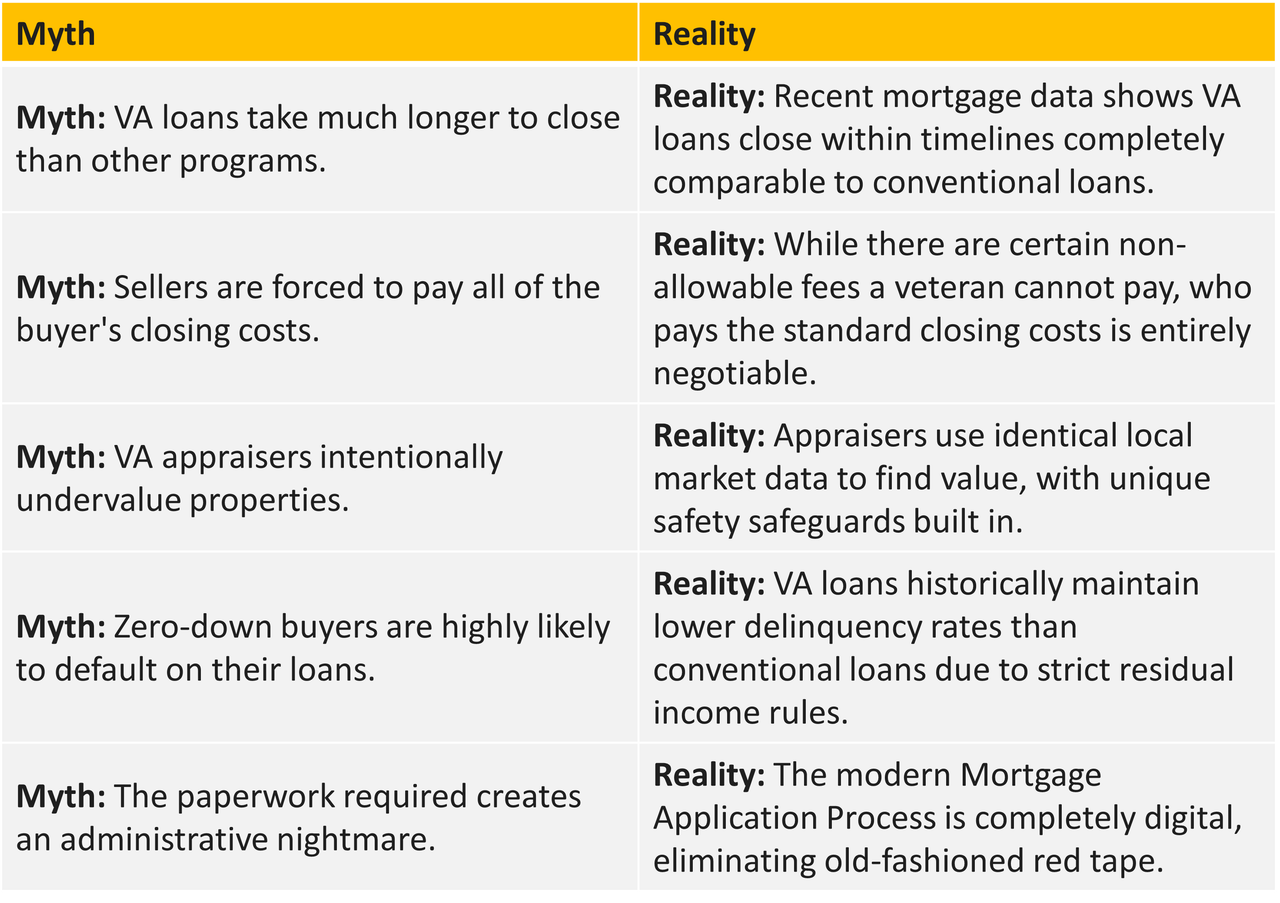
It is common for sellers, and even some real estate agents, to harbor reservations when a VA offer lands on the table. The most frequent misconceptions include the belief that VA loans are much harder to close, that the appraisal process will inevitably compromise the deal, or that VA buyers are less financially secure because they might not make a down payment. Additionally, many people worry that the timeline will drag out indefinitely.
In 2026, these beliefs are remarkably outdated. Modern digital underwriting and updated government guidelines have streamlined the timeline significantly. According to recent mortgage industry data, the closing times for VA loans are neck-and-neck with conventional loans. Furthermore, recent lending data indicates that VA loans actually have a higher overall closing success rate than conventional alternatives, making them an incredibly stable choice for sellers looking for a smooth path to the closing table.
What Makes a VA Loan Different?
To evaluate these offers fairly, it helps to look at how the VA Loan Program operates under the hood.
Backed by the U.S. Department of Veterans Affairs
The defining feature of a VA loan is the government guarantee. The U.S. Department of Veterans Affairs insures a significant portion of the loan amount against default. This structural support drastically reduces the risk for private lenders, allowing them to offer flexible terms to eligible active-duty military members, veterans, and surviving spouses.
Low Down Payment Requirements
One of the most significant perks for military buyers is the ability to secure up to 100% financing. While a conventional seller might view a zero-down offer as a red flag, it is simply a structural advantage given to those who served. A zero-down payment does not reflect a lack of cash reserves or weak purchasing power, it simply means the buyer is leveraging a well-deserved benefit.
Competitive Interest Rates
Because of the federal backing, lenders can offer highly competitive interest rates. Even in the current 2026 lending conditions, where the average mortgage rate environment has settled into a more balanced range, VA loans consistently feature lower interest rates than conventional products. This lower monthly obligation makes the housing payment far more manageable for your buyer, reducing the likelihood of financial stress during escrow.
Are VA Buyers Less Qualified Than Conventional Buyers?
A common myth is that VA buyers are weaker financially. In reality, VA borrowers undergo rigorous qualification standards that often surpass standard conventional guidelines.
Beyond checking credit scores and verifying steady employment income, VA underwriting enforces strict residual income standards. This unique metric calculates how much discretionary cash a family has left over each month after paying all major living expenses and housing costs. Based on trusted housing reports, this safeguard is a major reason why VA loans boast some of the lowest delinquency rates in the entire housing sector.
When you accept a VA offer, you are working with a borrower who has cleared strict federal and institutional hurdles before their Mortgage Pre-Approval ever reaches your hands.
Understanding the VA Appraisal Process
The appraisal process is often the biggest source of anxiety for sellers, but a little clarity can ease those concerns.
What the VA Appraisal Actually Does
Like any appraisal, a VA appraisal determines the fair market value of your property to ensure it matches the agreed-upon purchase price. However, the appraiser also checks the home against a set of Minimum Property Requirements, or MPRs.
Common Property Issues That Can Affect Approval
The MPRs are designed to protect the safety, structural integrity, and sanitation of the property. Common issues that can pop up include:
Major structural deficiencies or foundational issues
Roof concerns, such as a roof nearing the end of its functional life
Exposed or outdated electrical issues
Severe safety hazards, including missing handrails or peeling lead-based paint
Industry research shows that the vast majority of homes pass a VA appraisal without any major issues. If a minor safety item is discovered, it can usually be repaired prior to closing, keeping the transaction perfectly on track.
Benefits of Accepting a VA Loan Offer
When evaluating multiple contracts, keeping an open mind toward VA financing can work to your advantage. Consider these distinct benefits:
Highly Motivated Buyers
Military families often relocate on strict timelines due to Permanent Change of Station orders or transition goals. This makes them highly motivated to cooperate, move quickly, and reach the closing table without unnecessary delays.
Strong Qualification Standards
As noted, strict residual income checks and mandatory document verifications mean these buyers are thoroughly vetted by professionals well before making an offer.
Competitive Purchase Offers
Because VA buyers save money on down payments and monthly mortgage insurance, they often have additional financial flexibility to submit highly competitive purchase offers on homes they love.
What Sellers Should Consider Before Rejecting a VA Offer
In the 2026 real estate landscape, market conditions demand a flexible approach. Inventory levels and buyer demand shift constantly, meaning that judging an offer solely by the loan type can be a costly mistake.
If a VA buyer offers a competitive purchase price, favorable contract terms, and a solid timeline, rejecting them out of hand based on outdated myths could mean leaving money on the table. A well-constructed VA offer can easily compete with, and sometimes outperform, a conventional offer that contains complex contingencies. Look closely at the overall terms of the offer, rather than just the acronym at the top of the page. You can review alternative options in our Loan Programs overview.
VA Loan Myths vs. Reality
How Level Mortgage Helps Buyers and Sellers Navigate VA Transactions
At Level Mortgage, we believe a seamless real estate transaction relies heavily on education, direct communication, and teamwork. We specialize in demystifying the financing process for everyone involved in the sale.
By offering fast pre-approvals and maintaining open lines of communication with listing agents, we ensure sellers feel completely confident when accepting a VA offer. Our experienced strategists coordinate closely with buyers, sellers, and real estate professionals to ensure every property requirement and underwriting milestone is met with speed and accuracy.
Want personalized assistance? Visit our 'Contact Us' tab and leave your information with one of our experts.
About Us
A group of like-minded seasoned veterans came together to create a company with an employee-focused culture. A culture that values its members both personally and professionally and a company built on the idea that the customer comes first!
We do not share data with third parties for marketing/promotional purposes.
By submitting your phone number to Level Mortgage, you are authorizing a representative of our company to send you text messages and notifications. Message frequency may vary. Message/data rates apply. Reply STOP to unsubscribe to a message sent from us, and HELP to receive help.