The exact amount you need depends on your mortgage loan program, personal credit profile, gross income, property eligibility, and individual lender requirements. Understanding how minimum down payment rules work, accounting for additional upfront expenses, and leveraging state or local assistance programs will help you calculate a precise savings target before starting your home search.
What Is the Minimum Down Payment to Buy a House in Florida?
There is no single minimum down payment required for every home purchase in Florida. Instead, mortgage programs set specific baseline guidelines based on borrower risk, property type, and occupancy.
Conventional Loans: As Little as 3% Down
Conventional mortgages backed by Fannie Mae or Freddie Mac offer minimum down payments as low as 3% for qualified first-time homebuyers. To qualify for a 3% down option, borrowers typically need a minimum FICO score of 620, stable employment history, and an acceptable debt-to-income (DTI) ratio.
When putting down less than 20% on a conventional loan, borrowers are required to pay Private Mortgage Insurance (PMI). PMI protects the lender against default and is added to your monthly mortgage bill. However, unlike government mortgage insurance, conventional PMI can be canceled once you build 20% equity in your home.
FHA Loans: As Little as 3.5% Down
Government-backed Federal Housing Administration (FHA) loans allow qualified buyers to put down as little as 3.5% with a minimum credit score of 580. Borrowers with credit scores between 500 and 579 may still qualify for an FHA loan but must provide a minimum 10% down payment.
USDA Loans: Backed by the U.S. Department of Agriculture, USDA loans offer 0% down financing for homes located in designated rural and suburban areas. Borrowers must meet county-specific household income limits and occupy the property as their primary residence.
How Much Money Would You Need for a Florida Home?
To visualize your potential cash requirement, review these estimated down payments across various purchase price tiers in Florida:
Note: These figures represent down-payment amounts only and do not include closing costs, lender fees, or escrow reserves.
Down Payment Assistance Programs in Florida for 2026
First-time homebuyers and moderate-income residents can reduce out-of-pocket savings requirements through public down payment assistance (DPA) initiatives.
Florida Housing Finance Corporation (Florida Housing): Offers statewide first-mortgage programs paired with secondary down payment and closing-cost assistance.
Florida Hometown Heroes Housing Program:In 2026, eligible full-time Florida workers employed by a physical, Florida-based business can receive 5% of their first mortgage loan amount (minimum $10,000, maximum $35,000).This assistance is structured as a 0% interest, non-amortizing, 30-year deferred second mortgage. It is not free money or a forgivable grant; the balance must be repaid in full when the home is sold, refinanced, or ceases to be a primary residence.
State Housing Initiatives Partnership (SHIP): Local county and municipal programs provide SHIP funds for down payment and closing costs to low- and moderate-income buyers. Funding availability, award limits, and application windows vary by county.
To access these options, buyers must meet household income limits, pass credit underwriting, complete an approved homebuyer education course, and work with an approved participating lender.
Remember, the Down Payment Is Not Your Only Upfront Cost
A common homebuying mistake is assuming the down payment is the only cash required at closing. You must also account for essential upfront purchase expenses:
Closing Costs and Prepaids: Lender origination fees, title insurance, recording fees, credit report charges, and prepaid property taxes.
Third-Party Inspections & Appraisals: Professional home inspections, wind mitigation reports, 4-point inspections (for older homes), and appraisal fees paid upfront.
Escrow Reserves:Initial deposits for Florida homeowners insurance, hurricane deductibles, and local property taxes.
Moving and Emergency Reserves: Remaining funds for moving costs and post-closing maintenance.
Does a Bigger Down Payment Always Mean a Better Mortgage?
Putting more money down offers distinct financial advantages, but it may not always be the best strategy for your personal situation:
Pros of a Larger Down Payment: Lowers your total loan balance, reduces your monthly principal and interest payment, eliminates PMI (at 20% down on conventional loans), and secures better interest rate pricing tiers.
The Trade-Off: Draining your liquid savings to maximize a down payment can leave you vulnerable to unexpected home repairs, property tax adjustments, or job changes.
Comparing total monthly payments against post-closing cash reserves is essential before committing every dollar of savings to a purchase.
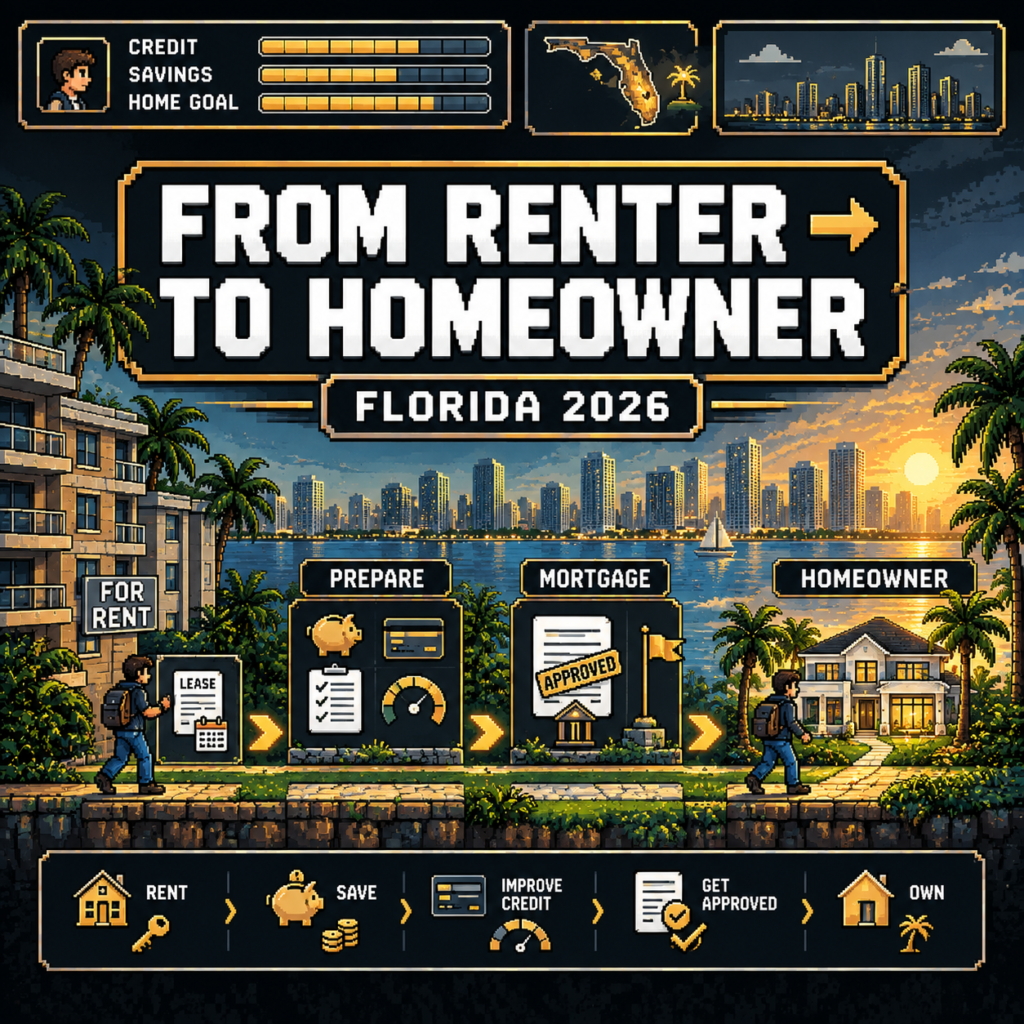
How to Prepare for Buying a House in Florida in 2026
Follow this clear sequence when preparing your finances:
Review Income and Credit: Check your credit report for errors and calculate your total monthly debt obligations.
Determine Your Savings Target: Account for the down payment, estimated closing costs, and post-closing reserves.
Compare Loan Programs:Evaluate conventional, FHA, VA, and USDA guidelines to find the best match.
Explore Assistance:Check income limits and funding availability for statewide and local DPA programs.
Get Pre-Approved: Work with a licensed mortgage specialist to receive an official Loan Estimate.
Final Answer: How Much Should You Save?
While saving 20% avoids mortgage insurance, many Florida buyers successfully purchase their homes with 3% to 5% down—or 0% if eligible for VA or USDA financing. The right savings target depends on your overall financial health, monthly budget preferences, and program eligibility.
Contact the mortgage professionals at LevelMTG today to explore tailored home financing options. Visit
Want personalized assistance? Visit our 'Contact Us' tab and leave your information with one of our experts.
About Us
A group of like-minded seasoned veterans came together to create a company with an employee-focused culture. A culture that values its members both personally and professionally and a company built on the idea that the customer comes first!
We do not share data with third parties for marketing/promotional purposes.
By submitting your phone number to Level Mortgage, you are authorizing a representative of our company to send you text messages and notifications. Message frequency may vary. Message/data rates apply. Reply STOP to unsubscribe to a message sent from us, and HELP to receive help.