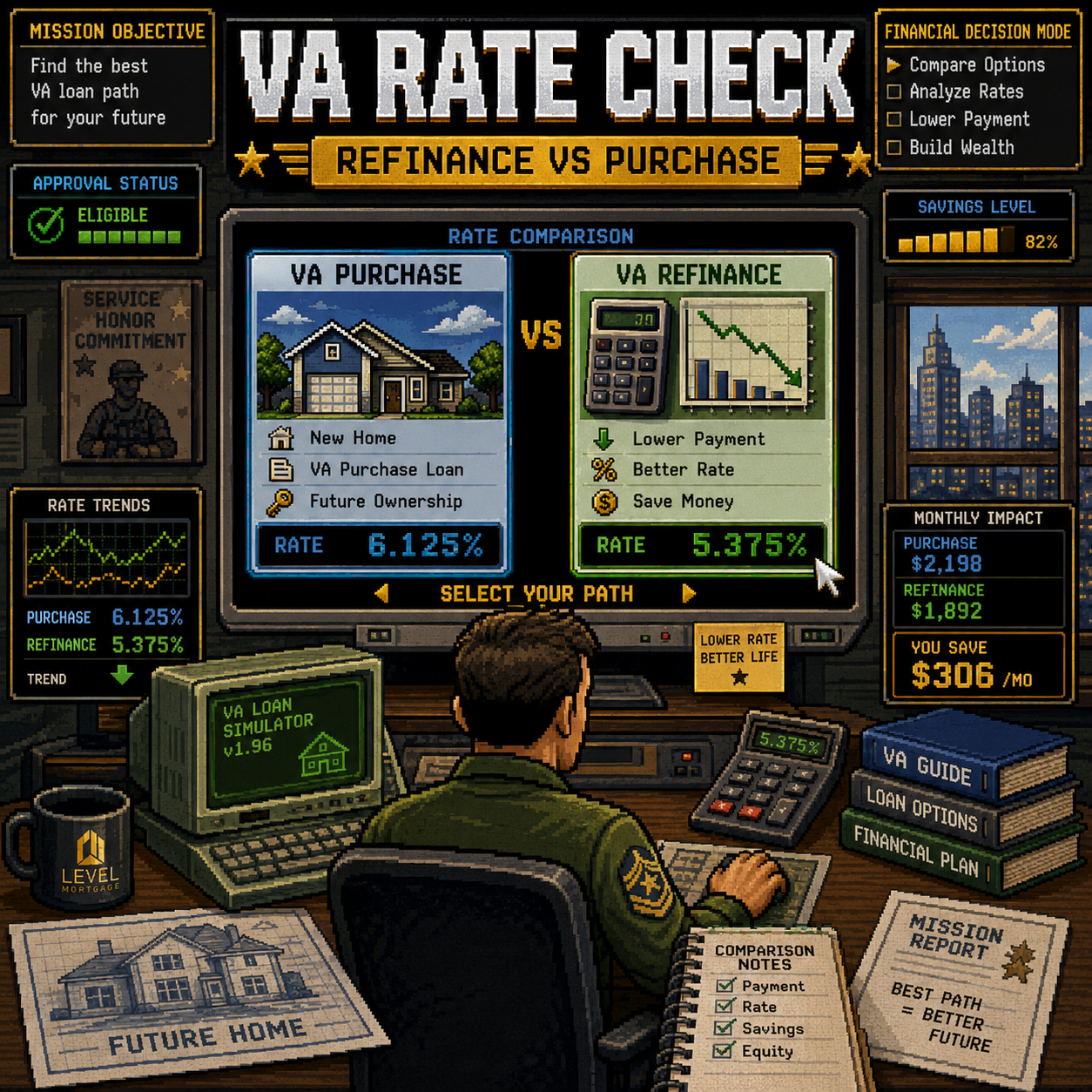
For many veterans, active-duty service members, and military families, the VA loan is a cornerstone of financial stability. It offers competitive terms and accessibility that are unmatched in the private market. However, when it comes time to either buy a new home or lower the interest rate on an existing one, a common question arises: do VA refinance rates differ from purchase rates?
The answer is rarely a simple yes or no. Pricing in the mortgage industry is dynamic, and understanding why these rates fluctuate is key to making the best financial decision for your family in 2026.
Understanding VA Loans
A VA loan is a mortgage program guaranteed by the Department of Veterans Affairs. It is designed to provide veterans, service members, and surviving spouses with favorable terms, including the ability to purchase a home with no down payment and no private mortgage insurance.
It is important to clarify that the VA does not lend the money itself. Instead, private lenders, such as Level Mortgage, issue the loans, and the VA provides a guarantee against default. Because lenders set the terms based on market conditions, the Department of Veterans Affairs does not directly set the interest rates you see in advertisements.
Are VA Refinance Rates Different from Purchase Rates?
In short, there is no permanent pricing rule that dictates one must be higher than the other. Sometimes, you may find that purchase rates are lower due to specific market incentives. In other scenarios, refinance rates, particularly for streamlined programs, might be more competitive.
The reality is that your rate depends on the specific product, the lender, and the economic climate at the moment you apply. There is no industry-wide mandate forcing a price gap between a new purchase and a refinance.
What Determines VA Mortgage Rates?
Market Interest Rates
VA mortgage rates are primarily influenced by the broader bond market, specifically mortgage-backed securities. Factors such as Treasury yields, inflation reports, and Federal Reserve policy decisions dictate the “base” cost of borrowing. When investors are concerned about inflation or economic instability, rates across the board typically rise. Inflation and Economic Outlook provides further context on how these macro trends impact everyday borrowing costs.
Borrower Qualifications
Your individual financial profile is just as important as the market. Lenders evaluate your credit score, debt-to-income ratio, occupancy status, and total financial reserves. A borrower with a pristine credit profile often secures a lower rate, regardless of whether they are purchasing or refinancing.
Loan Type
The specific VA product you choose carries its own pricing logic:
VA Purchase Loan: Often priced competitively to attract new buyers.
VA Interest Rate Reduction Refinance Loan (IRRRL): Sometimes referred to as a streamline refinance, these loans are designed to reduce your rate with minimal paperwork.
VA Cash-Out Refinance: Because this loan allows you to access home equity, it is often treated with slightly different risk parameters by lenders, which can impact the interest rate.
When Does Refinancing Make Sense?
Refinancing is a strategic tool, not an automatic win. It generally makes sense when your goal is to:
Lower Your Monthly Payment: Even a small drop in rate can save you significant money over the life of your loan.
Switch from Adjustable to Fixed Rate: If you have an adjustable-rate mortgage, moving to a fixed rate can provide long-term payment stability.
Access Home Equity: A cash-out refinance can help consolidate high-interest debt or fund necessary home improvements.
Shorten Your Loan Term: You might choose to refinance from a 30-year term to a 15-year term to build equity faster.
You can run your own numbers using our Mortgage Calculator to see how these adjustments affect your monthly output.
Current VA Mortgage Market in 2026
As we move through 2026, the mortgage environment remains focused on affordability. Mortgage Rate Trends indicates that while volatility has moderated compared to recent years, the market remains highly sensitive to economic data. Refinance activity has picked up as borrowers look for ways to optimize their monthly budgets amid persistent inflation and housing price pressures. VA Mortgage Market Report suggests that veterans who actively monitor their loan options are finding success in lowering their payments.
Should Veterans Refinance in 2026?
Refinancing in 2026 is a balance of immediate relief versus long-term cost. Before you proceed, consider the closing costs and the time it takes to break even on those expenses. If you plan to move within a few years, the cost of the refinance might outweigh the savings. However, if you are in your “forever home” and rates have dipped, the math often supports a refinance.
Always look at your loan term. Extending a loan term to get a lower payment might reduce your cash flow today but increase the total interest paid over the life of the loan. Housing Finance Statisticssupports the need for a thorough break-even analysis before committing to any refinance strategy.
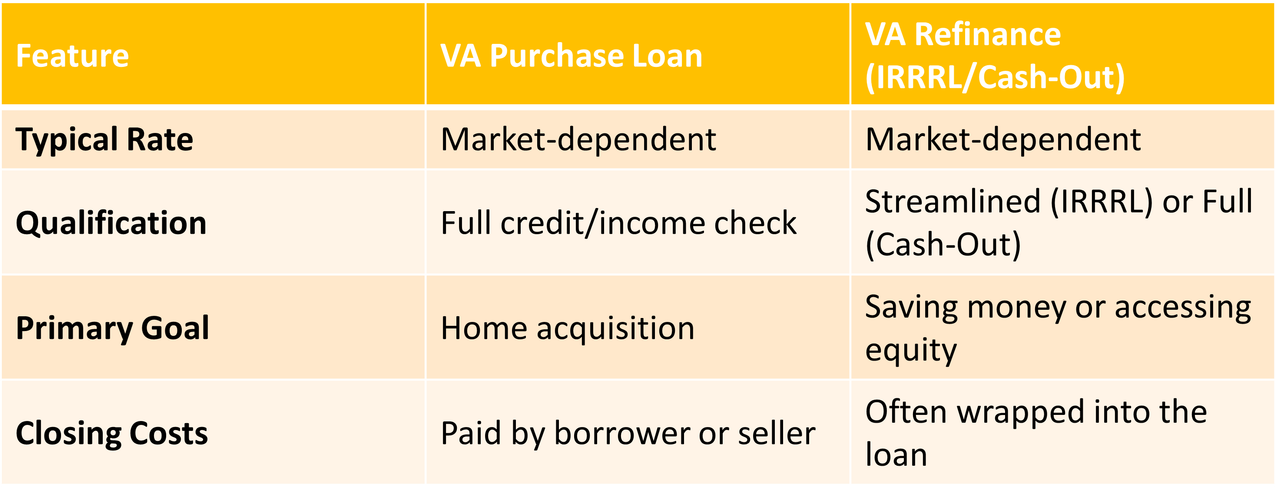
VA Purchase Loan vs VA Refinance Comparison
For those looking to buy their first home, our Home Buying Guide is a great resource to start your journey.
Common Misconceptions About VA Mortgage Rates
VA Always Offers the Lowest Rate: While VA loans are excellent, rates are still set by lenders. It pays to compare.
Refinancing Automatically Saves Money: You must account for closing costs and the length of your loan.
VA Refinance Has No Costs: While some costs can be financed, there are still administrative, appraisal, and funding fees involved.
How Level Mortgage Helps Veterans Choose the Right Strategy
At Level Mortgage, we understand that VA lending is more than just a transaction. It is a tool to secure your future. We provide personalized mortgage analysis to help you decide if a purchase loan is your best path or if your current loan can be improved via a refinance. We monitor Mortgage Rate Trends daily so that when the right opportunity arrives, you are ready to act. You can review your current standing by exploring our VA Loan Programs.
Final Thoughts
VA refinance rates and purchase rates both move with the market, and there is no guarantee that one will always be lower than the other. The right choice depends on your financial goals, your current interest rate, and the economic landscape of 2026. Whether you are using a VA Refinance or exploring a VA Cash-Out Refinance, professional guidance ensures you don’t leave money on the table.
Ready to evaluate your VA loan options?
Don’t navigate the market alone. Contact Level Mortgage today for a personalized refinance evaluation or purchase loan guidance. We are committed to providing military families with the clarity and support they deserve. Connect with us to get your Mortgage Pre-Approval started today.
Want personalized assistance? Visit our 'Contact Us' tab and leave your information with one of our experts.
About Us
A group of like-minded seasoned veterans came together to create a company with an employee-focused culture. A culture that values its members both personally and professionally and a company built on the idea that the customer comes first!
We do not share data with third parties for marketing/promotional purposes.
By submitting your phone number to Level Mortgage, you are authorizing a representative of our company to send you text messages and notifications. Message frequency may vary. Message/data rates apply. Reply STOP to unsubscribe to a message sent from us, and HELP to receive help.