How to Finance a New Construction Condo Before Completion
Buying a home that has not yet been built is an exciting prospect, especially in high-demand markets like South Florida. It offers the chance to secure a modern residence at today’s prices while the building rises from the ground. However, the financial path for a pre-construction unit is fundamentally different from buying an existing home.
Because the property does not yet exist as physical collateral, you cannot simply walk into a bank and get a standard mortgage on day one. Navigating this process requires a clear understanding of deposit phases, long-term credit stability, and the specific lending rules of 2026.
Why Buying Before Completion Is Different
When you buy a resale home, the transaction usually closes within thirty to sixty days. The property is inspected, appraised, and the mortgage is funded immediately. With a new construction condo, the timeline often stretches from one to four years.
Property Use Classification
This gap creates a unique set of challenges. The property cannot be used as collateral for a traditional mortgage until it receives a Certificate of Occupancy. This means the lender is essentially approving a loan for an asset that is not yet fully realized.
The Shift in Market Conditions
Furthermore, the market conditions and your personal financial situation may change between the time you sign the contract and the day you finally move in. While this involves more moving parts, it also provides the opportunity for significant equity growth before you even make your first mortgage payment.
Understanding the Two-Phase Financing Process
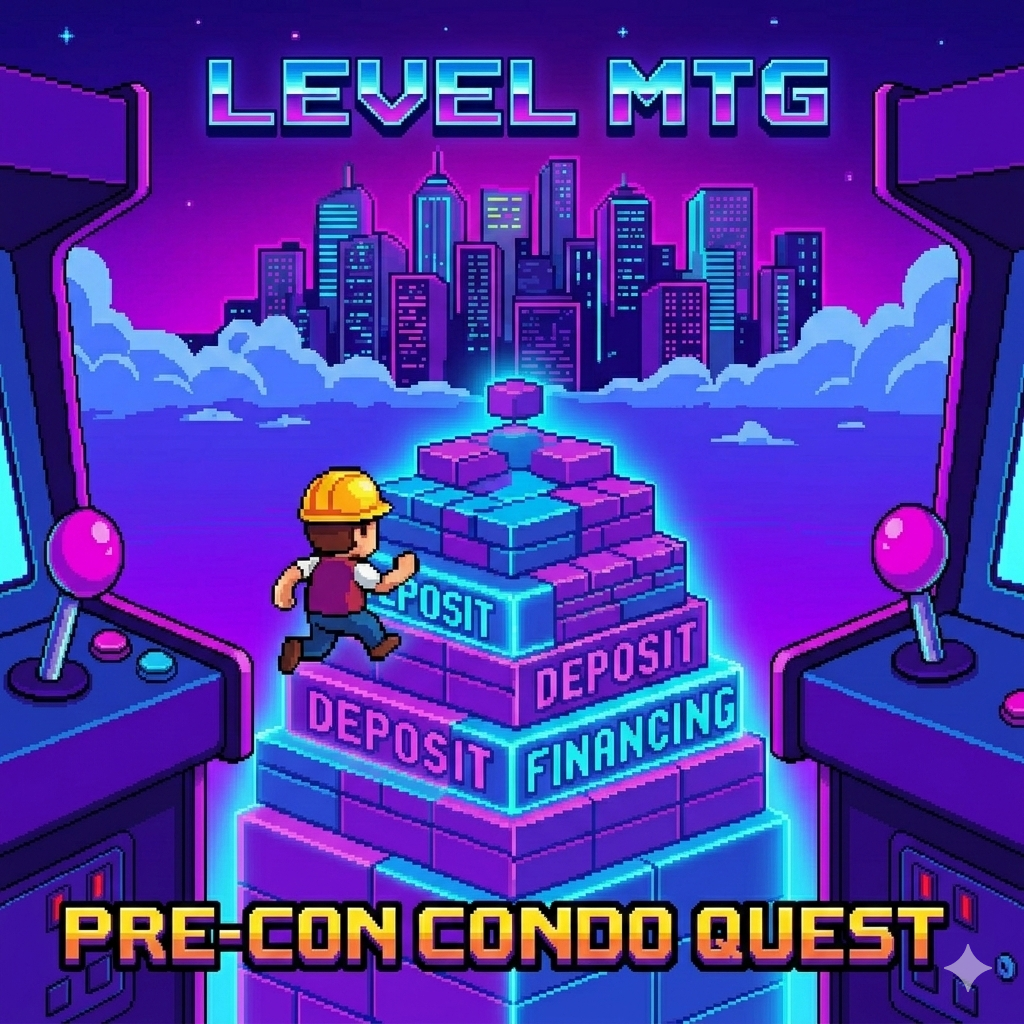
Financing a pre-construction condo is essentially a two-phase journey. You must treat the initial purchase and the final loan as two distinct financial events.
Phase One: The Deposit Phase
In the first phase, you are responsible for the deposit structure required by the developer. This is typically handled using your own liquid capital, proceeds from a current home sale, or personal lines of credit. Lenders do not typically provide mortgage funds at this stage.
Phase Two: The Mortgage Phase
The second phase is the mortgage phase. This occurs when the building is nearing completion. Only at this point does a traditional lender step in to provide the long-term financing. According to recent industry data, many buyers find themselves in a position where they must manage their liquidity for several years before the actual loan is finalized.
Typical Deposit Structure in 2026
Developers use your deposits to help fund the construction and prove the viability of the project to their own commercial lenders. Based on trusted mortgage reports, the standard deposit structure in 2026 has remained fairly consistent for premier developments.
10% at Reservation: This is the initial “good faith” deposit to hold the specific unit.
10% at Contract: Due when you sign the official purchase and sale agreement.
10% at Groundbreaking: Paid when the developer officially starts construction.
10% at Top-off: This occurs when the building reaches its highest structural point.
60% at Closing: The remaining balance is due when the unit is complete, usually covered by your mortgage.
Planning for Liquidity
This structure means you must have significant cash available early in the process. Planning for this liquidity is essential to ensure you do not default on your contract as the building reaches its milestones.
How to Qualify for the Mortgage at Closing
One of the most common misconceptions is that getting “pre-approved” at the time of the contract means you are set for the next three years. In reality, you must re-qualify for your mortgage as the building nears completion.
The Re-Qualification Reality
Lenders will perform a fresh review of your credit score, income stability, and debt-to-income ratio. Recent lending guidelines indicate that a credit score of 680 or higher is generally expected, though 720 or higher often yields the most competitive rates.
Avoiding Financial Major Changes
If you take on new debt, such as a car loan, or experience a significant change in employment during the construction years, it could jeopardize your final approval. Maintaining financial stability is the best strategy for a successful closing.
Condo Approval and Financing Challenges
Even if your personal finances are perfect, the condo project itself must meet specific lender requirements. Lenders look at the health of the entire building, not just your unit.
Warrantable vs. Non-Warrantable
Recent updates to condo financing rules in 2026 emphasize the importance of owner occupancy and financial reserves. Generally, a project should have an owner-occupancy threshold of around 50% to be considered warrantable by major agencies.
HOA Reserves and Risk
Additionally, the Homeowners Association (HOA) must typically allocate at least 10% of its budget to a reserve fund. If a project is deemed non-warrantable, perhaps because one entity owns too many units or the commercial space exceeds certain limits, you may need alternative financing. These loans often require a 20% to 25% down payment and carry interest rates that are 0.5% to 1.5% higher than standard programs.
Strategies to Reduce Risk Before Completion
Because of the long timeline, risk management is a priority. You want to ensure that the excitement of a new home isn’t overshadowed by financial stress at the finish line.
Locking Interest Rates
One strategy is to keep a close eye on interest rates. While most lenders cannot lock a rate for three years, some offer specialized long-term lock options for a fee. This can protect you if rates rise significantly during the construction period.
Expert Guidance on Contracts
You should also work closely with an experienced lender who understands developer contracts. Some contracts have specific clauses regarding your right to find outside financing versus using the developer’s preferred lender. Understanding these nuances early can save you thousands in closing costs.
Benefits of Buying Pre-Construction
Despite the complexity, the rewards can be substantial. Buying early often allows you to secure “lower entry pricing” compared to what the units will cost once the building is finished.
As construction progresses, the value of your contract often appreciates. It is not uncommon for buyers to have significant equity in their units before they ever move in. Additionally, buying before completion gives you the best choice of floor plans, views, and interior finishes, allowing you to customize your living space to your exact preferences.
How Level Mortgage Helps You Navigate the Process
At Level Mortgage, we specialize in the intricate world of new construction. We don’t just look at where you are today, we help you plan for where you will be when the building is finished.
Our team assists in structuring a financing strategy years in advance. We help you understand whether a project is warrantable and what your options are if it isn’t. We also guide you through the re-qualification process, ensuring your credit and income remain in the best possible shape for that final closing day. By acting as a strategic advisor, we turn a complex construction timeline into a clear path toward your new home.
Want personalized assistance? Visit our 'Contact Us' tab and leave your information with one of our experts.
About Us
A group of like-minded seasoned veterans came together to create a company with an employee-focused culture. A culture that values its members both personally and professionally and a company built on the idea that the customer comes first!
We do not share data with third parties for marketing/promotional purposes.
By submitting your phone number to Level Mortgage, you are authorizing a representative of our company to send you text messages and notifications. Message frequency may vary. Message/data rates apply. Reply STOP to unsubscribe to a message sent from us, and HELP to receive help.
Buy a Home Using the House Hacking Strategy in 2026
The landscape of the American housing market has shifted. In 2026, affordability is the primary concern for almost every homebuyer. With median households now spending more than 21% of their income on housing costs, the traditional path to homeownership is being traded for more strategic alternatives.
One of the most effective methods to combat these rising costs is house hacking. This strategy is no longer just a trend for niche real estate investors. It has become a vital financial tool for anyone looking to enter the market while maintaining a manageable monthly budget.
What Is House Hacking and Why It’s Trending Again
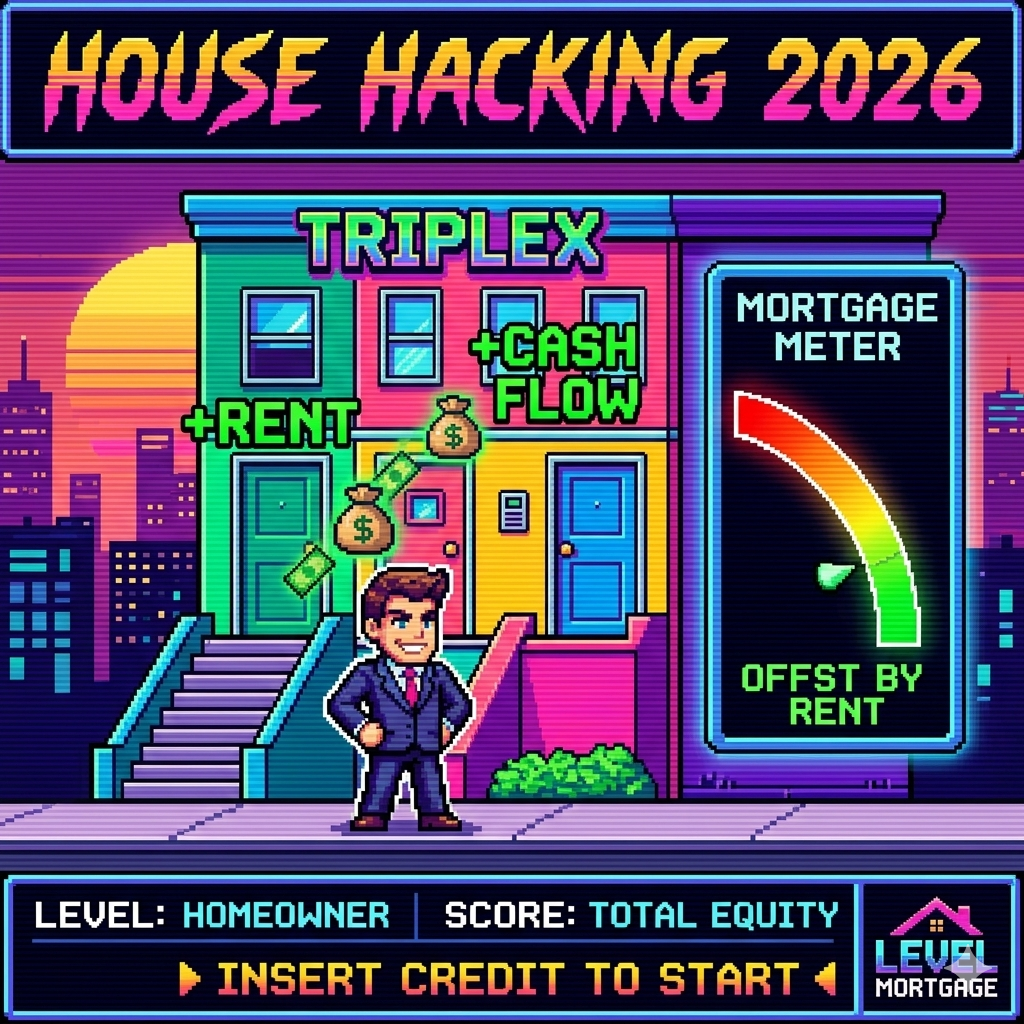
At its core, house hacking is a simple but powerful real estate strategy. You purchase a primary residence, live in one part of the property, and rent out the other units or rooms to tenants. The goal is to use the rental income to pay for some, or even all, of your monthly mortgage payment.
In 2026, this strategy is seeing a massive resurgence among younger investors and first-time buyers. As home prices continue to grow and inventory remains tight, people are looking for ways to make the math work. House hacking allows you to own a high-value asset while significantly reducing your personal cost of living.
Why House Hacking Makes Sense in 2026
The economic climate of 2026 offers a unique environment for this strategy. Based on trusted mortgage reports, interest rates are currently averaging between 6.0% and 6.3%. While these rates are higher than the historic lows of the past, they have stabilized, creating a predictable market for buyers.
Home prices are also showing steady, moderate growth. Industry data suggests an increase of roughly 2% to 3% in property values this year. This environment has shifted the house hacking philosophy. It is no longer viewed as a “get rich quick” scheme, but rather as a sophisticated, long-term affordability strategy. By offsetting a mortgage with rental income, buyers can secure a home in a market that might otherwise feel out of reach.
How House Hacking Works (Step-by-Step)
Executing a successful house hack requires a blend of real estate knowledge and smart financing. Here is the step-by-step breakdown for 2026.
Step 1: Choose the Right Property
The most common way to house hack is by purchasing a multi-unit property, such as a duplex, triplex, or fourplex. You live in one unit and rent the others. However, you can also apply this to a single-family home by renting out a finished basement, an accessory dwelling unit (ADU), or even individual bedrooms. In high-demand urban areas, ADUs have become a particularly popular choice for house hackers.
Step 2: Use the Right Loan Program
The type of financing you choose is the most critical part of the process. For many, the FHA loan remains the top choice.
Low Down Payment: You can enter a multi-unit property with as little as 3.5% down.
Accessible Credit: Many programs allow for a credit score as low as 580.
VA Loans: If you are a veteran or active-duty service member, you may be able to purchase a multi-unit property with 0% down.
Step 3: Use Rental Income to Your Advantage
One of the biggest secrets to house hacking in 2026 is how lenders view your income. According to recent industry data, many loan programs allow you to use approximately 75% of the projected rental income from the units you aren’t living in to help you qualify for the mortgage. This can effectively boost your purchasing power and help you afford a larger or more expensive property than you could on your own.
Real Financial Benefits of House Hacking
The numbers behind a house hack can be transformative for your personal balance sheet. Consider the following advantages:
Drastic Cost Reduction: If your total mortgage is $3,000 but you collect $2,000 in rent, your personal housing cost is only $1,000.
Equity Building: Your tenants are essentially paying down your loan principal every month, helping you build wealth faster.
Lower Entry Barrier: Low down payment options allow you to start investing with a fraction of the cash typically required for a standard investment property.
Tax Benefits: As a landlord, you may be eligible for various tax deductions related to property maintenance and depreciation.
What Lenders Look for in 2026
To successfully secure a loan for a house hack, you need to present a strong financial profile. Lenders are particularly focused on stability and preparation this year.
First, a strong credit profile is essential. While minimums exist, a higher score will always secure a better rate within that 6.0% to 6.3% range. Second, lenders want to see cash reserves. Since you will be responsible for multiple units, having a “rainy day fund” for repairs is a requirement for many loan programs. Finally, your rental assumptions must be realistic. Lenders will often use an appraiser to verify that the projected rents match the current market standard in your specific neighborhood.
Risks and Considerations
House hacking is a powerful tool, but it is not without responsibility. You must be prepared for the reality of being a landlord. This includes managing tenants, handling late-night maintenance calls, and navigating local rental laws.
There are also financial risks, such as vacancy periods. If a tenant moves out, you must be able to cover the full mortgage payment yourself until a new renter is found. It is a lifestyle trade-off. You are sacrificing some privacy today to build a much stronger financial future tomorrow.
How Level Mortgage Helps You Execute This Strategy
At Level Mortgage, we specialize in helping buyers navigate the complexities of house hacking. We understand that this is more than just a home purchase. It is a strategic financial move.
Our team works with you to identify the right loan program for your specific goals. We can help you analyze the projected rental income of a property to ensure it meets lender requirements. More importantly, we help you structure your financing so that you can maximize your affordability while minimizing your out-of-pocket costs. We provide the clarity and expertise needed to turn a complex transaction into a seamless experience.
Conclusion: Start Building Your Future Today
The 2026 housing market requires a new way of thinking. House hacking offers a path to homeownership that balances the reality of today’s rates with the necessity of long-term wealth building. By choosing the right property and the right financing, you can turn your home into an asset that works for you.
If you are ready to explore how house hacking can change your financial trajectory, we are here to help. Reach out to Level Mortgage today for a personalized affordability plan. We can discuss your loan options, review your strategy, and help you find the best way to move forward in this competitive market.
Want personalized assistance? Visit our 'Contact Us' tab and leave your information with one of our experts.
About Us
A group of like-minded seasoned veterans came together to create a company with an employee-focused culture. A culture that values its members both personally and professionally and a company built on the idea that the customer comes first!
We do not share data with third parties for marketing/promotional purposes.
By submitting your phone number to Level Mortgage, you are authorizing a representative of our company to send you text messages and notifications. Message frequency may vary. Message/data rates apply. Reply STOP to unsubscribe to a message sent from us, and HELP to receive help.
What Credit Score Do You Need to Buy a House in 2026?
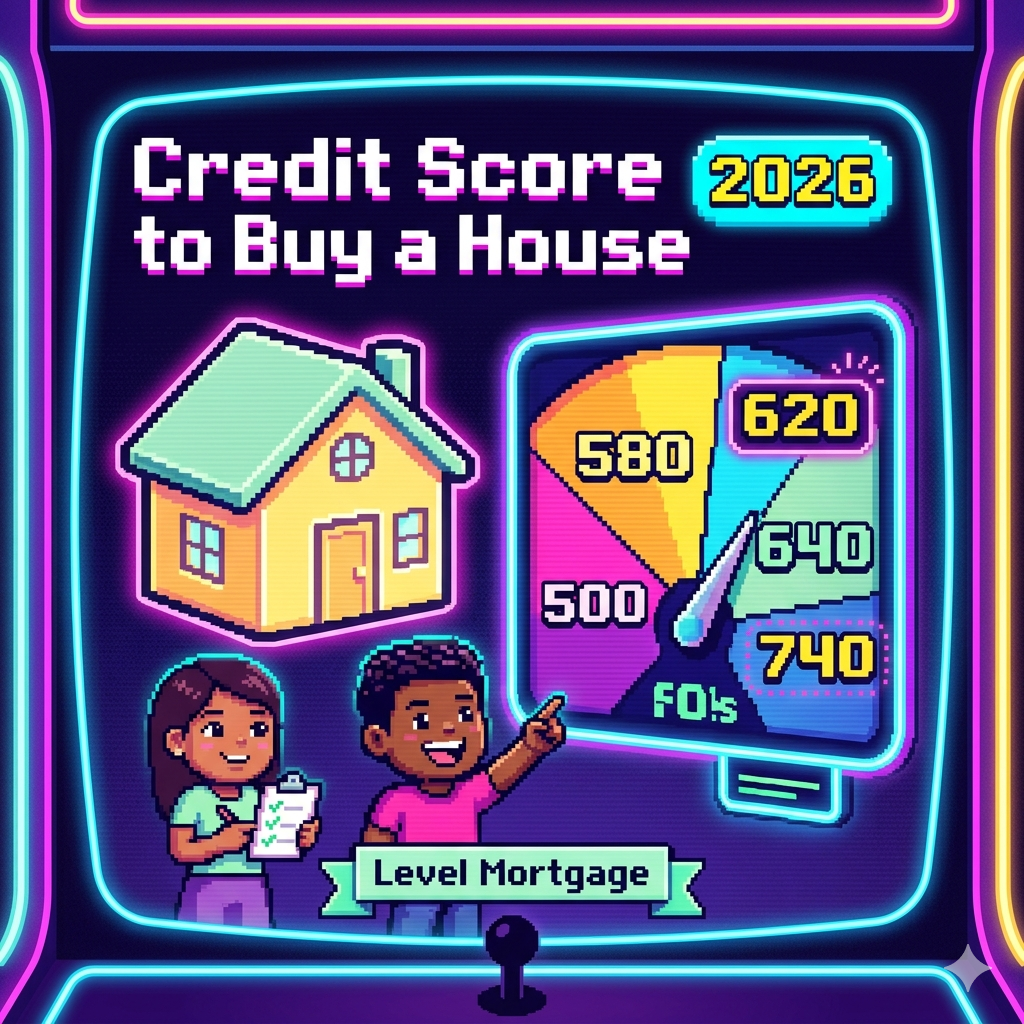
Different mortgage programs have different practical minimums. Below is a quick snapshot of common 2026 expectations. These ranges reflect typical lender practice today, and remember lenders also look at your full financial picture.
Conventional: about 620 minimum; best pricing at 740+
FHA:580+ for 3.5% down; 500–579 with 10% down
VA: no government minimum, but lenders often prefer 580–620
USDA: automated approvals commonly expect 640
Minimum Credit Score by Loan Type (2026 Breakdown)
Conventional Loans
Conventional mortgages usually require a minimum credit score around 620. Borrowers with scores of 740 or higher generally get the most competitive interest rates and lowest fees. Lenders also factor in down payment size and debt-to-income ratio when setting final terms.
FHA Loans
FHA loans remain one of the most accessible options:
580 and up: eligible for 3.5% down
500–579: may qualify with 10% down FHA loans include mortgage insurance, so compare the total monthly payment and long-term cost, not just the down payment.
VA Loans
VA loans do not have an official minimum credit score. In practice, private lenders typically look for scores in the 580–620 range. VA underwriting places extra weight on residual income and service history in addition to credit.
USDA Loans
USDA loans for eligible rural buyers often require about 640 for automated approval. Lower scores may be considered through manual underwriting if you have strong compensating factors like steady income or cash reserves.
Good News: Credit Score Isn’t Everything Anymore
Underwriting in 2026 is becoming more holistic. Lenders increasingly consider:
Debt-to-income ratio
Income stability and employment history
Cash reserves and down payment
Alternative credit data, such as rent and utility payments
This shift creates real opportunities for buyers with imperfect scores who can show steady income, low DTI, or documented alternative credit. According to recent industry data, these factors can offset a lower numeric score during manual underwriting.
What If Your Credit Score Isn’t Where You Want It?
Improving your profile before you apply is often faster and cheaper than accepting a higher rate. Practical steps you can take now:
Pay down revolving balances to lower credit utilization below 30%
Avoid new credit inquiries for 60 to 90 days before applying
Make every payment on time; payment history is the largest score factor
Review and dispute errors on your credit reports
Build alternative credit by documenting rent and utility payments for manual underwriting
Small, focused moves can raise your score enough to lower your rate or expand your loan options within a few months.
How Level Mortgage Helps You Navigate Your Options
Level Mortgage acts as your advisor, strategist, and problem solver. We will:
Review your credit profile and identify quick wins
Match you to loan programs that fit your score, income, and goals
Build a personalized plan that covers credit steps, down payment strategy, and lender matches
Our approach is clear and practical. We remove fear and replace it with a plan you can follow.
Ready to see what you qualify for? According to trusted mortgage reports, small improvements and the right loan choice can make homeownership realistic sooner than you think.
Connect with us for a free, no pressure credit review and a personalized loan strategy. We will walk through your options, outline next steps you can take right away, and help you move toward buying a home in 2026 with confidence.
Want personalized assistance? Visit our 'Contact Us' tab and leave your information with one of our experts.
About Us
A group of like-minded seasoned veterans came together to create a company with an employee-focused culture. A culture that values its members both personally and professionally and a company built on the idea that the customer comes first!
We do not share data with third parties for marketing/promotional purposes.
By submitting your phone number to Level Mortgage, you are authorizing a representative of our company to send you text messages and notifications. Message frequency may vary. Message/data rates apply. Reply STOP to unsubscribe to a message sent from us, and HELP to receive help.
Is 2026 Your Year? Why Buyers Are Returning to the Housing Market
The “wait-and-see” approach that defined much of the last two years is officially shifting. As we move through 2026, the housing market is vibrating with a renewed energy that hasn’t been felt in seasons. For many who paused their homeownership dreams due to volatile rates or inventory shortages, the current landscape offers a compelling reason to take a second look.
At Level Mortgage, we believe clarity is the foundation of confidence. Understanding the data behind this shift is the first step in determining if 2026 is the right time for your next move.
The 2026 Housing Market Is Gaining Momentum
After several years of “rate lock” paralysis—where both buyers and sellers felt stuck in place—the market has entered a period of healthy recalibration. We are no longer seeing the frantic, unsustainable spikes of the early 2020s, nor the stagnant lows of the post-inflationary correction.
Instead, 2026 is characterized by intentionality. Buyers are re-entering the market not out of panic, but because the fundamentals of homeownership—stability, equity, and lifestyle—are outweighing the desire to “time the market.”
Signs Buyers Are Coming Back
The numbers tell a clear story of a market in motion. According to recent data and seasonal reporting, the “sideline” is getting a lot thinner.
Rising Mortgage Applications: The Mortgage Bankers Association (MBA) recently reported a 14% year-over-year increase in purchase applications. This indicates that a significant wave of buyers is moving from the “browsing” phase into the “financing” phase.
Increased Home Showings: Real-time data from Redfin shows that home tours and requests for showings are up 11% nationwide compared to this time last year.
Spring Activity Surge: While the spring season always brings a boost, 2026 has seen the earliest start to the “buying season” in five years, as buyers attempt to get ahead of the traditional summer rush.
What’s Driving Buyer Confidence in 2026
Why now? The return of the buyer isn’t accidental; it is driven by three specific economic shifts that have created a more predictable environment.
1. Stabilizing Home Prices
The National Association of Realtors (NAR) indicates that while home values continue to appreciate, the pace has moderated to a sustainable 3% to 4% annually. This predictable growth allows buyers to plan their finances without the fear of a sudden 20% price hike while they save.
2. Increased Inventory
A major hurdle in previous years was the “Inventory Desert.” However, Fannie Mae reports that active listings have increased by 18% as more homeowners decide to trade up or downsize, finally feeling comfortable leaving their pandemic-era low rates.
3. Adaptation to the Interest Rate Environment
Buyers have largely accepted the “new normal.” With the Federal Reserve maintaining a more consistent stance, mortgage rates have stabilized around the 5.8% to 6.2% range. This stability has replaced the “rate shock” of 2023 and 2024 with a sense of predictability.
What This Means for You as a Buyer
If you are a first-time buyer or someone who paused your search in 2024, the current conditions offer a unique window of opportunity.
Less “Bidding War” Fatigue: While demand is up, the increase in inventory means you are less likely to face 20 competing offers on a single property. You have more room to breathe and perform due diligence.
The Cost of Waiting: With prices continuing to rise steadily, waiting for a “perfect” rate that may never return could cost you more in lost equity than you would save on a monthly payment.
Strategic Mindset: In 2026, the “best” deal isn’t just about the lowest price; it’s about the right total cost of homeownership, including your loan structure and long-term equity goals.
Why Your Mortgage Strategy Matters More Than Ever
In a more active market, your financing is your strongest negotiation tool. Sellers in 2026 are looking for “sure bets”—buyers who have their financing fully vetted and ready to go.
A mortgage is not a one-size-fits-all product. Depending on your goals, a Custom Loan Strategy might include:
Exploring adjustable-rate options if you plan to move in five years.
Utilizing specialized programs for first-time buyers.
Structuring your down payment to maximize your monthly cash flow.
Navigating these choices requires more than an online calculator; it requires a partner who understands the nuances of the 2026 economy.
How Level Mortgage Helps You Move Forward with Confidence
At Level Mortgage, we don’t just process loans; we provide a roadmap. We know that the 2026 housing market can feel complex, but it doesn’t have to be overwhelming.
Our team is dedicated to providing the educational resources, market insights, and personalized guidance you need to make a decision that fits your life and your legacy. We act as your advocate, ensuring that when you find the right home, you have the right financing to back it up.
Ready to Explore Your Options?
The 2026 market is moving, and you should feel empowered to move with it. Whether you’re just starting to save or you’re ready to get pre-approved, we’re here to help you understand your affordability and find the best path forward.
Want personalized assistance? Visit our 'Contact Us' tab and leave your information with one of our experts.
About Us
A group of like-minded seasoned veterans came together to create a company with an employee-focused culture. A culture that values its members both personally and professionally and a company built on the idea that the customer comes first!
We do not share data with third parties for marketing/promotional purposes.
By submitting your phone number to Level Mortgage, you are authorizing a representative of our company to send you text messages and notifications. Message frequency may vary. Message/data rates apply. Reply STOP to unsubscribe to a message sent from us, and HELP to receive help.
Mortgage Loans for Self-Employed Borrowers: How Business Owners Qualify for a Home Loan
The American dream of homeownership has historically been built on the foundation of a steady W-2 paycheck. For decades, mortgage underwriting was designed for the “9-to-5” employee with a predictable salary and a neat set of year-end tax forms. However, the modern economy looks vastly different. Today, the workforce is defined by agility, entrepreneurship, and independence.
If you are a business owner, a freelancer, or a consultant, you may have heard that securing a mortgage is an uphill battle. While it is true that the documentation process is more rigorous, the path to homeownership is wide open. By understanding the specific mortgage loans for self-employed borrowers and how lenders evaluate non-traditional income, you can navigate the market with confidence.
The Rise of Self-Employed Homebuyers
The landscape of work in the United States has undergone a tectonic shift. According to recent data, approximately 72.7 million Americans—roughly 42% of the workforce—earn income from independent work. Furthermore, Bureau of Labor Statistics (BLS) data indicates that around 10 million Americans are classified as full-time self-employed.
This is no longer a niche segment of the economy; it is the new mainstream. As a result, the mortgage industry is experiencing a forced evolution. Major entities like Fannie Mae and Freddie Mac, along with private “Non-QM” (Non-Qualified Mortgage) lenders, have updated their guidelines to better accommodate the “Gig Economy” and the sophisticated financial structures of successful entrepreneurs.
At Level Mortgage, we’ve seen firsthand how this trend is reshaping lending. Lenders are becoming more adept at reading complex tax returns and recognizing that a business owner’s “taxable income” rarely tells the full story of their true purchasing power.
Why Getting a Mortgage Is Harder for Self-Employed Borrowers
Despite the growth of the independent workforce, challenges remain. Traditional mortgage underwriting is inherently risk-averse. When a lender looks at a W-2 employee, they see a “guaranteed” salary. When they look at a business owner, they see variables.
The Underwriting Hurdles
Irregular Income: Revenue often fluctuates month-to-month. Lenders prefer “stable and predictable” income, which can be hard to prove if your business has seasonal peaks or project-based payouts.
The Tax Deduction Paradox: Every good CPA helps business owners maximize deductions to lower their tax liability. However, mortgage lenders typically use the Net Income found on your tax returns, not your Gross Revenue. If you earned $200,000 but wrote off $150,000 in expenses, a traditional lender sees you as an applicant making $50,000.
Documentation Complexity: While a W-2 employee provides two paystubs, a self-employed borrower may need to provide hundreds of pages of bank statements, profit and loss (P&L) statements, and multiple years of federal filings.
According to industry reports from groups like HousingWire, nearly 49% of mortgage applications from self-employed borrowers are denied or delayed, often due to documentation gaps or income variability. Understanding the “why” behind these denials is the first step toward a successful approval.
Mortgage Options for Self-Employed Borrowers
The good news is that there isn’t just one way to qualify. Depending on how you manage your finances, several loan “buckets” exist.
Conventional Loans
If you have been in business for at least two years and show a strong net profit on your tax returns, a conventional loan is usually the most cost-effective option.
Minimum Credit Score: Generally 620, but 740+ yields the best rates.
Down Payment: As low as 3% for first-time buyers.
Income Verification: Full verification of the last two years of personal and business tax returns.
Bank Statement Loans
This is the “gold standard” for entrepreneurs who have high cash flow but significant tax write-offs. Instead of looking at tax returns, lenders analyze your 12 to 24 months of personal or business bank statements.
How it works: Lenders total the eligible deposits over a year or two and divide by the number of months to determine a “qualifying monthly income.”
Market Growth: Non-QM lending, which includes bank statement programs, has expanded significantly as private investors seek to serve the millions of high-earning business owners who don’t fit the Fannie Mae box.
Non-QM Loans
Non-Qualified Mortgages (Non-QM) are loans that do not follow the federal government’s standard underwriting rules. These are not “subprime” loans; rather, they use alternative underwriting models to prove ability-to-repay. They are ideal for borrowers with complex income structures, such as those with multiple LLCs or 1099 income from various sources.
Asset Depletion Loans
For high-net-worth entrepreneurs who may not currently be taking a large salary but have significant liquid assets, asset depletion is an excellent choice. Lenders use a formula to “amortize” your liquid assets (stocks, bonds, cash) over a set period (usually 30 years) to create a theoretical monthly income.
Documents Self-Employed Borrowers Need
Preparation is the antidote to mortgage stress. If you are self-employed, you should maintain a “living folder” of the following documents:
Tax Returns: The last two years of personal (1040) and business (1120-S, 1065, or Schedule C) returns.
Profit and Loss (P&L) Statement: A year-to-date P&L, often required to be signed by a CPA.
Bank Statements: Usually the most recent 12 to 24 months of business and personal accounts.
Business License: Proof that your business is active and has been for at least two years.
CPA Verification Letter: A letter stating you are still in business and that your business is in good standing.
Pro Tip: Most lenders require a minimum of two years of self-employment history in the same industry. If you have been in business for less than two years, you may need to show significant previous W-2 experience in the same field.
Credit Score, Debt-to-Income Ratio, and Down Payment
While income verification is the biggest hurdle, the “Three Pillars” of mortgage lending still apply:
Credit Score: While the minimum is often 620, aiming for a 680 or higher significantly opens up your options, especially for Bank Statement loans.
Debt-to-Income (DTI) Ratio: Most programs prefer a DTI below 45%. This means your total monthly debt payments (including the new mortgage) shouldn’t exceed 45% of your qualifying income.
Down Payment: On a conventional loan, you might put down 3% to 5%. For alternative programs like Bank Statement or Non-QM loans, expect to put down 10% to 20%, as the lender is taking on more perceived risk.
Tips to Improve Mortgage Approval for Self-Employed Buyers
Separate Your Finances: Never commingle business and personal funds. It makes income analysis much harder for an underwriter.
Maintain Consistent Deposits: If you are pursuing a Bank Statement loan, avoid large “lumpy” deposits that can’t be explained as business revenue.
Consult Your CPA Early: If you plan to buy a home in the next 12–24 months, talk to your CPA about the balance between tax deductions and qualifying income.
Keep Debt Low: Pay off car loans or credit cards before applying to keep your DTI as lean as possible.
How Level Mortgage Helps Self-Employed Borrowers
Navigating the mortgage market as a business owner shouldn’t feel like a second job. At Level Mortgage, we specialize in the “complex” borrower. We act as a bridge between your unique financial reality and the right capital sources.
We help our clients by:
Expert Income Analysis: We pre-calculate your qualifying income using the same methods underwriters use, so there are no surprises.
Access to Multiple Lenders: We have relationships with both traditional banks and private Non-QM investors.
Structuring the Deal: Whether it’s a 1099-only loan or a 24-month bank statement program, we identify the specific product that fits your business structure.
Conclusion: Homeownership Is Possible for Entrepreneurs
Being your own boss shouldn’t be a barrier to owning your own home. While the “standard” mortgage process isn’t built for you, a whole world of mortgage loans for self-employed borrowers exists specifically to serve the modern entrepreneur.
Strategic planning, clean documentation, and the right advisory partner make the process not just possible, but seamless. Don’t let a complex tax return stand in the way of your investment in the future.
Want personalized assistance? Visit our 'Contact Us' tab and leave your information with one of our experts.
About Us
A group of like-minded seasoned veterans came together to create a company with an employee-focused culture. A culture that values its members both personally and professionally and a company built on the idea that the customer comes first!
We do not share data with third parties for marketing/promotional purposes.
By submitting your phone number to Level Mortgage, you are authorizing a representative of our company to send you text messages and notifications. Message frequency may vary. Message/data rates apply. Reply STOP to unsubscribe to a message sent from us, and HELP to receive help.
How to Finance a New Construction Condo Before Completion
the National Association of Realtors (NAR), the supply of existing homes remains well below the levels needed to satisfy buyer demand. This scarcity has pushed investors and primary residents alike toward a compelling alternative: pre-construction condos.
In high-growth hubs like Miami, Fort Lauderdale, and West Palm Beach, the skyline is a constant rotation of cranes. For many, buying “off-plan”—purchasing a unit before the building is even finished—is the only way to secure a prime piece of real estate in a competitive market. However, financing a property that doesn’t technically exist yet is a vastly different beast than a traditional resale purchase.
Understanding the mechanics of developer deposits, mortgage timing, and capital leverage is essential for any buyer looking to capitalize on the new construction boom.
Why Buyers Choose Pre-Construction Condos
The primary draw of pre-construction is the “early bird” advantage. Unlike the resale market, where you are competing with multiple offers on an aging asset, pre-construction allows you to lock in a price based on today’s market values for a product that won’t be delivered for two to four years.
1. Built-In Appreciation
In a healthy real estate market, a condo often appreciates significantly during its construction phase. Industry data suggests that pre-construction units in Tier-1 cities like Miami can see a 10% to 25% increase in value between the time the contract is signed and the day the keys are handed over. Essentially, you are “buying” the future equity.
2. Customization and Modern Incentives
Developers often offer incentives to early-stage buyers, including the ability to select finishes, floorings, and appliances. Furthermore, new buildings are constructed to the latest Florida Building Codes, which significantly reduces long-term maintenance costs and insurance premiums—a major factor in today’s high-cost insurance environment.
3. Favorable Entry Pricing
During the “friends and family” or “first tier” of sales, developers frequently price units lower to hit the sales quotas required to trigger their construction financing.
The Most Common Ways to Finance a Pre-Construction Condo
Because a bank cannot place a lien on a property that isn’t finished, you cannot get a standard mortgage on day one. Instead, financing a pre-construction condo is a two-phase process: the Deposit Phase and the Closing Phase.
Developer Deposit Structure
In most U.S. markets, and specifically in Florida, developers follow a “staggered” deposit schedule. Instead of a 20% down payment at the start, you pay in installments. A typical structure looks like this:
10% at Reservation: Held in escrow while you review the offering plan.
10% at Contract Execution: Totaling 20% down to secure the unit.
10% at Groundbreaking: When the foundation work begins.
10% at “Top-Off”: Once the building reaches its highest structural point.
Remaining 60% (Balance) at Closing: Typically covered by a traditional mortgage.
Developers require these deposits to secure their own construction loans and ensure buyer commitment.
Traditional Mortgage at Closing
The actual “financing” through a lender typically happens only when the building receives its Certificate of Occupancy (CO).
The Pre-Approval: You should be pre-approved at the time of contract to ensure you can afford the unit.
The Final Loan: You will apply for the formal mortgage 60 to 90 days before the building is finished.
Lender Requirements: The lender will evaluate the building’s health, ensuring at least 50% of units are under contract and the condo association has adequate reserves (often 10% of the total budget).
Using a HELOC or Home Equity Loan
Many savvy investors do not use their “cash on hand” for the initial deposit phase. Instead, they leverage the equity in their current primary residence or other investment properties.
Strategy: By opening a Home Equity Line of Credit (HELOC), an investor can draw the 10% increments needed for the developer deposits.
Benefit: This allows the investor to keep their liquid cash working in other investments while using a lower-interest credit line to secure the new condo.
Private or Portfolio Lenders
If a building is “non-warrantable” (meaning it doesn’t meet Fannie Mae or Freddie Mac standards, often due to high investor concentration), traditional banks might shy away. In these cases, portfolio lenders or private lenders step in. These entities keep the loans on their own books, allowing for more flexible debt-to-income (DTI) requirements and lending to foreign nationals—a massive demographic in the Miami luxury condo market.
Key Financial Requirements Buyers Should Prepare
Lenders treat new construction condos with a higher level of scrutiny. To ensure your financing goes smoothly at the finish line, you should aim for the following benchmarks:
Credit Score: While FHA loans allow lower scores, most condo lenders prefer a 720 or higher to secure the best interest rates.
Debt-to-Income (DTI) Ratio: Lenders generally want your total monthly debt payments (including the new mortgage, HOA fees, and taxes) to be under 43% of your gross monthly income.
Liquid Reserves: Be prepared to show 6 to 12 months of “PITI” (Principal, Interest, Taxes, and Insurance) in a liquid account after the down payment is made.
Appraisal: The property must appraise for the purchase price at the time of completion. If the market dips and the appraisal comes in low, the buyer is responsible for covering the gap in cash.
Risks Buyers Should Understand Before Financing
While the rewards are high, pre-construction carries unique risks that aren’t present in the resale market.
Interest Rate Volatility: You sign a contract today, but you won’t get a mortgage for two years. If interest rates rise from 6% to 8% in that time, your monthly payment could increase significantly.
Construction Delays: According to the U.S. Census Bureau, large-scale residential projects can face delays of 6 to 12 months due to labor shortages or supply chain issues. You must ensure your financial situation is stable enough to wait.
Market Fluctuations: While appreciation is expected, it is not guaranteed. If the market oversupplies units in a specific neighborhood, value growth may stagnate.
Why Pre-Construction Financing Can Be a Powerful Investment Strategy
Despite the risks, the data favors the long-term investor. Florida’s population grew by over 365,000 people between 2023 and 2024, maintaining its status as one of the fastest-growing states. This influx of residents creates a “floor” for demand.
By financing a pre-construction unit, you are essentially “locking in” a price in a high-inflation environment. If the cost of raw materials (lumber, steel, concrete) continues to rise, the replacement cost of the building goes up, naturally lifting the value of your unit before you’ve even moved in.
How Level Mortgage Can Help Buyers Finance New Construction Condos
Navigating the gap between a developer contract and a bank closing requires a sophisticated mortgage partner. At Level Mortgage, we specialize in bridge strategies and long-term financing for pre-construction buyers.
Pre-Approval for Future Deliveries: We help you understand your borrowing power years in advance.
Investor-Specific Products: Including DSCR (Debt Service Coverage Ratio) loans that focus on the property’s future rental income rather than your personal income.
HELOC Coordination: We can help you tap into existing equity to cover those initial developer deposits.
Guidance on “Non-Warrantable” Buildings: We have access to a wide network of portfolio lenders who specialize in luxury condo projects that traditional banks may avoid.
Final Thoughts
Financing a new construction condo is a marathon, not a sprint. Success depends on understanding the developer’s deposit timeline, maintaining a strong financial profile during the construction years, and choosing a lender who understands the nuances of the Florida market.
With the right strategy, buying pre-construction isn’t just a way to get a home—it’s a powerful vehicle for wealth creation.
Want personalized assistance? Visit our 'Contact Us' tab and leave your information with one of our experts.
About Us
A group of like-minded seasoned veterans came together to create a company with an employee-focused culture. A culture that values its members both personally and professionally and a company built on the idea that the customer comes first!
We do not share data with third parties for marketing/promotional purposes.
By submitting your phone number to Level Mortgage, you are authorizing a representative of our company to send you text messages and notifications. Message frequency may vary. Message/data rates apply. Reply STOP to unsubscribe to a message sent from us, and HELP to receive help.
Using a HELOC to Buy a Second Home: Pros, Cons & Mortgage Insights
For many homeowners in 2026, the greatest financial asset isn’t sitting in a savings account—it’s locked within the walls of their primary residence. As home values have maintained a steady upward trajectory over the last several years, tappable equity has reached record highs. If you are looking to expand your real estate portfolio or secure a vacation getaway, using a HELOC to buy a second home has emerged as a premier strategy for savvy investors and families alike.
Leveraging equity allows you to bypass the hurdles of liquidating cash reserves or selling off stocks in a volatile market. However, navigating the mortgage landscape in 2026 requires a nuanced understanding of interest rate trends and debt-to-income ratios. This guide explores how a Home Equity Line of Credit (HELOC) works and whether it is the right engine to power your next property purchase.
What Is a HELOC and How It Works
Despite regulatory shifts in some cities, the short‑term rental market remains strong. According to AirDNA’s 2025 U.S. Short‑Term Rental Outlook, national STR demand grew 7.8% year‑over‑year, and average daily rates increased 3.2% heading into 2026. Investor interest remains high because:
STRs often generate 20–40% higher gross rental income than comparable long‑term rentals in the same market.
Remote work and flexible travel trends continue to support year‑round occupancy.
Many secondary and tertiary markets have seen rising tourism and fewer regulatory restrictions.
However, higher potential returns also come with more complex financing requirements.
HELOC Basics
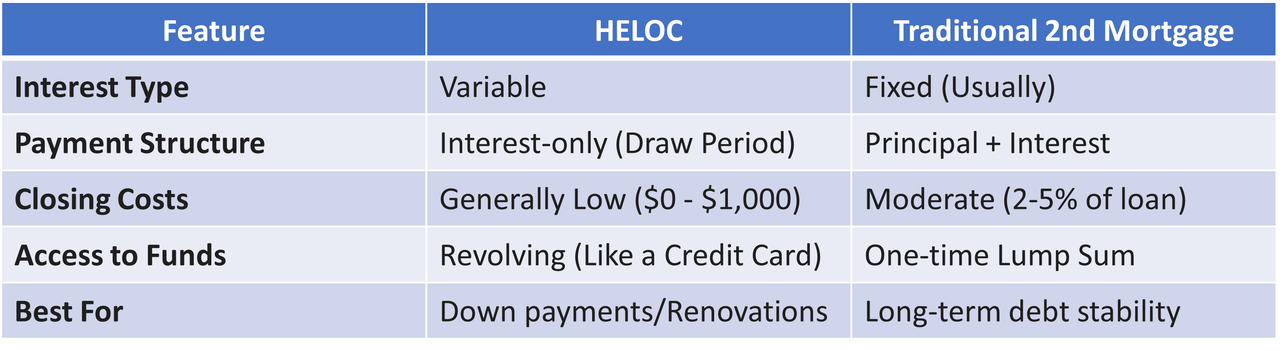
Loan Against Home Equity: Your credit limit is based on the appraised value of your home minus what you still owe on your primary mortgage.
Line of Credit vs. Lump Sum: You have the freedom to spend only what you need for a down payment or closing costs, leaving the rest of the credit line available for emergencies or renovations.
Interest-Only Draw Period: Most HELOCs offer a 10-year “draw period.” During this time, you typically only have to pay interest on the amount you’ve borrowed, which keeps initial monthly costs low while you manage a new second home.
Why Buyers Consider a HELOC for a Second Home Purchase
With the 2026 market showing signs of increased competition in the “second home” sector—driven by the continued normalization of remote work—buyers need to move fast. A HELOC provides “ready-to-go” capital that acts like cash in the eyes of a seller.
Financial Leverage & Timing
Using a HELOC allows you to maintain your liquidity. Instead of selling off stocks or dipping into a high-yield savings account (which may be earning 4-5% in today’s environment), you leverage the “dead equity” in your home. This strategy is particularly effective when you need to act quickly on a property listing before other buyers can secure traditional financing. It also allows you to bypass the need for a “home sale contingency” if you were planning to sell a different asset to fund the purchase.
Pros of Using a HELOC to Buy a Second Home
Leveraging your primary residence comes with distinct advantages that traditional second-home mortgages often lack:
Minimal Upfront Costs: HELOCs often have little to no closing costs. Many lenders in 2026 offer “no-cost” setups where they cover the appraisal and origination fees.
Borrow up to 85% CLTV: Most lenders allow a Combined Loan-to-Value (CLTV) of 80% to 85%. If your home is worth $1,000,000 and you owe $500,000, you could potentially access up to $350,000 in credit.
Tax Advantages: Per current IRS guidelines, the interest on a HELOC may be tax-deductible if the funds are used specifically to “buy, build, or substantially improve” the home that secures the loan.
Flexibility: You only pay interest on what you use. If you only need $50,000 for a down payment on a $250,000 condo, you aren’t forced to pay interest on a full $250,000 loan.
Cons & Risks of Using a HELOC for a Second Home
Despite the benefits, this strategy is not without significant risk. In the 2026 economy, borrowers must be wary of “rate creep” and equity volatility.
Variable Interest Rates: HELOCs are almost always tied to the Prime Rate. If the Federal Reserve raises rates to combat inflation, your HELOC payment will climb immediately.
Collateral Risk: Your primary home is the collateral. If you experience a financial hardship and cannot pay the HELOC, you risk losing the roof over your head.
Future Payment Shock: Once the 10-year draw period ends, the loan enters the “repayment period” (usually 20 years). At this point, you must pay both principal and interest, which can cause your monthly payment to double or even triple.
Rate Volatility & Market Conditions
Over the last 5 to 10 years, we have seen the Prime Rate move from near-zero to over 8%. While 2026 forecasts suggest a period of relative stability, a 2% increase in the Prime Rate can add significant stress to a household budget that is already managing two properties. Borrowers should always calculate their “break-even” point—the highest interest rate they could afford before the second home becomes a financial burden.
How Lenders Evaluate HELOC Usage
Securing a HELOC in 2026 is a more rigorous process than it was a decade ago. Lenders are looking for “pristine” borrowers who can weather economic shifts.
Credit Score: A FICO score of 720+ is typically required for the best rates, though some lenders will go down to 680 with higher interest margins.
Debt-to-Income (DTI): Most lenders want to see a DTI of 43% or lower. This calculation includes your primary mortgage, the new HELOC payment, and the projected costs of the second home (taxes, insurance, and HOA).
Home Equity: You usually need at least 15-20% equity remaining in the home after the HELOC is taken out.
Occupancy Type: Lenders will ask if the second home is a “vacation home” or an “investment property.” Investment properties often carry stricter requirements and slightly higher rates.
Smart Strategies for Using a HELOC to Buy Your Second Home
The Down Payment Bridge: Use the HELOC only for the 20% down payment. This allows you to avoid Private Mortgage Insurance (PMI) on your second home mortgage while keeping your cash reserves intact.
The “Fix and Refi”: Use the HELOC to buy a property that needs work. Once the renovations are complete and the value of the second home has increased, perform a “cash-out refinance” on the second home to pay off the HELOC on your primary home.
Aggressive Principal Reduction: During the 10-year draw period, don’t just pay the interest. Treat it like a fixed loan and pay down the principal monthly to reduce your long-term interest exposure.
HELOC vs. Traditional Second Mortgage
Real-World Example (Hypothetical)
magine a homeowner in 2026 with the following profile:
Primary Residence Value: $800,000
Current Mortgage: $400,000
Available Equity: $400,000
They find a beach cottage for $500,000. Instead of taking out a full $500,000 mortgage at 6.5%, they use their HELOC to pull $100,000 (20%) for a down payment. They then finance the remaining $400,000 with a traditional mortgage.
By using the HELOC, they avoided a “Jumbo” loan category (if applicable) and kept $100,000 in their brokerage account, which is currently yielding 8% annually. The “cost of capital” from the HELOC is offset by the “return on capital” from their investments.
What This Means for Buyers & Investors in 2026
The 2026 market is characterized by steady, if not explosive, growth. Rental demand remains high as many would-be buyers stay on the sidelines due to inventory shortages. For the savvy investor, using a HELOC to buy a second home is a way to capitalize on this rental demand.
However, keep an eye on the Tax Cuts and Jobs Act (TCJA) provisions, as tax laws regarding interest deductibility can shift. In 2026, the strategy is about precision: using just enough equity to secure the deal without over-leveraging your foundation.
Conclusion: Is a HELOC Right for You?
Leveraging your home equity to expand your real estate holdings is one of the fastest ways to build long-term wealth. A HELOC provides the speed and flexibility needed in a modern market, but it requires a disciplined repayment strategy and a keen eye on interest rate trends.
Before you tap into your equity, it is essential to have a professional evaluate your debt-to-income ratio and your long-term goals.
Would you like a personalized equity analysis to see how much you can borrow? Contact Level Mortgage today to explore HELOC options tailored to your second home goals.
Want personalized assistance? Visit our 'Contact Us' tab and leave your information with one of our experts.
About Us
A group of like-minded seasoned veterans came together to create a company with an employee-focused culture. A culture that values its members both personally and professionally and a company built on the idea that the customer comes first!
We do not share data with third parties for marketing/promotional purposes.
By submitting your phone number to Level Mortgage, you are authorizing a representative of our company to send you text messages and notifications. Message frequency may vary. Message/data rates apply. Reply STOP to unsubscribe to a message sent from us, and HELP to receive help.
Airbnb investing financing has become one of the most important topics for real estate investors heading into 2026. With short‑term rentals (STRs) continuing to outperform many traditional long‑term rentals, investors are increasingly looking for mortgage strategies that support cash‑flow‑positive Airbnb acquisitions. Understanding how lenders evaluate STR properties—and how financing impacts returns—is essential before making a purchase.
Why Airbnb Investing Continues to Grow in 2026
Despite regulatory shifts in some cities, the short‑term rental market remains strong. According to AirDNA’s 2025 U.S. Short‑Term Rental Outlook, national STR demand grew 7.8% year‑over‑year, and average daily rates increased 3.2% heading into 2026. Investor interest remains high because:
STRs often generate 20–40% higher gross rental income than comparable long‑term rentals in the same market.
Remote work and flexible travel trends continue to support year‑round occupancy.
Many secondary and tertiary markets have seen rising tourism and fewer regulatory restrictions.
However, higher potential returns also come with more complex financing requirements.
Why Mortgage Financing Matters More for Airbnb Investors
Financing an Airbnb is not the same as financing a primary residence or even a traditional rental. Lenders view STRs as higher‑risk assets because income can fluctuate seasonally and depends on market demand. This means:
Higher down payment requirements
Stricter underwriting
More emphasis on projected rental income
Different loan programs compared to long‑term rentals
Choosing the right mortgage structure can significantly impact cash flow, break‑even occupancy, and long‑term ROI.
How Lenders Evaluate Airbnb Properties
Property Use Classification
Lenders classify STR properties as:
Second homes (borrower uses the property part‑time)
This classification affects interest rates, down payments, and underwriting standards.
Income Analysis
Airbnb income is variable, so lenders may use:
Historical STR income (Airbnb/Vrbo statements)
Appraiser‑generated STR income schedules
Market‑based projections from tools like AirDNA
DSCR calculations based on projected monthly income
Most DSCR lenders in 2025–2026 require a minimum DSCR of 1.0–1.1.
Risk-Based Pricing
Because STRs carry higher perceived risk, Airbnb‑friendly loans typically have interest rates 0.5%–1.25% higher than standard investment property loans.
How Interest Rates, Down Payments, and Terms Affect Cash Flow
Interest Rates
As of early 2026, average investment property mortgage rates range from 7.1% to 8.4%, depending on credit score, loan type, and DSCR strength. Even a 0.25% rate change can shift monthly cash flow significantly.
Down Payments
Typical requirements include:
Second home loans: 10–15% down
Conventional investment loans: 20–25% down
zDSCR loans: 15–30% down
Higher down payments often improve DSCR and increase approval odds.
Loan Terms
Common loan structures for Airbnb investors:
30‑year fixed loans for predictable payments
Interest‑only DSCR loans for maximum cash flow
Interest‑only periods can improve DSCR by 20–35%, making qualification easier.
Traditional Investment Loans vs. Airbnb-Friendly Loan Programs
Conventional Loans
Pros:
Lower rates
Lower fees
Cons:
Harder to qualify using STR income
Stricter DTI requirements
DSCR Loans
Pros:
Qualification based on property income
Airbnb income allowed
Faster approvals
Cons:
Higher rates
Larger down payments
Possible prepayment penalties
Second Home Loans
Pros:
Lower down payments
Lower rates than DSCR loans
Cons:
Borrower must occupy the property part‑time
Some lenders restrict STR usage
How Rental Income Is Evaluated for Mortgage Qualification
Lenders may use:
Actual Airbnb statements (12–24 months preferred)
Appraiser‑generated STR income schedules
Market rent estimates (for DSCR loans)
Most lenders apply a 10–25% vacancy factor to STR income to account for seasonality.
Key Risks Investors Must Understand Before Financing an Airbnb
Airbnb investing can be lucrative, but investors must understand:
Regulatory volatility: Over 200 U.S. cities updated STR rules between 2024–2025.
Seasonal income swings: Occupancy can vary 20–50% between peak and off‑peak seasons.
Higher operating costs: Furnishing, cleaning, utilities, and management fees can reduce net income by 30–45%.
Financing risk: DSCR loans may require higher reserves if income projections fall short.
Regulatory, Zoning, and Market Factors That Impact Loan Approval
Lenders increasingly review:
Local STR ordinances
Permit requirements
HOA restrictions
Market saturation
Zoning compliance
A property in a restricted or oversaturated market may face stricter underwriting or reduced loan amounts.
Internal Linking Opportunities
This article naturally supports internal links to:
Want personalized assistance? Visit our 'Contact Us' tab and leave your information with one of our experts.
About Us
A group of like-minded seasoned veterans came together to create a company with an employee-focused culture. A culture that values its members both personally and professionally and a company built on the idea that the customer comes first!
We do not share data with third parties for marketing/promotional purposes.
By submitting your phone number to Level Mortgage, you are authorizing a representative of our company to send you text messages and notifications. Message frequency may vary. Message/data rates apply. Reply STOP to unsubscribe to a message sent from us, and HELP to receive help.
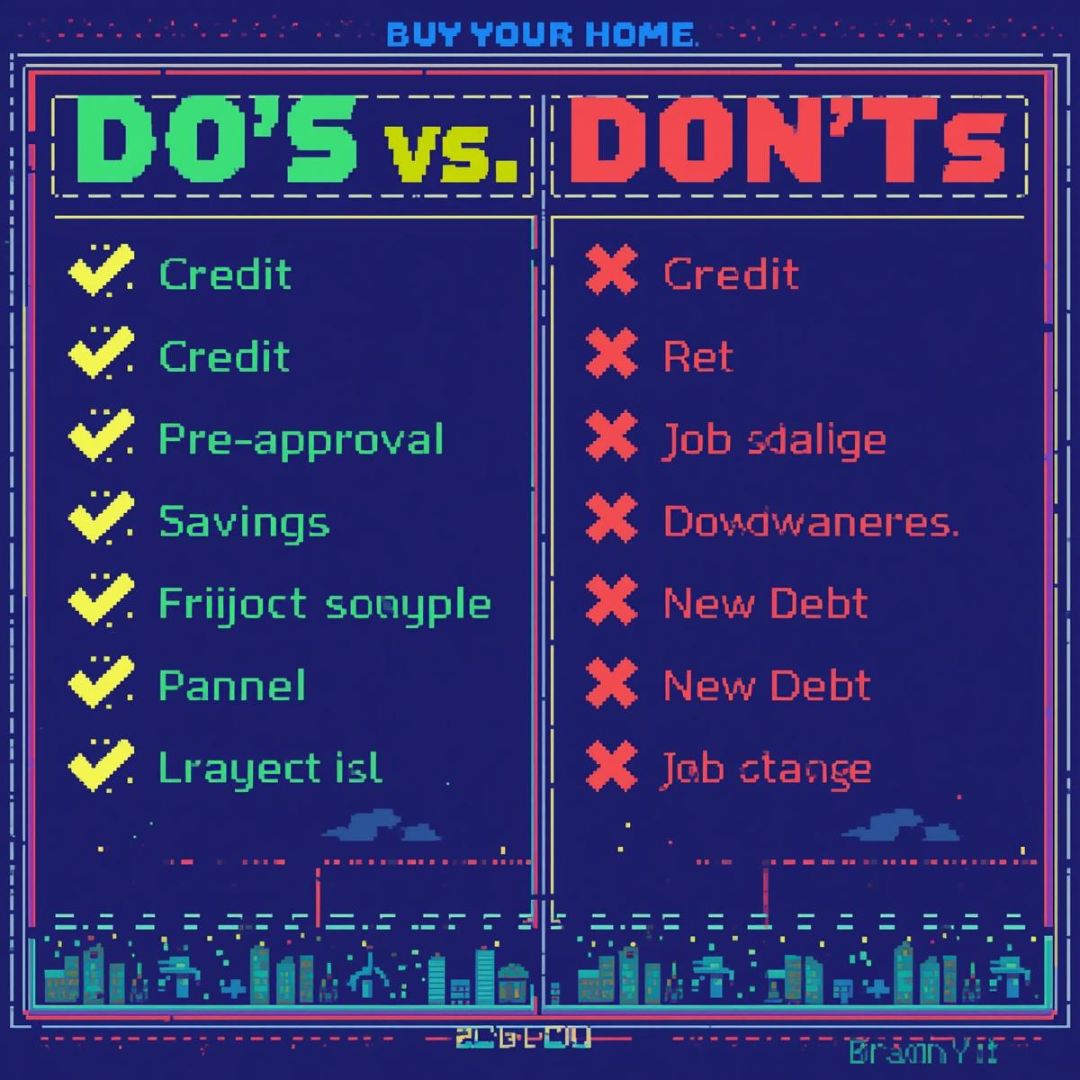
Buying a home in Florida is an exciting milestone, especially for first-time buyers. However, the mortgage application process can feel overwhelming if you’re not prepared. Understanding the do’s and don’ts of applying for a mortgage can save you time, money, and stress—and help you secure the best possible loan terms.
The Do’s of Applying for a Mortgage
Do Check Your Credit Early
Lenders rely heavily on your credit score to determine eligibility and interest rates.
According to Fannie Mae, borrowers with higher credit scores often qualify for lower rates, potentially saving thousands over the life of the loan.
In Florida, where median home prices reached $405,000 in late 2025 (NAR data), even a 0.5% difference in interest rate can significantly impact affordability.
Do Get Pre-Approved
Pre-approval shows sellers you’re a serious buyer and gives you a clear budget.
New credit inquiries can lower your score and raise red flags.
Lenders may see new debt as a risk, especially during underwriting.
Don’t Make Large, Unverified Deposits
Any unexplained deposit can trigger questions about the source of funds.
Always document gifts or transfers with proper paperwork.
Don’t Change Jobs Without Consulting Your Lender
Even a promotion can complicate income verification.
Stability is key—wait until after closing to make career moves.
Don’t Ignore Your Debt-to-Income Ratio (DTI)
Most lenders prefer a DTI below 43%, though FHA may allow slightly higher.
Adding new debt (like financing a car) during the process can push you over the limit.
Don’t Skip Professional Guidance
Mortgage brokers and loan officers can help you compare options.
According to Fannie Mae’s 2024 survey, 71% of buyers said digital mortgage tools made the process easier, but expert guidance remains invaluable.
Florida Market Insights
Florida’s housing market remains competitive, with strong demand in coastal cities and suburban areas.
Rising interest rates in 2025–2026 have cooled some buyer activity, but affordability programs continue to support first-time buyers.
The Federal Reserve noted that mortgage rates averaged 6.7% in late 2025, up from historic lows in 2021. This makes preparation and smart financial moves more critical than ever.
Actionable Tips for Florida Homebuyers
Start early: Check credit and savings at least six months before applying.
Stay consistent: Avoid financial changes until after closing.
Leverage programs: Explore FHA, VA, USDA, and Florida-specific assistance.
Work with experts: Partner with trusted mortgage professionals like Level Mortgage to navigate the process.
Think long-term: Choose a loan that fits both your current budget and future goals.
Conclusion
Applying for a mortgage in Florida doesn’t have to be stressful. By following the do’s—like maintaining stable income, getting pre-approved, and exploring assistance programs—and avoiding the don’ts—like opening new credit or making undocumented deposits—you’ll position yourself for success. With preparation and guidance, you can secure financing confidently and move closer to owning your Florida dream home.
Want personalized assistance? Visit our 'Contact Us' tab and leave your information with one of our experts.
About Us
A group of like-minded seasoned veterans came together to create a company with an employee-focused culture. A culture that values its members both personally and professionally and a company built on the idea that the customer comes first!
We do not share data with third parties for marketing/promotional purposes.
By submitting your phone number to Level Mortgage, you are authorizing a representative of our company to send you text messages and notifications. Message frequency may vary. Message/data rates apply. Reply STOP to unsubscribe to a message sent from us, and HELP to receive help.
Why Waiting for the “Perfect Rate” to Refinance Might Cost You More
The Florida Mortgage Landscape in 2026
Mortgage rates in Florida—and nationwide—have cooled from their 2023 highs but remain in the 6.0–6.2% range for 30-year fixed loans. Freddie Mac reports the average 30-year fixed mortgage at 6.10% as of January 2026, while Fannie Mae forecasts rates to hover near 6.0% through mid-2026.
For Florida homeowners, this means refinancing opportunities are available now. But many hesitate, waiting for the “perfect” rate—often a psychological anchor like 5% or lower. The reality? That wait can cost more than it saves.
The Myth of the “Perfect Rate”
Rate Anchoring Bias
Homeowners often anchor to past rates (like the 3% era of 2020–2021). This creates unrealistic expectations. Rates today are shaped by inflation, Federal Reserve policy, and housing demand—not nostalgia.
Market Timing Fallacy
Trying to predict the exact bottom of mortgage rates is like timing the stock market. Even experts at the Mortgage Bankers Association (MBA) caution that rates fluctuate weekly, and waiting often results in missed savings opportunities.
Why Waiting Can Cost You More
1. Opportunity Cost of Monthly Savings
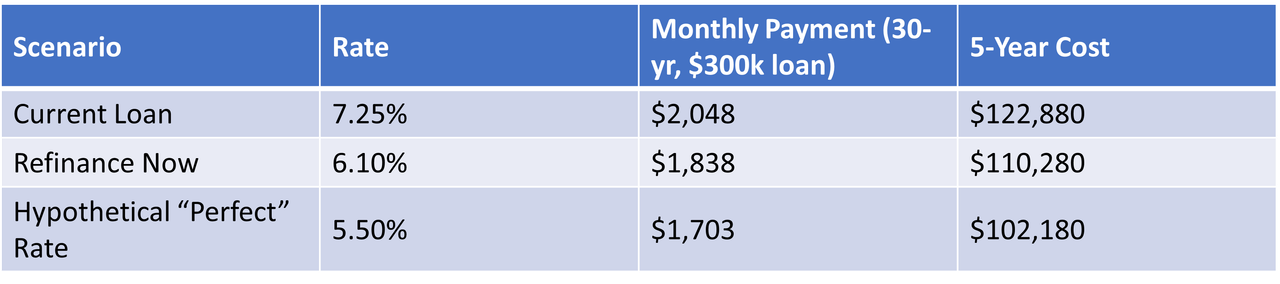
Suppose you have a $300,000 mortgage at 7.25% (a common rate in 2023). Refinancing today at 6.1% saves about $210 per month.
Annual savings: $2,520
5-year savings: $12,600
Waiting for rates to drop to 5.5% might save an extra $100 per month—but if rates never reach that level, you’ve lost years of savings.
2. Long-Term Equity Impact
Lower monthly payments free up cash flow, allowing homeowners to build equity faster or invest elsewhere. Delaying refinancing means slower equity growth and less financial flexibility.
3. Florida-Specific Risks
Florida’s housing market remains competitive, with home prices up 6% year-over-year in 2025 according to MBA data. Rising property values mean waiting could also increase your loan-to-value ratio, potentially limiting refinance options or raising costs.
Real Numbers: Comparing Scenarios
Key takeaway: Waiting for 5.5% could save $8,100 over 5 years—but if rates stay at 6.1%, you lose $12,600 by not refinancing now.
Common Refinance Myths Debunked
Myth 1: “Rates will always go lower.”
Reality: Rates are influenced by inflation and Fed policy. The Federal Reserve has signaled cautious cuts, not dramatic drops.
Myth 2: “It’s better to wait until I hit the bottom.”
Reality: No one can consistently predict the bottom. Even professional forecasts vary within a 0.5% range.
Myth 3: “Refinancing isn’t worth it unless I save 1%.”
Reality: The CFPB notes that even a 0.5% reduction can yield significant long-term savings, especially on larger loans.
Psychological Traps to Avoid
Anchoring: Comparing today’s rates to pandemic-era lows.
Loss Aversion: Fear of missing out on a lower rate keeps borrowers stuck.
Overconfidence: Believing you can outsmart the market.
Recognizing these biases helps homeowners make rational, financially sound decisions.
Why Acting Now Makes Sense in Florida
Rates are stable around 6.0–6.2%, offering predictable refinance opportunities.
Home values are rising, meaning equity gains can be locked in sooner.
Demand is strong—refinance applications surged 40% in January 2026.
Florida homeowners who act now can secure savings and avoid the uncertainty of waiting.
The Advisor’s Perspective
As a trusted mortgage advisor with Level Mortgage, I’ve seen countless clients wait for the “perfect” rate—only to regret missing years of savings. The smarter move is to evaluate your refinance options today, based on your financial goals, not market speculation.
Conclusion
Refinancing in Florida at current rates can deliver immediate monthly savings, long-term equity growth, and financial flexibility. Waiting for the “perfect” rate is a gamble that often costs more than it saves.
Want personalized assistance? Visit our 'Contact Us' tab and leave your information with one of our experts.
About Us
A group of like-minded seasoned veterans came together to create a company with an employee-focused culture. A culture that values its members both personally and professionally and a company built on the idea that the customer comes first!
We do not share data with third parties for marketing/promotional purposes.
By submitting your phone number to Level Mortgage, you are authorizing a representative of our company to send you text messages and notifications. Message frequency may vary. Message/data rates apply. Reply STOP to unsubscribe to a message sent from us, and HELP to receive help.












-(10).jpg)