Buying a Vacation Home: What You Need to Know Before You Invest
Purchasing a vacation home is an exciting milestone. Whether you dream of a peaceful mountain cabin, a sunny beachside retreat, or a vibrant resort condo, owning a second property offers both lifestyle flexibility and long-term financial potential. However, financing and managing a vacation home is different from buying your primary residence.
Navigating today’s housing market requires a clear understanding of mortgage requirements, ownership costs, and market trends. Level Mortgage is here to help you break down everything you need to know before making your investment.
Why Vacation Homes Are Becoming More Popular in 2026
The demand for second homes remains resilient. National Vacation Home Market Report indicates that hybrid work models and flexible schedules continue to empower buyers to split their time between urban centers and scenic destinations. Families are prioritizing lifestyle and long-term wealth preservation through real estate.
Additionally, many buyers view vacation properties as dual-purpose assets. They provide personal getaway spaces while offering lucrative short-term rental opportunities when unoccupied. Based on recent housing market research, buyers are increasingly looking at vacation real estate as a stable hedge against inflation.
What Qualifies as a Vacation Home?
Lenders and the IRS have specific definitions for what constitutes a second home versus an investment property. To qualify for standard vacation home financing, a property generally must:
Be occupied by the borrower for a portion of the year.
Be located a reasonable distance from your primary residence, usually at least 50 to 100 miles away.
Not be part of a mandatory rental pool or managed by a hotel chain that restricts your personal use.
Understanding these distinctions ensures you secure the correct loan type and avoid compliance issues.
Financing a Vacation Home
Mortgage Requirements
Securing a mortgage for a second home is typically more rigorous than buying a primary residence. Lenders assume higher risk because borrowers facing financial hardship are more likely to default on a second property before their primary home. Requirements typically include:
Higher Down Payments: Expect to put down anywhere from 10% to 20% or more, depending on your credit profile and loan program.
Interest rates for vacation homes are often slightly higher than those for primary residences. This is due to risk-based pricing models used across the mortgage industry. Mortgage Rate Statistics highlights how economic fluctuations and market conditions impact second-home pricing differently than primary home loans. To explore your choices, check out our Second Home Mortgage Options.
Understanding the True Cost of Ownership
Purchasing a vacation home involves ongoing expenses that go beyond the monthly mortgage payment. Proper budgeting is essential.
Property Taxes
Depending on the destination, property taxes can vary significantly. Popular resort areas often feature higher municipal assessments.
Homeowners Insurance
Properties located near beaches, coastal areas, or wildfire-prone mountain regions may require specialized hazard or flood insurance, which can increase monthly overhead.
HOA Fees
Many vacation destinations are located within planned communities or resorts governed by homeowners associations, which carry monthly or annual dues.
Maintenance, Repairs, and Utilities
Keeping up a second home requires budgeting for regular upkeep, lawn care, utilities, and emergency repairs, especially if the home sits vacant for weeks at a time.
Property Management
If you plan to rent out your vacation home when you are not using it, professional property management companies typically charge between 20% and 40% of rental revenue.
Can a Vacation Home Generate Rental Income?
Renting out your vacation property can help offset ownership costs, but it requires careful planning. Tourism and Vacation Rental Data shows that short-term rental demand remains strong in premier travel markets. However, local regulations, municipal zoning laws, and HOA rules can restrict short-term rentals. Always research local ordinances before assuming you can list a property on rental platforms.
Best Locations for Vacation Home Investments in 2026
Market intelligence indicates that buyers are focusing on specific geographical sectors. Coastal beach destinations in Florida and the Carolinas, mountain communities in Colorado and Utah, and lakefront retreats across the Midwest continue to attract high interest. Housing Market Outlook suggests that these regions maintain steady tourism demand and long-term appreciation potential.
Market Trends Shaping Vacation Home Purchases
Current housing market research shows that inventory in prime vacation markets remains relatively balanced. Second Home Financing Research notes that while mortgage rates have fluctuated, serious buyers are utilizing creative financing structures, such as Adjustable-Rate Mortgages Explained, to manage initial costs.
Common Mistakes Buyers Should Avoid
Underestimating Ownership Costs: Failing to budget for taxes, insurance, and maintenance can strain your finances.
Buying Without a Long-Term Strategy: Ensure the property aligns with your family goals or retirement plans.
Ignoring Financing Options: Working with a specialized lender ensures you find competitive Investment Property Loans.
Overestimating Rental Income: Build your budget around conservative rental projections rather than peak season estimates.
Not Understanding Local Regulations: Always verify short-term rental rules with local municipalities.
Is Buying a Vacation Home Right for You?
Evaluating your readiness involves balancing personal lifestyle goals with financial reality. If your budget accommodates the dual expenses of maintaining two properties, and your timeline supports long-term ownership, a vacation home can be an exceptional addition to your portfolio.
Want personalized assistance? Visit our 'Contact Us' tab and leave your information with one of our experts.
About Us
A group of like-minded seasoned veterans came together to create a company with an employee-focused culture. A culture that values its members both personally and professionally and a company built on the idea that the customer comes first!
We do not share data with third parties for marketing/promotional purposes.
By submitting your phone number to Level Mortgage, you are authorizing a representative of our company to send you text messages and notifications. Message frequency may vary. Message/data rates apply. Reply STOP to unsubscribe to a message sent from us, and HELP to receive help.
For many veterans, active-duty service members, and military families, the VA loan is a cornerstone of financial stability. It offers competitive terms and accessibility that are unmatched in the private market. However, when it comes time to either buy a new home or lower the interest rate on an existing one, a common question arises: do VA refinance rates differ from purchase rates?
The answer is rarely a simple yes or no. Pricing in the mortgage industry is dynamic, and understanding why these rates fluctuate is key to making the best financial decision for your family in 2026.
Understanding VA Loans
A VA loan is a mortgage program guaranteed by the Department of Veterans Affairs. It is designed to provide veterans, service members, and surviving spouses with favorable terms, including the ability to purchase a home with no down payment and no private mortgage insurance.
It is important to clarify that the VA does not lend the money itself. Instead, private lenders, such as Level Mortgage, issue the loans, and the VA provides a guarantee against default. Because lenders set the terms based on market conditions, the Department of Veterans Affairs does not directly set the interest rates you see in advertisements.
Are VA Refinance Rates Different from Purchase Rates?
In short, there is no permanent pricing rule that dictates one must be higher than the other. Sometimes, you may find that purchase rates are lower due to specific market incentives. In other scenarios, refinance rates, particularly for streamlined programs, might be more competitive.
The reality is that your rate depends on the specific product, the lender, and the economic climate at the moment you apply. There is no industry-wide mandate forcing a price gap between a new purchase and a refinance.
What Determines VA Mortgage Rates?
Market Interest Rates
VA mortgage rates are primarily influenced by the broader bond market, specifically mortgage-backed securities. Factors such as Treasury yields, inflation reports, and Federal Reserve policy decisions dictate the “base” cost of borrowing. When investors are concerned about inflation or economic instability, rates across the board typically rise. Inflation and Economic Outlook provides further context on how these macro trends impact everyday borrowing costs.
Borrower Qualifications
Your individual financial profile is just as important as the market. Lenders evaluate your credit score, debt-to-income ratio, occupancy status, and total financial reserves. A borrower with a pristine credit profile often secures a lower rate, regardless of whether they are purchasing or refinancing.
Loan Type
The specific VA product you choose carries its own pricing logic:
VA Purchase Loan: Often priced competitively to attract new buyers.
VA Interest Rate Reduction Refinance Loan (IRRRL): Sometimes referred to as a streamline refinance, these loans are designed to reduce your rate with minimal paperwork.
VA Cash-Out Refinance: Because this loan allows you to access home equity, it is often treated with slightly different risk parameters by lenders, which can impact the interest rate.
When Does Refinancing Make Sense?
Refinancing is a strategic tool, not an automatic win. It generally makes sense when your goal is to:
Lower Your Monthly Payment: Even a small drop in rate can save you significant money over the life of your loan.
Switch from Adjustable to Fixed Rate: If you have an adjustable-rate mortgage, moving to a fixed rate can provide long-term payment stability.
Access Home Equity: A cash-out refinance can help consolidate high-interest debt or fund necessary home improvements.
Shorten Your Loan Term: You might choose to refinance from a 30-year term to a 15-year term to build equity faster.
You can run your own numbers using our Mortgage Calculator to see how these adjustments affect your monthly output.
Current VA Mortgage Market in 2026
As we move through 2026, the mortgage environment remains focused on affordability. Mortgage Rate Trends indicates that while volatility has moderated compared to recent years, the market remains highly sensitive to economic data. Refinance activity has picked up as borrowers look for ways to optimize their monthly budgets amid persistent inflation and housing price pressures. VA Mortgage Market Report suggests that veterans who actively monitor their loan options are finding success in lowering their payments.
Should Veterans Refinance in 2026?
Refinancing in 2026 is a balance of immediate relief versus long-term cost. Before you proceed, consider the closing costs and the time it takes to break even on those expenses. If you plan to move within a few years, the cost of the refinance might outweigh the savings. However, if you are in your “forever home” and rates have dipped, the math often supports a refinance.
Always look at your loan term. Extending a loan term to get a lower payment might reduce your cash flow today but increase the total interest paid over the life of the loan. Housing Finance Statisticssupports the need for a thorough break-even analysis before committing to any refinance strategy.
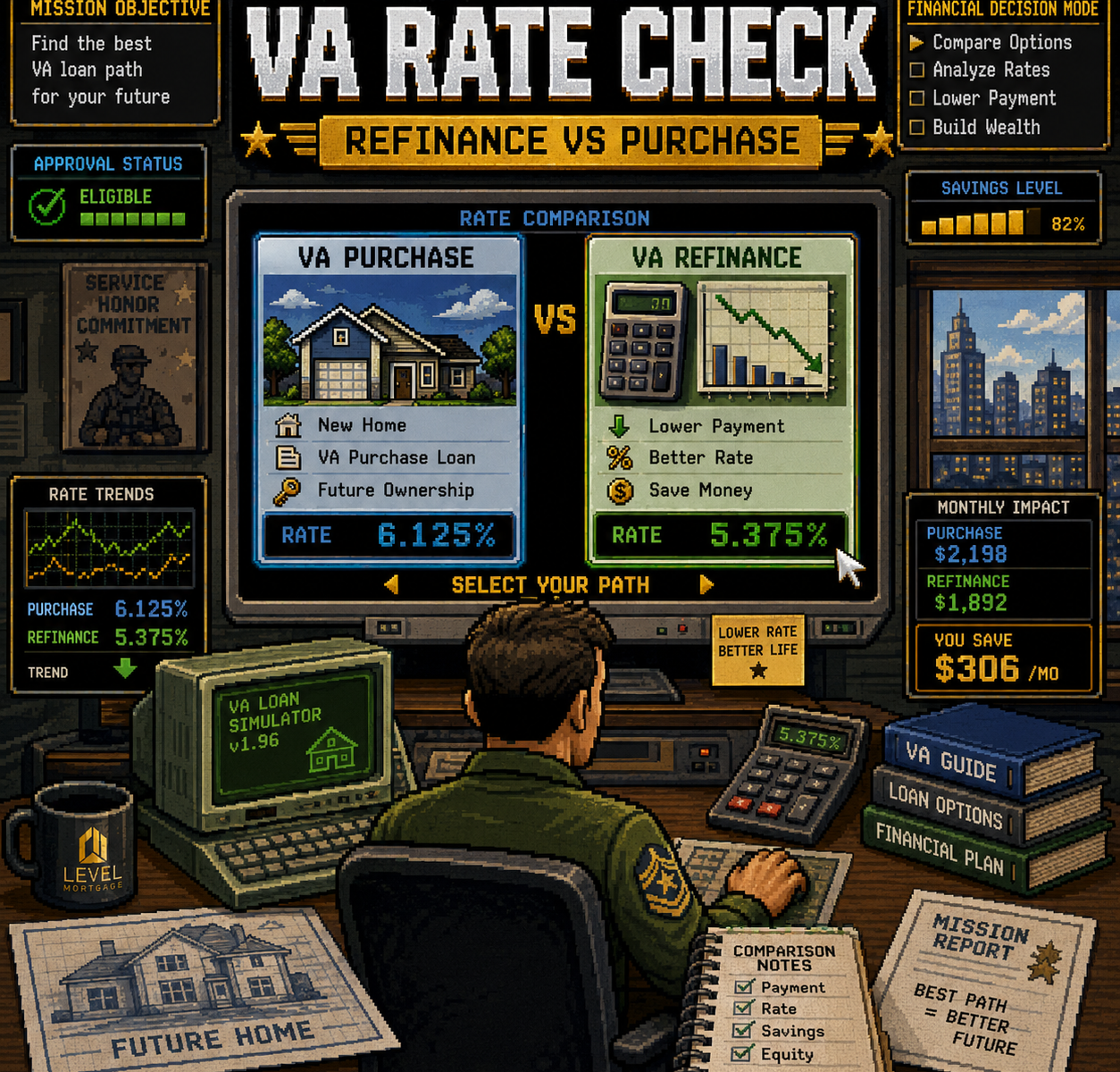
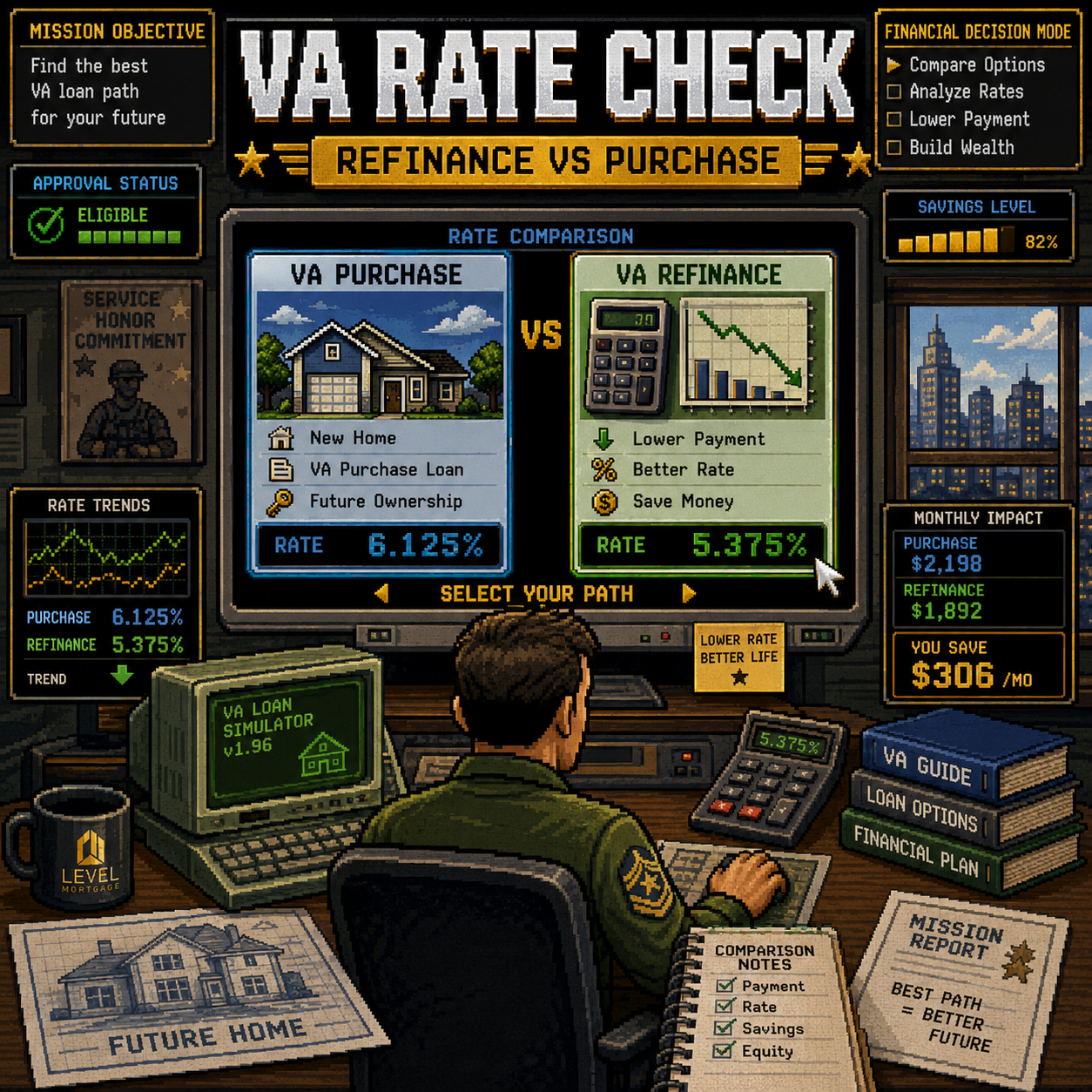
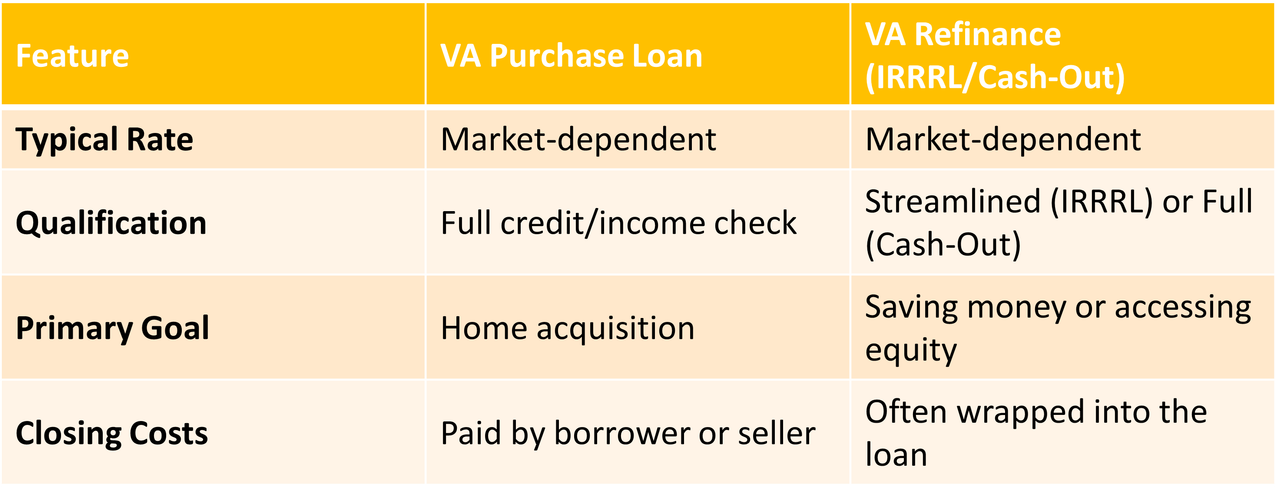
VA Purchase Loan vs VA Refinance Comparison
For those looking to buy their first home, our Home Buying Guide is a great resource to start your journey.
Common Misconceptions About VA Mortgage Rates
VA Always Offers the Lowest Rate: While VA loans are excellent, rates are still set by lenders. It pays to compare.
Refinancing Automatically Saves Money: You must account for closing costs and the length of your loan.
VA Refinance Has No Costs: While some costs can be financed, there are still administrative, appraisal, and funding fees involved.
How Level Mortgage Helps Veterans Choose the Right Strategy
At Level Mortgage, we understand that VA lending is more than just a transaction. It is a tool to secure your future. We provide personalized mortgage analysis to help you decide if a purchase loan is your best path or if your current loan can be improved via a refinance. We monitor Mortgage Rate Trends daily so that when the right opportunity arrives, you are ready to act. You can review your current standing by exploring our VA Loan Programs.
Final Thoughts
VA refinance rates and purchase rates both move with the market, and there is no guarantee that one will always be lower than the other. The right choice depends on your financial goals, your current interest rate, and the economic landscape of 2026. Whether you are using a VA Refinance or exploring a VA Cash-Out Refinance, professional guidance ensures you don’t leave money on the table.
Ready to evaluate your VA loan options?
Don’t navigate the market alone. Contact Level Mortgage today for a personalized refinance evaluation or purchase loan guidance. We are committed to providing military families with the clarity and support they deserve. Connect with us to get your Mortgage Pre-Approval started today.
Want personalized assistance? Visit our 'Contact Us' tab and leave your information with one of our experts.
About Us
A group of like-minded seasoned veterans came together to create a company with an employee-focused culture. A culture that values its members both personally and professionally and a company built on the idea that the customer comes first!
We do not share data with third parties for marketing/promotional purposes.
By submitting your phone number to Level Mortgage, you are authorizing a representative of our company to send you text messages and notifications. Message frequency may vary. Message/data rates apply. Reply STOP to unsubscribe to a message sent from us, and HELP to receive help.
Jumbo Loans Explained: When They Make Sense and How They Work
In the world of luxury real estate, standard mortgage products often fall short. When you are looking to purchase a high-value property that exceeds the standard limits set for government-backed mortgages, you enter the territory of jumbo loans. These financial tools are essential for professionals, investors, and families looking to secure financing for premium real estate.
As we navigate the 2026 market, jumbo financing has become a sophisticated instrument for those managing high-net-worth portfolios. At Level Mortgage, we specialize in helping borrowers navigate these complex loan structures to find the best possible terms for their luxury acquisitions.
What Is a Jumbo Loan?
A jumbo loan is a mortgage that exceeds the conforming loan limits established by federal housing authorities. Because these loans cannot be purchased or guaranteed by standard government-sponsored entities, they are considered “non-conforming.”
In 2026, conforming loan limits have been adjusted to reflect ongoing changes in the national housing market. When your financing needs cross these thresholds, you move into the jumbo category. These loans exist specifically to provide liquidity for the luxury market, allowing borrowers to finance expensive homes without being forced to pay exclusively in cash. Unlike conventional loans, jumbo mortgages are held by the lenders who originate them, which is why underwriting standards are often more rigorous. You can learn more about our specific Jumbo Loan Programs to see how these limits apply to your search.
How Jumbo Loans Work
Jumbo loans are structured differently than standard residential mortgages to account for the increased financial exposure to the lender.
Loan Amounts Above Conforming Limits
In 2026, the threshold for a jumbo classification begins the moment your loan amount exceeds the current national conforming limit. In high-cost areas, these limits are often scaled higher, but once you surpass them, your loan is treated as a jumbo product. Financing a high-value property requires a structural approach that accounts for the unique nature of luxury asset valuation.
Interest Rates and Risk Factors
Historically, jumbo loans often carried higher interest rates than conventional loans due to the perceived risk of larger loan amounts. However, in the current market, that gap has narrowed. Mortgage Rate Trends Report indicates that for borrowers with strong credit profiles, jumbo rates are often highly competitive. Lenders use risk-based pricing, meaning your specific financial picture plays a larger role in your final rate than it might with a government-backed loan.
Down Payment Requirements
Down payment expectations for jumbo loans in 2026 are generally more substantial than the low-down-payment options seen in conventional lending. While standards vary by borrower profile, a down payment ranging from 10% to 30% is common. Furthermore, lenders often look for “asset-based underwriting,” meaning they want to see your full financial picture, not just your salary.
Who Qualifies for a Jumbo Loan in 2026?
Lenders are more conservative when underwriting jumbo loans because the financial stakes are higher.
Credit Score Requirements
Expect higher credit score expectations. While a 620 score might suffice for some government-backed loans, jumbo lending in 2026 frequently looks for scores in the 700 to 740 range or higher to ensure the best pricing.
Income Verification
Documentation is exhaustive. Because many jumbo borrowers are self-employed or have complex compensation structures, lenders require meticulous proof of income. Expect to provide two years of tax returns, bank statements, and often a profit and loss statement if you own your business.
Debt-to-Income Ratio
Jumbo lenders generally enforce a more conservative debt-to-income (DTI) ratio. They want to ensure that your luxury purchase does not overextend your monthly budget, especially in light of the high taxes and insurance costs associated with high-value homes.
Asset Reserves
This is a critical differentiator. Jumbo lenders often require borrowers to hold significant “cash reserves” in their accounts. This represents an amount, often equal to 6 to 12 months of mortgage payments, that remains untouched in your account after the loan closes.
When Does a Jumbo Loan Make Sense?
Buying Luxury or High-Value Homes
If you are buying in a high-cost market or seeking a property with unique features that push the price point above conforming limits, a jumbo loan is often your only financing option. It allows you to enter the Luxury Home Financing space while keeping your own capital deployed elsewhere.
Avoiding Multiple Loan Structures
Some borrowers try to avoid jumbo loans by using “piggyback” loans, which involve taking out two separate mortgages to keep the first under the conforming limit. A single jumbo loan is almost always simpler, cleaner, and easier to manage long-term.
Investment Property Strategy
High-end rental properties or luxury vacation homes are often financed with jumbo products. If you are diversifying your portfolio, a jumbo mortgage can be a strategic way to leverage real estate as an asset class. Explore our Investment Property Loansfor more on this strategy.
Benefits of Jumbo Loans
Higher Borrowing Capacity: Finance homes that fall well above standard price limits.
Flexible Property Options: Use financing for non-standard, premium real estate.
Competitive Rates: For high-credit-tier borrowers, rates can be exceptionally attractive.
Simplified Financing: Manage one loan rather than complex, multiple-loan structures.
Risks and Considerations of Jumbo Loans
Stricter Qualification: The underwriting process is deep and requires significant documentation.
Larger Down Payments: Expect to tie up more cash upfront compared to conventional loans.
Sensitivity to Market Conditions: Jumbo lenders can change their appetite for risk quickly, so having your Mortgage Pre-Approval early is essential.
Total Cost of Ownership: Beyond the loan, luxury homes come with higher property taxes and insurance premiums that must be factored into your budget.
Jumbo Loan Market Trends in 2026
The demand for luxury real estate in 2026 remains resilient, driven by high-net-worth buyers who prioritize primary residence quality. According to Luxury Real Estate Data, prices in the premium segment have continued to see steady growth, outperforming lower-tier segments in many urban markets. Jumbo Loan Market Report data indicates that lenders have become more comfortable with high-balance loans as property values have remained stable, making now an opportune time for those with strong financial profiles to explore their options.
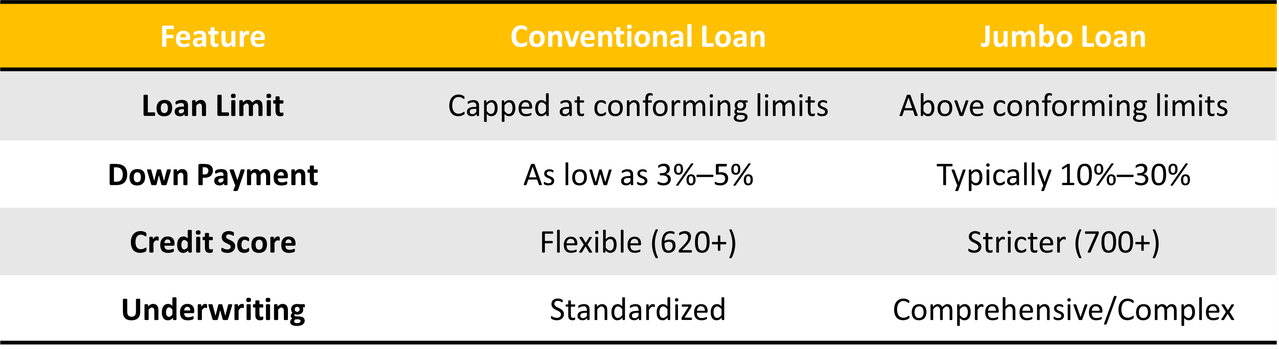
Jumbo Loan vs Conventional Loan Comparison
Common Mistakes When Applying for Jumbo Loans
Underestimating Reserve Requirements: Failing to keep enough cash liquid to satisfy lender requirements.
Overextending Budget: Not accounting for the taxes and insurance of a luxury property.
Not Comparing Lenders: Not all jumbo lenders offer the same terms or underwriting flexibility.
How Level Mortgage Helps Jumbo Borrowers
At Level Mortgage, we specialize in high-value property financing. We offer personalized jumbo loan structuring that considers your full financial picture. We don’t just process a file; we create a strategy that optimizes your rate and balances your cash flow. Whether you are an entrepreneur with complex income or a high-net-worth investor, we provide the guidance necessary to navigate the jumbo lending landscape with confidence. If you are just starting, use our Loan Calculator to get a sense of your potential payments.
Final Thoughts
Jumbo loans are sophisticated tools that enable you to leverage your wealth for high-value real estate. While the qualification process is more rigorous than standard lending, the benefits of securing premium financing for the right property are undeniable. By preparing your financial documentation and partnering with an expert, you can turn your luxury home aspirations into reality.
Want personalized assistance? Visit our 'Contact Us' tab and leave your information with one of our experts.
About Us
A group of like-minded seasoned veterans came together to create a company with an employee-focused culture. A culture that values its members both personally and professionally and a company built on the idea that the customer comes first!
We do not share data with third parties for marketing/promotional purposes.
By submitting your phone number to Level Mortgage, you are authorizing a representative of our company to send you text messages and notifications. Message frequency may vary. Message/data rates apply. Reply STOP to unsubscribe to a message sent from us, and HELP to receive help.
Pay Off Your Mortgage Early or Invest? How to Make the Right Financial Move
One of the most common debates among homeowners is whether to funnel extra funds into paying off their mortgage or to deploy that capital into the investment markets. Both paths offer distinct benefits. Paying down debt provides a sense of security and guaranteed returns in the form of interest savings. Investing, on the other hand, offers the potential for higher long-term wealth growth through the power of compounding.
At Level Mortgage, we believe there is no universal right answer. The decision depends entirely on your financial goals, your risk tolerance, your time horizon, and your current mortgage terms. This guide will help you weigh the trade-offs so you can make an informed decision for your unique situation.
The Real Question: Debt Freedom or Wealth Growth?
Choosing between debt repayment and investing is a balancing act. Paying off your mortgage faster essentially “earns” you a return equal to your mortgage interest rate. It is a guaranteed, tax-free return on your money. However, by putting all your extra cash into your home, you may be missing out on higher historical returns in the stock market or other real estate opportunities.
To decide, you must look at your financial life as a whole. Are you prioritizing immediate peace of mind, or are you focused on maximizing your net worth over the next twenty years? Your mortgage rate, your age, and your proximity to retirement are all critical data points in this calculation.
The Benefits of Paying Off Your Mortgage Early
Guaranteed Interest Savings
Every dollar you pay toward your principal reduces the balance upon which your interest is calculated. This creates a compounding effect of interest savings that can save you thousands of dollars over the remaining life of your loan. If you have a high-interest mortgage, this “return” on your money is substantial.
Financial Security and Peace of Mind
For many, the psychological weight of a mortgage is a primary source of stress. Eliminating that monthly obligation provides unparalleled peace of mind. Once your mortgage is paid off, your monthly cash flow increases significantly, providing a buffer against economic downturns or changes in employment.
Building Home Equity Faster
Paying down your principal builds your home equity at an accelerated rate. This increases your net worth and gives you more options for future borrowing, such as using Home Equity Loans to fund major life goals or renovations.
The Benefits of Investing Instead of Paying Off Your Mortgage
Potential Higher Returns
Historical market data often shows that diversified investment portfolios provide returns that exceed current mortgage interest rates. When you pay off a 6% mortgage, your return is exactly 6%. When you invest in a diversified strategy, your long-term potential may be higher, though it comes with more volatility.
The Power of Compound Growth
Investing early allows your money to work for you over decades. Even small monthly contributions can grow into significant wealth because of the time advantage. Investment Market Performance Data highlights how long-term market participation can outperform simple debt repayment, especially for younger homeowners.
Maintaining Liquidity
Money paid into a mortgage is often “trapped” in the home until you sell or refinance. Money in a brokerage account or investment fund remains liquid. In an emergency, it is much easier to access investment funds than it is to pull equity out of your home.
What 2026 Mortgage Rates Mean for This Decision
The 2026 mortgage rate environment is a major factor in your decision. According to recent financial data, mortgage rates have settled into a range that makes the choice more complex than it was during the era of sub-3% rates.
If your current mortgage rate is low, the “cost” of keeping that debt is minimal, and investing those extra funds often makes mathematical sense. If your rate is higher, the “guaranteed return” of paying down your principal becomes much more attractive. Mortgage Rate Data confirms that current rates remain elevated compared to the early 2020s, which is prompting many homeowners to prioritize debt reduction.
Mortgage Interest Rate vs Investment Return: How to Compare
When comparing your mortgage rate to potential investment returns, consider the following:
The “After-Tax” Return: Mortgage interest can sometimes be tax-deductible, which lowers the effective cost of the debt. Conversely, investment gains may be subject to capital gains taxes.
Risk and Volatility: Paying off your mortgage carries zero risk. Investing carries the risk of market loss.
Investment Timeline: The longer your timeline, the more likely you are to ride out market volatility to achieve higher average returns.
Situations Where Paying Off Your Mortgage May Make More Sense
Near Retirement: Many retirees prefer to enter their post-work years without a mortgage payment to minimize monthly expenses.
Low Risk Preference: If you lose sleep over debt, the emotional benefit of being “debt-free” is worth more than any potential market gain.
High Mortgage Interest Rate: If your rate is significantly higher than 6%, paying down the balance provides a robust and risk-free return.
Situations Where Investing May Be the Better Choice
Younger Homeowners: With a multi-decade time horizon, you have the luxury of time to recover from market cycles and benefit from compound growth.
Strong Emergency Savings: If you already have a fully funded emergency reserve, you can afford to take on the market risk associated with investing.
Access to Employer Benefits: If your employer offers a 401(k) match, that is an immediate 100% return on your money. You should always maximize this before paying extra on your mortgage.
A Balanced Strategy: Can You Do Both?
Financial planning is rarely an “either/or” situation. Many homeowners find success by adopting a balanced approach. You can allocate 50% of your extra cash to principal reduction and 50% to a diversified investment account. This allows you to build home equity while simultaneously growing your liquid wealth. This keeps your financial life diversified and flexible.
How Level Mortgage Helps You Make Smarter Mortgage Decisions
At Level Mortgage, we don’t just see a loan; we see a component of your long-term wealth strategy. We help you evaluate your current mortgage terms, run projections on potential Refinance Options, and compare how different payment strategies affect your long-term net worth.
If you are a first-time buyer exploring your options, our First-Time Home Buyer Guide offers a clear roadmap. If you are a seasoned homeowner looking to optimize your debt, we can walk you through the math and help you determine whether your mortgage strategy is aligned with your future goals.
Want personalized assistance? Visit our 'Contact Us' tab and leave your information with one of our experts.
About Us
A group of like-minded seasoned veterans came together to create a company with an employee-focused culture. A culture that values its members both personally and professionally and a company built on the idea that the customer comes first!
We do not share data with third parties for marketing/promotional purposes.
By submitting your phone number to Level Mortgage, you are authorizing a representative of our company to send you text messages and notifications. Message frequency may vary. Message/data rates apply. Reply STOP to unsubscribe to a message sent from us, and HELP to receive help.
When the Federal Reserve makes headlines, homeowners and prospective buyers often wonder how those decisions will hit their own wallets. It is common to hear that the Fed is raising or cutting rates, but the connection between those actions and your specific mortgage payment is more nuanced than many realize. Understanding this relationship is a critical step in managing your financial future.
At Level Mortgage, we aim to demystify these economic shifts. While the Federal Reserve plays a massive role in our financial ecosystem, it does not hold the remote control for your mortgage rate. Here is a breakdown of how economic policy moves through the markets and eventually lands on your front door.
What Does the Federal Reserve Have to Do With Mortgage Rates?
The Federal Reserve, or the Fed, is the central bank of the United States. Its dual mandate is to promote maximum employment and stable prices. To achieve this, it manages the money supply and adjusts the Federal Funds Rate, which is the interest rate banks charge each other for overnight loans.
It is important to clarify a major misconception: the Fed does not directly set mortgage rates. Instead, the Fed influences short-term interest rates. Mortgage rates, however, are long-term rates. They are primarily driven by the bond market, specifically the yield on 10-year Treasury notes and mortgage-backed securities. While the Fed acts as a massive signal to the broader economy, mortgage lenders price their loans based on what investors are willing to accept for long-term investments.
How Fed Decisions Influence the Housing Market
Even without direct control, the Fed’s decisions create ripples that shift the entire housing landscape.
Interest Rate Changes
When the Fed increases the Federal Funds Rate, it is usually to combat inflation by cooling down the economy. This makes borrowing more expensive across the board, which can lead to higher mortgage rates. Conversely, when the economy needs a boost, the Fed may cut rates to lower borrowing costs. These shifts dictate the monthly payment a buyer faces for the same home, directly impacting buyer affordability and housing demand. You can monitor your potential payments using our Mortgage Calculator.
Inflation and Mortgage Rates
Inflation is the greatest enemy of fixed-rate investments. When inflation is high, the future value of a mortgage payment is eroded. Lenders demand higher yields to compensate for this risk. When the Fed signals that it is fighting inflation, it often calms investor fears, which can lead to a stabilization or decrease in mortgage rates over time. According to recent economic data, the market is constantly balancing the current inflation rate against the Fed’s future policy goals.
What Happened With Mortgage Rates Leading Into 2026?
As we entered 2026, the mortgage market remained in a state of cautious adjustment. The Fed navigated a path that sought to balance continued economic growth with the goal of keeping inflation near its target levels. Mortgage rates in 2026 have generally trended within a more predictable range compared to the sharp spikes of previous years, but they remain sensitive to every new economic report. Mortgage Rate Trends Report highlights that while volatility has decreased, the market remains highly reactive to employment and consumer spending data.
Why Mortgage Rates Can Change Even Without a Fed Decision
Because mortgage rates are tied to the bond market, they can move daily, even when the Fed is not meeting.
Bond Market Influence
Mortgage rates move in correlation with the yield on long-term government bonds. When investors are confident in the economy, they may pull money out of bonds, causing yields to rise. This forces lenders to increase mortgage rates to attract those same investors back to mortgage-backed securities.
Economic Data Reports
Investors are obsessive about data. Employment reports, GDP growth numbers, and consumer spending figures are scrutinized every month. If an employment report suggests the economy is overheating, mortgage rates often climb. If a report indicates slowing growth, rates might drop. This is why you might see a mortgage rate shift on a Tuesday morning based on a report that has nothing to do with the Federal Reserve. You can find up-to-date info on our Current Mortgage Rates page.
How Fed Policy Impacts Homebuyers in 2026
The practical effect of these policy decisions is felt in the purchasing power of every buyer. For example, a difference of just 0.5% in a mortgage rate can change a buyer’s monthly payment by hundreds of dollars. In 2026, where home prices remain elevated, this shift is the difference between being able to afford a home and being sidelined by the market. Borrowers seeking to enter the market should prioritize Mortgage Pre-Approval to understand their specific budget in the current rate environment.
Should Buyers Wait for Lower Mortgage Rates?
Waiting for the perfect rate is a common strategy, but it carries inherent risks.
Benefits of waiting: If rates drop, your monthly payment decreases, and your long-term cost of borrowing drops.
Risks of waiting: If you wait for lower rates, you may be competing against a surge of other buyers who were also waiting. This can drive home prices higher, potentially wiping out any savings you gained from a lower interest rate. Housing Market Forecast suggests that inventory remains tight, meaning that price appreciation may continue to outpace rate drops in many high-demand regions.
Deciding whether to buy is a personal financial decision. It is rarely just about the rate, but rather about your long-term goals and your ability to sustain the payment in the current market.
How Investors Monitor Federal Reserve Decisions
Investors treat the Fed as the ultimate macro-indicator. Whether you are looking at multifamily assets or single-family rental properties, your financing costs are the primary factor in your cap rate. Investors analyze interest rate cycles to determine when to lock in long-term debt versus when to use short-term financing strategies. Keeping an eye on Economic Outlook Report helps investors understand whether to hold assets or expand their portfolio based on projected financing costs.
How Level Mortgage Helps You Navigate Changing Rates
At Level Mortgage, we don’t just look at today’s rate. We help you plan for a long-term strategy. Whether you are exploring First-Time Home Buyer Guide or comparing various Loan Programs, our advisors monitor market trends to help you time your rate lock. We provide personalized guidance that balances the realities of the Fed’s policy with your personal financial timeline. We believe in transparency, education, and helping you find the right home financing solution for your specific life stage.
Final Thoughts
The Federal Reserve is a significant force in our economy, but it is only one piece of a complex puzzle. While Fed policy creates the environment in which we operate, the actual cost of your home loan is influenced by global investors, economic data, and the state of the housing market. By focusing on your own financial goals and working with an advisor who keeps a pulse on these changes, you can move forward with confidence.
Ready to plan your mortgage strategy?
The market is always moving, but you don’t have to navigate it alone. Connect with Level Mortgage today for personalized rate guidance and a review of the best loan options for your unique goals. Whether you are ready to buy or considering your Refinance Options, we are here to help you understand your choices and move forward on your terms.
Want personalized assistance? Visit our 'Contact Us' tab and leave your information with one of our experts.
About Us
A group of like-minded seasoned veterans came together to create a company with an employee-focused culture. A culture that values its members both personally and professionally and a company built on the idea that the customer comes first!
We do not share data with third parties for marketing/promotional purposes.
By submitting your phone number to Level Mortgage, you are authorizing a representative of our company to send you text messages and notifications. Message frequency may vary. Message/data rates apply. Reply STOP to unsubscribe to a message sent from us, and HELP to receive help.
Adjustable-Rate Loans Explained: How They Work & When to Get One
Navigating the mortgage landscape in 2026 requires more than just checking the daily interest rates. It involves understanding the tools available to maximize your purchasing power and align your financing with your lifestyle goals. One of the most misunderstood yet potentially powerful tools in a borrower’s arsenal is the Adjustable-Rate Mortgage (ARM). While fixed-rate loans are the industry standard, ARMs offer unique features that may serve specific financial strategies. This guide will help you understand how these loans function and how to determine if one is right for your unique situation.
What Is an Adjustable-Rate Mortgage (ARM)?
An Adjustable-Rate Mortgage is a home loan with an interest rate that can fluctuate over the life of the loan. Unlike a fixed-rate mortgage, where your interest rate and principal and interest payments remain constant for the entire term, an ARM features an initial period of stability followed by a period where the rate adjusts based on market conditions.
Lenders offer ARMs because they provide flexibility for borrowers who do not plan to stay in their homes for 30 years. The rate on an ARM is typically tied to an index, which is a benchmark interest rate that reflects general market conditions. When you add a margin, which is a set percentage determined by the lender, you arrive at the fully indexed rate that determines your payment during the adjustment period.
How Adjustable-Rate Mortgages Work
Understanding an ARM requires looking beyond the initial rate. These loans are built on a specific structure that dictates when and how your payment changes.
The Initial Fixed-Rate Period
Every ARM has an initial period where the interest rate is fixed. This is often represented by two numbers, such as a 5/1 ARM or a 7/1 ARM. The first number represents the years the rate remains fixed. The second number indicates how often the rate can adjust after that period ends. For example, in a 5/1 ARM, your rate is locked for five years. After that, the rate can adjust once every year.
The Adjustment Period
Once the initial fixed period expires, the loan enters the adjustment period. During this time, the lender recalculates your interest rate based on current market indexes. If market rates have risen, your payment may increase. Conversely, if rates have fallen, your payment could decrease. This period continues for the remainder of the loan term, which is typically 30 years.
Rate Caps and Borrower Protections
To protect borrowers from wild fluctuations, ARMs include rate caps.
Initial Adjustment Cap: Limits how much the rate can increase the first time it adjusts.
Periodic Cap: Limits how much the rate can increase from one adjustment period to the next.
Lifetime Cap: Sets a maximum limit on how high the interest rate can rise over the entire life of the loan.
These caps are vital safeguards that prevent your monthly payment from becoming unexpectedly unmanageable.
Why Some Buyers Choose ARMs in 2026
In 2026, the housing market presents unique challenges regarding affordability. Mortgage Rate Trends Report indicates that while rates have stabilized, they remain at a level that pressures the monthly budgets of many homebuyers. Consequently, borrowers are looking for financing options that provide a lower entry point.
Many buyers are exploring ARMs because the initial interest rate is often lower than the rate offered on a traditional fixed-rate loan. This can result in lower monthly payments, which helps borrowers qualify for a higher loan amount. As noted in Housing Affordability Report, strategic financing is becoming a key component for homebuyers looking to enter competitive markets without overextending their monthly cash flow.
Potential Benefits of an Adjustable-Rate Mortgage
Lower Initial Interest Rates
The primary draw of an ARM is the initial lower interest rate. For buyers who plan to move within a few years, this can lead to substantial savings.
Lower Monthly Payments
Lower rates translate directly to lower monthly obligations. This extra breathing room in your budget can be used to pay down other high-interest debt or save for future home maintenance.
Increased Buying Power
Because your initial monthly payment is lower, your debt-to-income ratio may look more favorable to a lender. This can allow you to purchase a home that might have been out of reach under a fixed-rate loan.
Savings for Short-Term Homeowners
If you know you will be in the home for less than the duration of the fixed period, an ARM can be a mathematically superior choice. You capture the lower rate during your entire ownership period and sell or refinance before the first adjustment ever occurs.
Risks Homebuyers Should Understand
While ARMs offer advantages, they carry inherent risks that should not be overlooked.
Future Payment Increases
The most significant risk is the uncertainty of future payments. If market rates rise significantly by the time your adjustment period begins, your monthly housing expense could climb.
Interest Rate Volatility
Market conditions can change rapidly. ARM Market Statistics shows that while ARMs are a stable tool, they are still subject to broader economic shifts that can impact interest rates unexpectedly.
Budgeting Challenges
For homeowners who prefer predictable finances, the variable nature of an ARM can cause stress. It requires a more disciplined approach to financial planning compared to a fixed-rate loan.
When an ARM May Make Sense
An ARM is often a strategic choice rather than a risky gamble. It may make sense if:
You plan to relocate: If you are in a career that requires frequent moves, a 5/1 or 7/1 ARM allows you to take advantage of lower rates for the short time you plan to own the home.
You expect income growth: If you are an early-career professional expecting your salary to increase significantly over the next few years, an ARM can help you manage your budget now, with the peace of mind that you will be able to handle potential payment increases later.
You plan to refinance: If you intend to refinance into a fixed-rate mortgage within a few years, an ARM can bridge the gap.
For those who need long-term stability, a Fixed-Rate Mortgage Guide is generally the safer recommendation. Retirees or those on fixed incomes should carefully consider the risks of payment fluctuations before choosing an ARM.
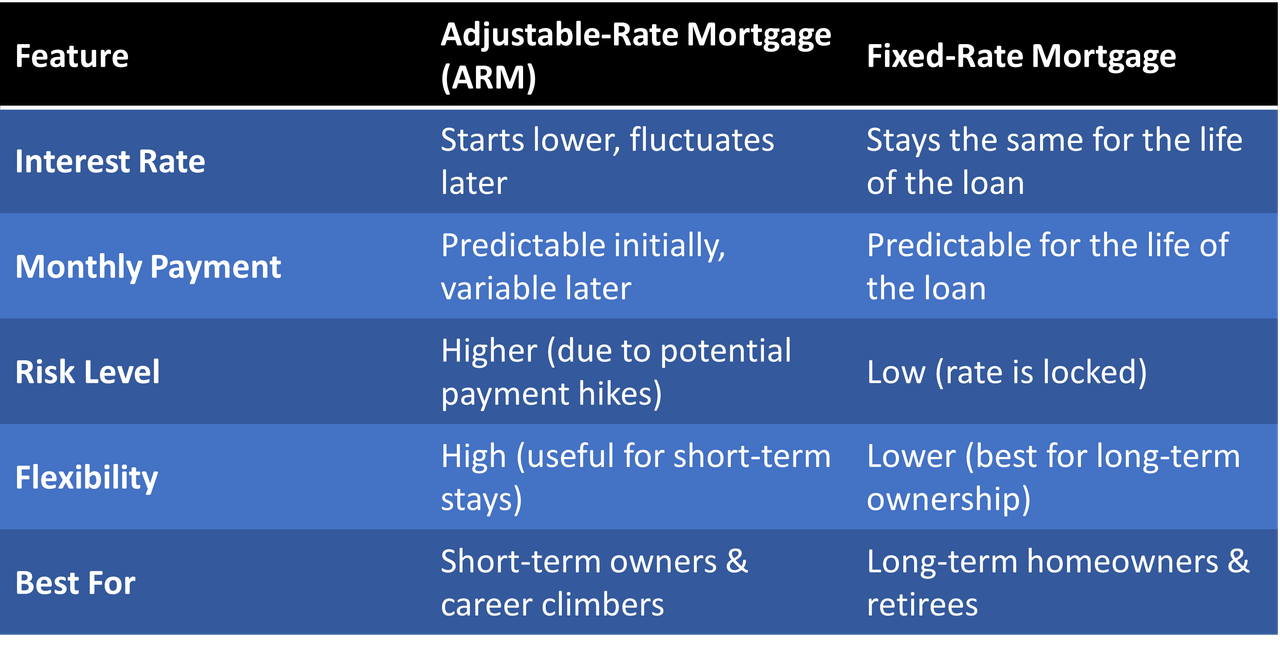
ARM vs Fixed Mortgage: A Side-by-Side Comparison
How Level Mortgage Helps Borrowers Choose the Right Loan
At Level Mortgage, we do not believe in one-size-fits-all financing. We act as your mortgage planners, not just loan processors. We perform comprehensive loan comparison analysis to show you exactly how different products will affect your monthly budget and long-term wealth.
Whether you are applying for Mortgage Pre-Approval or just beginning to navigate the Home Buying Process, our goal is to provide clarity. We want you to feel confident that your mortgage is a strategic asset, not a burden. From evaluating Loan Programs to guiding you through our First-Time Homebuyer Guide, we are here to ensure you understand every aspect of your financial commitment.
Final Thoughts
Adjustable-rate mortgages are sophisticated financial instruments that, when used strategically, can provide significant advantages in affordability and purchasing power. However, they are not suitable for every borrower. The decision to choose an ARM should be based on your unique timeline, your financial flexibility, and your tolerance for market changes. As we look at the Mortgage Industry Forecast for the remainder of 2026, it is clear that borrowers who take the time to evaluate their options will be in the best position to succeed. Connect with Level Mortgage today to begin your loan comparison and find the financing strategy that aligns with your future.
Want personalized assistance? Visit our 'Contact Us' tab and leave your information with one of our experts.
About Us
A group of like-minded seasoned veterans came together to create a company with an employee-focused culture. A culture that values its members both personally and professionally and a company built on the idea that the customer comes first!
We do not share data with third parties for marketing/promotional purposes.
By submitting your phone number to Level Mortgage, you are authorizing a representative of our company to send you text messages and notifications. Message frequency may vary. Message/data rates apply. Reply STOP to unsubscribe to a message sent from us, and HELP to receive help.
What You Need to Know Before Refinancing Your Mortgage
Refinancing your home is one of the most significant financial maneuvers you can perform. As the mortgage landscape shifts in 2026, many homeowners are reevaluating their long-term strategies. Whether you are looking to lower your monthly payments, consolidate high-interest debt, or access your home equity, the decision requires more than just a quick look at interest rates. It demands a comprehensive view of your financial health and long-term goals.
At Level Mortgage, we believe that an informed decision is the only way to proceed. This guide will help you understand the mechanics, costs, and considerations involved in the refinancing process in today’s market.
What Is Mortgage Refinancing?
At its core, refinancing is the process of replacing your existing mortgage with a new loan. When you refinance, you are essentially paying off your current loan and establishing a new one, typically with different terms, interest rates, or loan structures.
In 2026, the process remains relatively straightforward, but the strategic implications are heightened by current economic conditions. Most homeowners refinance to achieve specific financial objectives, such as reducing monthly overhead, shortening their payoff timeline, or extracting cash for other investments. Understanding these mechanics is the first step toward determining if the timing is right for your unique situation. You can learn more about our Mortgage Refinance Programs to see which options align with your goals.
Why Homeowners Refinance
This is the most common motivation. By securing a lower interest rate, you can reduce the amount of interest paid over the life of your loan, which lowers your monthly commitment.In the current 2026 interest rate environment, even a modest reduction in your rate can lead to significant savings over the long term.
Lower Monthly Payments
This is the most common motivation. By securing a lower interest rate, you can reduce the amount of interest paid over the life of your loan, which lowers your monthly commitment.In the current 2026 interest rate environment, even a modest reduction in your rate can lead to significant savings over the long term.
Access Home Equity
If your home has appreciated in value, you may have substantial “tappable” equity. A cash-out refinance allows you to replace your current loan with a larger one and receive the difference in cash. This is frequently used to fund home improvements, pay off high-interest consumer debt, or invest in other assets.Suggests that homeowners currently hold near-record levels of equity, making this a popular route for those looking to leverage their property.
Shorten the Loan Term
Some homeowners choose to refinance from a 30-year mortgage to a 15-year or 20-year term. While this may increase your monthly payment, it significantly reduces the total interest paid over the life of the loan and helps you build equity at an accelerated pace.
Switch Loan Types
You might decide to move from an adjustable-rate mortgage (ARM) to a fixed-rate loan to gain payment stability. Alternatively, some homeowners with FHA or VA loans may seek to refinance into a conventional loan to remove mortgage insurance premiums. If you are exploring this, reviewing [Loan Programs] is a great starting point.
Current Refinance Market Conditions in 2026
The mortgage market in 2026 is defined by a stabilization of rates following the volatility of previous years. Mortgage Rate Trends Report indicates that rates have settled into a more predictable range, though they remain higher than the historic lows seen during the pandemic.
Recent lending statistics indicate that refinance activity is rising as homeowners adjust to this new reality.With many U.S. homeowners sitting on substantial home equity, the ability to tap into those funds has become a major driver of market volume.However, because most homeowners currently have interest rates well below today’s market levels, the “lock-in effect” remains a significant factor in decision-making. You must carefully weigh the cost of moving to a higher rate against the benefits of your specific refinance goals.
How Much Does It Cost to Refinance?
Refinancing is not free. It involves closing costs similar to those you paid when you first purchased your home.
Typical Closing Costs
In 2026, closing costs for a refinance typically range between 2% and 6% of the new loan amount. These fees cover a variety of services, including:
Origination fees: Charged by the lender for processing the new loan.
Appraisal costs: To verify the current market value of your property.
Title fees: To ensure the property title is clean and protected.
Recording fees: Government charges for filing the new mortgage documents.
Calculating Your Break-Even Point
To determine if a refinance is worthwhile, you must calculate your break-even point. This is the amount of time it takes for your monthly savings to cover the total closing costs of the loan.
Example: If your refinance costs $5,000 and saves you $200 per month, your break-even point is 25 months. If you plan to move before that time, the refinance may not be mathematically advantageous. A [INTERNAL LINK: Mortgage Calculator] can help you visualize these numbers.
Qualification Requirements for Refinancing
Lenders look for specific markers of financial stability when evaluating a refinance application.
Credit Score: While standards vary, a higher credit score generally unlocks the best interest rates. Consumer Lending Statisticssuggest that maintaining a score above 700 is typically necessary to access the most competitive pricing.
Debt-to-Income Ratio: Lenders want to see that your total monthly debt payments, including the new mortgage, do not exceed a certain percentage of your gross monthly income.
Home Equity Position: Most lenders require a minimum amount of equity, often represented by a maximum loan-to-value (LTV) ratio.
Income Verification: Expect to provide recent pay stubs, W-2s, or tax returns to prove your ability to repay the loan.
When Refinancing Might Not Make Sense
Refinancing is not a universal solution. It may not be the right choice if:
You plan to move soon: If you sell your home before reaching the break-even point, you will likely lose money on the transaction.
The interest rate spread is too small: If the difference between your current rate and the new rate is negligible, the closing costs may outweigh the savings.
You are resetting your loan term: If you are 20 years into a 30-year mortgage and refinance into a new 30-year loan, you may end up paying significantly more in interest over time, even with a lower payment.
How Level Mortgage Helps Homeowners Make Smarter Refinance Decisions
Refinancing is not a one-size-fits-all product. At Level Mortgage, we act as your strategic partner. We offer personalized mortgage reviews to analyze your current debt structure, your long-term housing plans, and your financial goals. We perform cost-benefit evaluations to ensure that any move you make actually puts you in a stronger position.
Whether you are debating between FHA Loans, VA Loans, or conventional options, we provide the clarity you need to navigate the 2026 market with confidence. We focus on education first, ensuring you understand exactly how your loan strategy impacts your household budget.
Final Thoughts
Refinancing can be an incredibly powerful tool for managing your finances, but it requires careful planning. It is about more than just finding a lower rate; it is about ensuring the structure of your debt aligns with your life goals. As you navigate the 2026 market, remember that professional guidance is an asset. By taking the time to evaluate costs, timing, and long-term impact, you can secure a mortgage strategy that supports your financial well-being for years to come.
Ready to see if refinancing makes sense for your goals?
The best decisions are made with data and expert guidance. Connect with Level Mortgage today for a personalized refinance analysis. We will compare your current mortgage against today’s options and help you determine if a refinance is the strategic move you need.
Want personalized assistance? Visit our 'Contact Us' tab and leave your information with one of our experts.
About Us
A group of like-minded seasoned veterans came together to create a company with an employee-focused culture. A culture that values its members both personally and professionally and a company built on the idea that the customer comes first!
We do not share data with third parties for marketing/promotional purposes.
By submitting your phone number to Level Mortgage, you are authorizing a representative of our company to send you text messages and notifications. Message frequency may vary. Message/data rates apply. Reply STOP to unsubscribe to a message sent from us, and HELP to receive help.
VA Loan Offers: What Home Sellers Really Need to Know
When you list your home for sale, receiving multiple offers is an exciting milestone. Among those purchase contracts, you might find an offer from a buyer utilizing a VA loan. For decades, a cloud of misunderstanding has surrounded this specific financing type, causing some sellers to hesitate.
As a home seller, understanding the true mechanics of VA financing can prevent you from passing up an excellent, secure transaction. Buyers who earn these benefits through military service are often some of the most reliable borrowers in the market. Let’s explore what a VA loan offer actually means for your bottom line.
Why Some Sellers Hesitate When They See a VA Loan Offer
It is common for sellers, and even some real estate agents, to harbor reservations when a VA offer lands on the table. The most frequent misconceptions include the belief that VA loans are much harder to close, that the appraisal process will inevitably compromise the deal, or that VA buyers are less financially secure because they might not make a down payment. Additionally, many people worry that the timeline will drag out indefinitely.
In 2026, these beliefs are remarkably outdated. Modern digital underwriting and updated government guidelines have streamlined the timeline significantly. According to recent mortgage industry data, the closing times for VA loans are neck-and-neck with conventional loans. Furthermore, recent lending data indicates that VA loans actually have a higher overall closing success rate than conventional alternatives, making them an incredibly stable choice for sellers looking for a smooth path to the closing table.
What Makes a VA Loan Different?
To evaluate these offers fairly, it helps to look at how the VA Loan Program operates under the hood.
Backed by the U.S. Department of Veterans Affairs
The defining feature of a VA loan is the government guarantee. The U.S. Department of Veterans Affairs insures a significant portion of the loan amount against default. This structural support drastically reduces the risk for private lenders, allowing them to offer flexible terms to eligible active-duty military members, veterans, and surviving spouses.
Low Down Payment Requirements
One of the most significant perks for military buyers is the ability to secure up to 100% financing. While a conventional seller might view a zero-down offer as a red flag, it is simply a structural advantage given to those who served. A zero-down payment does not reflect a lack of cash reserves or weak purchasing power, it simply means the buyer is leveraging a well-deserved benefit.
Competitive Interest Rates
Because of the federal backing, lenders can offer highly competitive interest rates. Even in the current 2026 lending conditions, where the average mortgage rate environment has settled into a more balanced range, VA loans consistently feature lower interest rates than conventional products. This lower monthly obligation makes the housing payment far more manageable for your buyer, reducing the likelihood of financial stress during escrow.
Are VA Buyers Less Qualified Than Conventional Buyers?
A common myth is that VA buyers are weaker financially. In reality, VA borrowers undergo rigorous qualification standards that often surpass standard conventional guidelines.
Beyond checking credit scores and verifying steady employment income, VA underwriting enforces strict residual income standards. This unique metric calculates how much discretionary cash a family has left over each month after paying all major living expenses and housing costs. Based on trusted housing reports, this safeguard is a major reason why VA loans boast some of the lowest delinquency rates in the entire housing sector.
When you accept a VA offer, you are working with a borrower who has cleared strict federal and institutional hurdles before their Mortgage Pre-Approval ever reaches your hands.
Understanding the VA Appraisal Process
The appraisal process is often the biggest source of anxiety for sellers, but a little clarity can ease those concerns.
What the VA Appraisal Actually Does
Like any appraisal, a VA appraisal determines the fair market value of your property to ensure it matches the agreed-upon purchase price. However, the appraiser also checks the home against a set of Minimum Property Requirements, or MPRs.
Common Property Issues That Can Affect Approval
The MPRs are designed to protect the safety, structural integrity, and sanitation of the property. Common issues that can pop up include:
Major structural deficiencies or foundational issues
Roof concerns, such as a roof nearing the end of its functional life
Exposed or outdated electrical issues
Severe safety hazards, including missing handrails or peeling lead-based paint
Industry research shows that the vast majority of homes pass a VA appraisal without any major issues. If a minor safety item is discovered, it can usually be repaired prior to closing, keeping the transaction perfectly on track.
Benefits of Accepting a VA Loan Offer
When evaluating multiple contracts, keeping an open mind toward VA financing can work to your advantage. Consider these distinct benefits:
Highly Motivated Buyers
Military families often relocate on strict timelines due to Permanent Change of Station orders or transition goals. This makes them highly motivated to cooperate, move quickly, and reach the closing table without unnecessary delays.
Strong Qualification Standards
As noted, strict residual income checks and mandatory document verifications mean these buyers are thoroughly vetted by professionals well before making an offer.
Competitive Purchase Offers
Because VA buyers save money on down payments and monthly mortgage insurance, they often have additional financial flexibility to submit highly competitive purchase offers on homes they love.
What Sellers Should Consider Before Rejecting a VA Offer
In the 2026 real estate landscape, market conditions demand a flexible approach. Inventory levels and buyer demand shift constantly, meaning that judging an offer solely by the loan type can be a costly mistake.
If a VA buyer offers a competitive purchase price, favorable contract terms, and a solid timeline, rejecting them out of hand based on outdated myths could mean leaving money on the table. A well-constructed VA offer can easily compete with, and sometimes outperform, a conventional offer that contains complex contingencies. Look closely at the overall terms of the offer, rather than just the acronym at the top of the page. You can review alternative options in our Loan Programs overview.
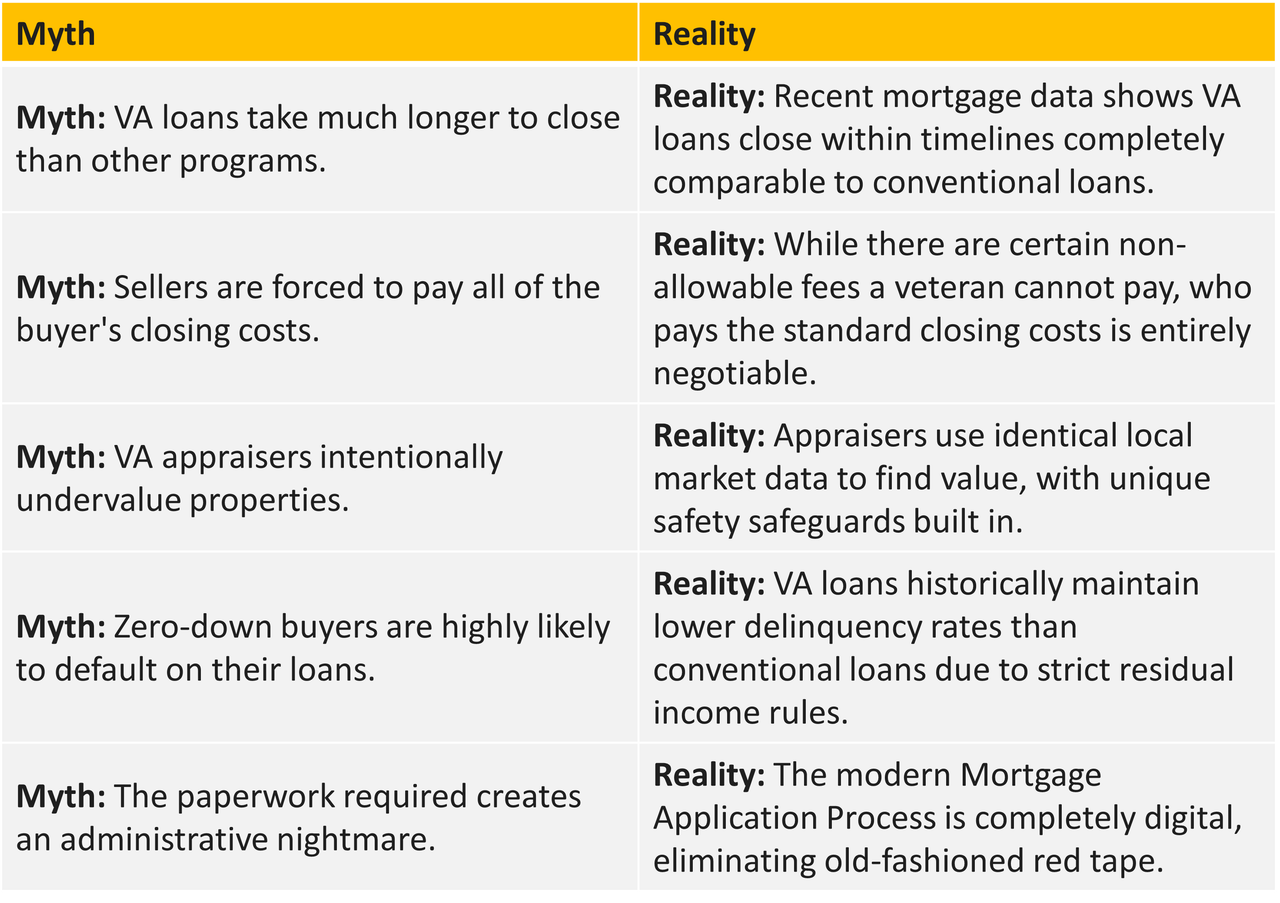
VA Loan Myths vs. Reality
How Level Mortgage Helps Buyers and Sellers Navigate VA Transactions
At Level Mortgage, we believe a seamless real estate transaction relies heavily on education, direct communication, and teamwork. We specialize in demystifying the financing process for everyone involved in the sale.
By offering fast pre-approvals and maintaining open lines of communication with listing agents, we ensure sellers feel completely confident when accepting a VA offer. Our experienced strategists coordinate closely with buyers, sellers, and real estate professionals to ensure every property requirement and underwriting milestone is met with speed and accuracy.
Want personalized assistance? Visit our 'Contact Us' tab and leave your information with one of our experts.
About Us
A group of like-minded seasoned veterans came together to create a company with an employee-focused culture. A culture that values its members both personally and professionally and a company built on the idea that the customer comes first!
We do not share data with third parties for marketing/promotional purposes.
By submitting your phone number to Level Mortgage, you are authorizing a representative of our company to send you text messages and notifications. Message frequency may vary. Message/data rates apply. Reply STOP to unsubscribe to a message sent from us, and HELP to receive help.
Multifamily Property Investing: Benefits, Risks, and Financing Explained
Investing in real estate has always been a cornerstone of wealth building, but as we move through 2026, the landscape has shifted. While single-family homes were once the default entry point for many, multifamily property investing has taken center stage. This asset class offers a unique blend of stability and scalability that is hard to match in today’s economy. Whether you are looking at a small duplex or a large apartment complex, understanding the mechanics of multifamily deals is essential for any serious investor.
What Is Multifamily Property Investing?
At its core, multifamily property investing involves purchasing a single building or a collection of buildings that contain more than one housing unit. These properties are designed to house multiple separate tenants, each with their own kitchen and living space.
Investors generally categorize these properties into two distinct groups:
Residential Multifamily (2 to 4 Units)
This category includes duplexes, triplexes, and fourplexes. These are unique because they are still governed by residential lending rules. This means you can often secure financing with lower down payments and more flexible terms, especially if you plan to live in one of the units.
Commercial Multifamily (5+ Units)
Once a property reaches five units or more, it is considered commercial real estate. This includes everything from small five-unit walk-ups to massive high-rise apartment buildings. Financing for these properties is based more on the income the building generates rather than the personal income of the borrower.
Why Multifamily Investing Is Growing in 2026
The investment climate in 2026 is defined by a significant supply-demand imbalance. While the volatile interest rate environment of previous years has stabilized, the cost of homeownership remains high for many individuals. According to recent market reports, the demand for rental housing is at a ten-year high because many aspiring homeowners are staying in the rental market longer.
Industry data shows that multifamily occupancy rates are hovering around 95 percent in major metropolitan areas. Additionally, rent growth trends remain steady, with an average annual increase of 3 to 5 percent in high-growth corridors. With interest rates currently sitting in the 6 percent range, investors are finding that the spread between borrowing costs and rental yields is becoming increasingly attractive. This environment has led to a notable increase in investor activity, particularly among those looking for a hedge against inflation.
Key Benefits of Multifamily Property Investing
The reason so many investors are pivoting to multifamily units is simple. The math often works better than single-family rentals.
Stronger Cash Flow Potential
With multiple tenants under one roof, you have multiple streams of income. If one tenant moves out of a single-family home, your vacancy rate is 100 percent. In a fourplex, a single vacancy only reduces your income by 25 percent. This significantly reduces the risk of being unable to cover your mortgage during a transition period.
Easier Scalability
Buying ten single-family homes requires ten separate closings, ten inspections, and ten different insurance policies. Buying one ten-unit building is a much more efficient way to scale. You can grow your portfolio significantly faster by focusing on larger assets.
Long-Term Appreciation
Multifamily properties appreciate in two ways. First, there is the natural market appreciation of the land and structure. Second, there is “forced appreciation.” Since commercial multifamily value is tied to net operating income, any improvement you make that increases rent or decreases expenses directly increases the property’s market value.
Tax Advantages
Real estate remains one of the most tax-advantaged investments available. Investors can utilize depreciation to offset their rental income. Furthermore, interest deductions and expense write-offs for repairs and management can often lead to a scenario where you are cash-flow positive but show a loss for tax purposes.
Risks Investors Should Understand
No investment is without risk, and multifamily properties come with their own set of challenges that require careful management.
Higher Maintenance Costs
More units mean more toilets, more appliances, and more HVAC systems that can fail. Maintenance on a large building is often more complex and expensive than on a single-family home. It is vital to budget for a healthy capital expenditure reserve from day one.
Tenant and Vacancy Risk
Managing multiple personalities can be difficult. High turnover rates can lead to increased costs for cleaning, painting, and marketing. Investors in 2026 must be diligent in their tenant screening processes to ensure long-term stability.
Financing Complexity
While residential multifamily is straightforward, commercial financing involves more moving parts. Lenders will scrutinize the building’s profit and loss statements, environmental reports, and the local sub-market’s economic health.
Market and Interest Rate Risk
The 2026 lending environment is more stable than in years past, but investors are still sensitive to rate fluctuations. A shift in interest rates can impact your cap rate and your eventual exit strategy.
Financing Options for Multifamily Properties in 2026
Choosing the right loan is just as important as choosing the right property. At Level Mortgage, we see a wide variety of structures that help investors meet their goals.
Conventional Loans
Ideal for 2 to 4 unit properties, these loans offer some of the lowest interest rates and are backed by Fannie Mae or Freddie Mac. They typically require a 20 to 25 percent down payment for investment properties.
FHA Loans for Owner-Occupied Multifamily
This is a favorite for “house hackers.” You can buy a property with up to 4 units, live in one, and rent out the others while putting down as little as 3.5 percent. This is one of the most powerful ways to start a real estate empire with limited capital.
DSCR Loans
Debt-Service Coverage Ratio loans are the breakout star of 2026. These loans do not require tax returns or debt-to-income checks for the borrower. Instead, the lender looks at whether the property’s rental income covers the mortgage payment. It is a streamlined way for seasoned investors to close deals quickly.
Commercial Multifamily Loans
For properties with 5 or more units, commercial loans are the standard. These can be structured as bridge loans for value-add projects or long-term permanent financing for stabilized assets.
What Lenders Look for in 2026
Lending standards in 2026 remain disciplined. To secure the best terms, you generally need a credit score of 700 or higher, though some programs exist for scores in the 660 range. Lenders also want to see that you have cash reserves, often six to twelve months of mortgage payments, to handle any unexpected vacancies or repairs. For DSCR loans, the property typically needs to generate 20 percent more income than the total debt service.
Is Multifamily Investing Right for You?
If you are looking for long-term wealth building and a steady stream of income, the answer is likely yes. However, you must decide if you want to be an active investor, managing the property yourself, or a passive investor who hires professional management. Multifamily investing is a business, and it requires a strategic mindset to succeed in the 2026 market.
How Level Mortgage Helps Multifamily Investors
Navigating the complexities of multifamily financing requires more than just a lender. You need a strategic advisor. At Level Mortgage, we act as your partner in every deal. We don’t just look for a loan, we look for the financing structure that optimizes your cash flow and helps you scale your portfolio. From analyzing your first duplex to restructuring a large apartment portfolio, our team provides the guidance and problem-solving expertise needed to thrive in today’s market.
Want personalized assistance? Visit our 'Contact Us' tab and leave your information with one of our experts.
About Us
A group of like-minded seasoned veterans came together to create a company with an employee-focused culture. A culture that values its members both personally and professionally and a company built on the idea that the customer comes first!
We do not share data with third parties for marketing/promotional purposes.
By submitting your phone number to Level Mortgage, you are authorizing a representative of our company to send you text messages and notifications. Message frequency may vary. Message/data rates apply. Reply STOP to unsubscribe to a message sent from us, and HELP to receive help.
Understanding Timelines: How Long Does the Mortgage Process Take?
Buying a home is one of the most significant milestones in life, but the wait between finding your dream home and receiving the keys can feel like an eternity. In the 2026 housing market, understanding the rhythm of the mortgage process is essential for reducing stress and planning your move. While technology has streamlined many aspects of lending, the current economic climate has introduced new variables that every buyer should anticipate.
The Short Answer: Most Mortgages Take 30 to 60 Days
If you are looking for a general window, most mortgage loans in 2026 will close within 30 to 60 days. According to recent industry data, the national average closing time currently sits between 42 and 46 days. This timeframe covers everything from the moment you submit your formal application to the day you sign the final paperwork.
However, no two financial situations are identical. A simple loan, such as one for a borrower with high credit and a large down payment on a standard single family home, can often be wrapped up in about 30 days. On the other hand, complex files involving self-employment income, unique property types, or credit nuances may take 60 days or longer. Setting your expectations early helps you negotiate a realistic closing date in your purchase contract.
Step-by-Step Mortgage Timeline in 2026
To understand why the process takes several weeks, it helps to break it down into the specific phases every loan must pass through.
Step 1: Pre-Approval (1 to 3 Days)
Your journey should always begin with a pre-approval. This is a quick but vital phase where a lender reviews your credit report, income documents, and debt to income ratio. In 2026, most lenders can turn this around in 24 to 72 hours. You can get started with mortgage pre-approval online to get a head start. Having this in hand not only tells you what you can afford but also proves to sellers that you are a serious, qualified buyer.
Step 2: Home Search (Weeks to Months)
Once pre-approved, the timeline is largely in your hands. Depending on local inventory and your specific needs, searching for a home can take anywhere from a few weekends to several months. In the current market, with interest rates hovering between 6.0% and 6.4%, many buyers are taking their time to find a home that fits their long term budget.
Step 3: Loan Application (1 to 3 Days)
After your offer is accepted, you move from pre-approved to a formal loan application. You will update your financial documents and sign initial disclosures. Thanks to modern digital portals, this step is usually completed in just a day or two.
Step 4: Processing and Underwriting (3 to 10+ Days)
This is the engine room of the mortgage process. A loan processor gathers all necessary verifications, while the underwriter makes the final decision on the risk of the loan. In 2026, the average underwriting turnaround is 3 to 7 days, though complex files may require 10 to 14 days. This is the stage where the lender ensures everything in your file meets federal and internal guidelines.
Step 5: Appraisal and Title (1 to 3 Weeks)
While your lender works on the numbers, third party professionals must evaluate the property. An appraiser determines the home’s value, and a title company ensures there are no legal liens against the property. Delays in this stage are often outside the lender’s direct control, especially in busy real estate markets where appraisers have a high backlog.
Step 6: Closing (Final 3 to 7 Days)
Once you receive “Clear to Close,” the final stretch begins. You will receive a Closing Disclosure, which you must acknowledge at least three days before signing. This period allows you to review your final rates and costs one last time before the big day.
What Can Slow Down the Mortgage Process
Even with the best planning, certain roadblocks can extend your timeline. Based on trusted mortgage reports, nearly 60% of loan delays are caused by missing or incomplete documentation. If a lender asks for a bank statement and it takes a week to receive it, the entire process pauses.
Other common slow down factors include:
Employment Verification: If an employer is slow to confirm your salary or start date.
Appraisal Gaps: If the home appraises for less than the purchase price, it triggers a new round of negotiations.
Title Complications: Unresolved tax liens or ownership disputes from previous owners.
Credit Changes: Opening a new credit card or buying a car during the process can force an underwriter to re-evaluate your entire file.
What Can Speed It Up
The key to a fast closing is preparation. Borrowers who have their tax returns, pay stubs, and asset statements ready before they even find a house often save a full week on the timeline.
Responsiveness is equally important. In 2026, lenders use secure digital platforms to request missing items. Checking your email daily and responding to lender requests within a few hours can keep your file at the top of the pile. Finally, working with an experienced lender who understands how to navigate 2026 market volatility can prevent avoidable errors.
How 2026 Market Conditions Are Affecting Timelines
The current economic landscape plays a significant role in how fast you can move. With interest rates in the 6.0% to 6.4% range, lenders are facing increased scrutiny from investors. This means underwriters are looking closer at every detail than they might have a few years ago.
Additionally, rate volatility can cause surges in application volume. When rates dip slightly, a rush of buyers enters the market, which can stretch the capacity of appraisers and title companies. Being aware of these macro trends helps you stay patient and prepared.
Our Industry Connections and Your Strategy
A mortgage is more than just a loan, it is a financial strategy. We maintain strong ties with the broader housing community to ensure our data and processes remain cutting edge. We actively participate with Local Real Estate Associations and Hispanic Real Estate Networks like NAHREP to stay informed on market shifts that affect your closing date.
By following the latest insights from major housing market blogs and national news outlets, we adapt our loan structuring to the 2026 environment. This ensures that you aren’t just getting a loan, but a streamlined path to homeownership backed by industry wide expertise. Because every situation is unique, we encourage you to explore various loan programs to see which timeline and structure best fits your financial goals.
How Level Mortgage Helps You Close Faster
At Level Mortgage, we understand that time is of the essence when you are trying to secure your future home. We have refined our process to eliminate the bottlenecks that typically frustrate buyers. By using proactive communication and strategic loan structuring, we aim to get you through underwriting as smoothly as possible.
Our team anticipates potential issues before they become delays, ensuring that your journey from pre-approval to the closing table is handled with expert care.
Ready to Start Your Timeline?
The first step toward a successful home purchase is knowing exactly where you stand. Whether you are just beginning your search or you are ready to move forward, our team is here to guide you. We can help you build a custom loan strategy that fits the 2026 market and your personal goals.
Reach out to Level Mortgage today for a supportive, low-pressure consultation about your mortgage timeline.
Want personalized assistance? Visit our 'Contact Us' tab and leave your information with one of our experts.
About Us
A group of like-minded seasoned veterans came together to create a company with an employee-focused culture. A culture that values its members both personally and professionally and a company built on the idea that the customer comes first!
We do not share data with third parties for marketing/promotional purposes.
By submitting your phone number to Level Mortgage, you are authorizing a representative of our company to send you text messages and notifications. Message frequency may vary. Message/data rates apply. Reply STOP to unsubscribe to a message sent from us, and HELP to receive help.