What to Know About Single Unit vs. Multifamily Investing
Florida’s real estate market continues to attract investors nationwide, but choosing between single-unit and multifamily properties requires a strategic understanding of mortgage financing, rental dynamics, and long-term wealth potential. This guide breaks down the key differences, benefits, and risks of each investment type—backed by 2025 data and mortgage loan insights.
Single-Unit vs. Multifamily: What’s the Difference?
– Single-unit properties refer to standalone homes, townhouses, or condos designed for one household.
– Multifamily properties include duplexes, triplexes, quadplexes, and apartment buildings with two or more rental units.
Both asset classes offer income potential, but they differ significantly in financing structure, scalability, and risk exposure.
Mortgage Loan Structures: Key Differences
1. Single-Unit Financing
Loan Type: Conventional, FHA, VA, and USDA loans are widely available.
Down Payment: Typically 3%–20% depending on loan type and credit profile.
Interest Rates: Slightly lower than multifamily loans due to reduced risk.
Florida’s population surged 8.5% between 2020 and 2024, driven by retirees, remote workers, and international migration. This growth fuels rental demand across both single and multifamily sectors.
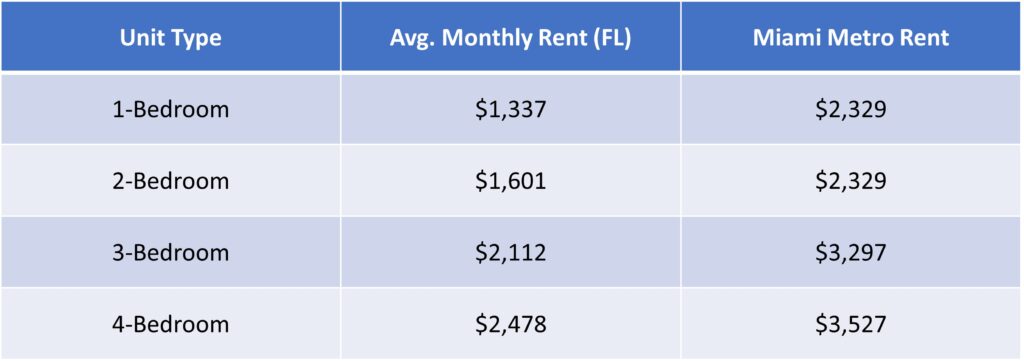
Rental Rates:
Median Home Price (FL): $410,400
Investment Performance & Wealth Building
Multifamily Advantages
– Economies of Scale: One roof, multiple rents. A quadplex renting at $2,000/unit generates $8,000/month. With $5,500 debt service, DSCR = 1.45.
– Risk Diversification: Vacancy in one unit doesn’t eliminate income.
– Institutional Appeal: Easier to scale portfolios and attract capital.
Single-Unit Advantages
– Lower Entry Barriers: Easier for first-time investors.
– Appreciation Potential: Strong in suburban areas with limited inventory.
– Simpler Financing: More lenders, lower rates, and easier underwriting.
– Resale Flexibility: Easier to sell to owner-occupants.
DSCR Loans: A Game-Changer for Multifamily
DSCR (Debt Service Coverage Ratio) = Gross Rental Income ÷ Debt Obligations
– Most lenders require DSCR > 1.1 or 1.2.
– Example: Triplex renting at $1,800/unit = $5,400/month. Debt service = $4,000 → DSCR = 1.35.
– Benefits:
– No personal income verification.
– Ideal for self-employed investors.
– Strong cushion against vacancies.
Regional Investment Hotspots
North Florida (e.g., Jacksonville, Pensacola)
– Lower purchase prices.
– High rent-to-price ratios.
– Rent growth: 4%–6% annually.
Central Florida (e.g., Orlando)
– Balanced appreciation.
– Tourism-driven rental demand.
South Florida (e.g., Miami, Fort Lauderdale)
– High rents.
– Strong demand from international tenants.
Final Thoughts
Choosing between single-unit and multifamily investing in Florida depends on your financial goals, risk tolerance, and mortgage strategy. Single-family homes offer simplicity and appreciation, while multifamily properties deliver scalability and income stability—especially when paired with DSCR loans.
For investors seeking long-term cash flow and portfolio growth, multifamily assets in Florida’s thriving rental markets may offer the edge in 2025.
Want personalized assistance? Visit our 'Contact Us' tab and leave your information with one of our experts.
About Us
A group of like-minded seasoned veterans came together to create a company with an employee-focused culture. A culture that values its members both personally and professionally and a company built on the idea that the customer comes first!
We do not share data with third parties for marketing/promotional purposes.
By submitting your phone number to Level Mortgage, you are authorizing a representative of our company to send you text messages and notifications. Message frequency may vary. Message/data rates apply. Reply STOP to unsubscribe to a message sent from us, and HELP to receive help.
In Florida’s dynamic real estate landscape, 2025 has ushered in a wave of cautious optimism. With mortgage rates stabilizing and property values holding strong, homeowners and investors alike are asking: Is now the right time to refinance? The answer depends on your financial goals, current mortgage terms, and the evolving market conditions across the Sunshine State.
This shift is particularly relevant in Florida, where home prices have remained resilient. According to recent data, the median home value in Florida is approximately $415,000, up 3.2% year-over-year, driven by strong demand in coastal cities like Tampa, Miami, and Sarasota.
When Does Refinancing Make Sense?
Refinancing your mortgage can be a powerful financial tool—but only when done strategically. Here are the key scenarios where refinancing makes sense in Florida’s 2025 market:
1. Lowering Your Interest Rate
If your current mortgage rate is above 7%, refinancing to today’s average of 6.4% could save you thousands over the life of your loan. For example, refinancing a $300,000 mortgage from 7.25% to 6.4% could reduce monthly payments by $150–$200, depending on loan terms and fees.
2. Switching Loan Terms
Many Florida homeowners are opting to refinance from a 30-year to a 15-year mortgage. While monthly payments may increase, the interest savings are substantial. At today’s 15-year rate of 5.35%, a $250,000 loan would save over $40,000 in interest compared to a 30-year term.
3. Tapping Home Equity
Florida’s rising home values mean many homeowners now have significant equity. Cash-out refinancing allows you to access this equity for renovations, debt consolidation, or investment. With home equity levels up 12% statewide compared to 2022, this strategy is gaining traction among investors looking to expand their portfolios.
4. Eliminating Private Mortgage Insurance (PMI)
If your home has appreciated and your loan-to-value ratio has dropped below 80%, refinancing can help eliminate PMI—saving you $100–$300 per month.
5. Improving Credit Profile
If your credit score has improved since your original mortgage, you may qualify for better rates. Lenders in Florida are offering competitive terms to borrowers with scores above 740, including reduced closing costs and faster approvals.
Florida-Specific Considerations
Florida’s real estate market is unique, shaped by seasonal demand, coastal risk factors, and a strong influx of out-of-state buyers. Here are some Florida-specific factors to weigh before refinancing:
– Property Insurance Costs: Rising insurance premiums—especially in hurricane-prone areas—can offset savings from refinancing. Be sure to factor in total housing costs.
– Homestead Exemption Rules: Refinancing doesn’t affect your homestead exemption, but cash-out refinances may impact eligibility if ownership changes.
– Investment Property Trends: Florida remains a hotspot for short-term rentals. Investors refinancing to fund new acquisitions should consider local regulations and occupancy rates, which average 72% in top markets like Orlando and Clearwater.
Tips for a Smart Refinance in 2025
– Shop Around: Rates vary by lender. Use Florida-specific mortgage comparison tools to find the best deal.
– Watch the Fed: Interest rate decisions by the Federal Reserve will influence mortgage rates. A predicted rate cut in Q4 2025 could make refinancing even more attractive.
– Calculate Break-Even Point: Determine how long it will take to recoup closing costs. If you plan to move within 3–5 years, refinancing may not be worth it.
– Consider Hybrid Loans: Adjustable-rate mortgages (ARMs) with fixed initial periods (e.g., 5/1 or 7/1) offer lower rates and may suit short-term homeowners.
Investor Perspective: Strategic Refinancing
For real estate investors, refinancing is more than a cost-saving tactic—it’s a portfolio growth strategy. With Florida’s rental demand surging and cap rates holding steady around 5.8%, refinancing can unlock capital for new acquisitions or renovations. Investors should consider:
– Debt Service Coverage Ratio (DSCR): Ensure rental income covers new mortgage payments.
– Tax Implications: Cash-out refinances are not taxable, but interest deductions may change.
– Market Timing: With rates expected to dip, locking in a refinance now could offer long-term advantages.
Final Thoughts
Refinancing your mortgage in Florida in 2025 can be a smart move—if the timing and terms align with your financial goals. Whether you’re a homeowner looking to lower monthly payments or an investor seeking to leverage equity, the current market offers compelling opportunities. With rates stabilizing and home values strong, now is the time to evaluate your options and make informed decisions.
Want personalized assistance? Visit our 'Contact Us' tab and leave your information with one of our experts.
About Us
A group of like-minded seasoned veterans came together to create a company with an employee-focused culture. A culture that values its members both personally and professionally and a company built on the idea that the customer comes first!
We do not share data with third parties for marketing/promotional purposes.
By submitting your phone number to Level Mortgage, you are authorizing a representative of our company to send you text messages and notifications. Message frequency may vary. Message/data rates apply. Reply STOP to unsubscribe to a message sent from us, and HELP to receive help.
Florida is home to over 1.5 million veterans, making it one of the most veteran-populated states in the U.S. With its warm climate, military bases, and veteran-friendly communities, it’s no surprise that many service members choose to settle here. For those eligible, VA loans offer a powerful path to homeownership—but securing the lowest possible interest rate can make a significant difference in long-term affordability. In this guide, we’ll break down actionable strategies to help you lock in a lower rate on your VA loan in Florida.
What Is a VA Loan?
A VA loan is a mortgage backed by the U.S. Department of Veterans Affairs, designed to help veterans, active-duty service members, and certain military spouses buy homes with favorable terms. Key benefits include:
– No down payment required
– No private mortgage insurance (PMI)
– Competitive interest rates
– Flexible credit requirements
However, VA loans are issued by private lenders, so rates can vary based on your financial profile and market conditions.
Improve Your Credit Score
Your credit score is one of the most influential factors in determining your VA loan interest rate. According to Experian, the average credit score in Florida is 707, but lenders often offer the best rates to borrowers with scores above 740.
Your DTI ratio compares your monthly debt payments to your gross income. VA guidelines recommend a DTI of 41% or lower, though some lenders may allow higher ratios with strong compensating factors.
How to reduce DTI:
– Pay off small debts before applying
– Avoid taking on new loans
– Increase your income through side gigs or bonuses
A lower DTI not only improves your chances of approval but can also help you qualify for better rates.
– During seasonal slowdowns (e.g., late fall or early winter)
Locking in your rate when the market dips can save you thousands over the life of the loan.
Consider Making a Down Payment
While VA loans don’t require a down payment, putting money down can reduce your interest rate and funding fee. For example:
– 0% down: Funding fee is 2.15% (first-time use)
– 5% down: Funding fee drops to 1.50%
– 10% down: Funding fee drops to 1.25%
Even a modest down payment can lower your monthly payment and total loan cost.
Use the VA IRRRL Program for Refinancing
Already have a VA loan? You may qualify for the Interest Rate Reduction Refinance Loan (IRRRL), also known as the VA Streamline Refinance. This program allows you to refinance to a lower rate with minimal paperwork and no appraisal.
Benefits of IRRRL:
– Lower monthly payments
– No income verification
– No credit check (in some cases)
This is especially useful if rates drop after you’ve closed on your original VA loan.
Choose a Shorter Loan Term
VA loans are available in various term lengths. A 15-year VA loan typically offers a lower interest rate than a 30-year loan, though monthly payments are higher.
Example:
– 30-year VA loan at 6.25% = $1,847/month
– 15-year VA loan at 5.75% = $2,591/month
While the monthly cost is higher, you’ll save tens of thousands in interest over the life of the loan.
Florida-Specific Considerations
Florida’s housing market remains competitive, with median home prices around $410,000 in 2025. VA loans are especially valuable in high-cost areas like Miami, Tampa, and Orlando, where conventional loan limits may be exceeded.
Florida VA loan facts:
– No state income tax (helps with DTI)
– High veteran population = more lender options
– Property tax exemptions for disabled veterans
These factors make Florida an ideal place to maximize your VA loan benefits.
Final Thoughts
Securing a lower rate on your VA loan in Florida isn’t just about luck—it’s about preparation, timing, and strategy. By improving your credit, lowering your DTI, shopping lenders, and understanding VA loan nuances, you can unlock significant savings and make your dream home more affordable.
Want personalized assistance? Visit our 'Contact Us' tab and leave your information with one of our experts.
About Us
A group of like-minded seasoned veterans came together to create a company with an employee-focused culture. A culture that values its members both personally and professionally and a company built on the idea that the customer comes first!
We do not share data with third parties for marketing/promotional purposes.
By submitting your phone number to Level Mortgage, you are authorizing a representative of our company to send you text messages and notifications. Message frequency may vary. Message/data rates apply. Reply STOP to unsubscribe to a message sent from us, and HELP to receive help.
Top 10 Tax Benefits of Homeownership in Florida (2025 Guide)
Florida’s real estate market continues to shine in 2025—not just for its sun-soaked beaches and booming property values, but also for the compelling tax advantages it offers homeowners. Whether you’re a first-time buyer, seasoned investor, or relocating retiree, understanding the tax benefits of owning property in Florida can significantly impact your financial planning and long-term wealth strategy.
Why Florida? A Tax-Friendly Oasis
Florida ranks as the third most tax-friendly state in the U.S. in 2025. The absence of a state income tax is a major draw, especially for high-income earners, entrepreneurs, and retirees. This alone can save residents thousands of dollars annually compared to states like New York or California.
1. No State Income Tax
Florida’s constitution prohibits a state income tax, meaning:
– 100% of your salary, pension, or investment income stays with you
– Retirees benefit from no taxation on Social Security, pensions, or IRA withdrawals
– Remote workers and business owners relocating to Florida can see effective tax savings of 5–10% compared to income-taxed states
This foundational benefit sets the stage for additional tax perks tied directly to homeownership.
2. Homestead Exemption: Up to $50,000 in Taxable Value Reduction
Florida’s Homestead Exemption is one of the most powerful tools for reducing property taxes:
– Homeowners who declare their Florida property as their primary residence can receive up to $50,000 off their home’s assessed value
– The first $25,000 applies to all property taxes, including school district levies
– More residents qualify, including those with lower-value homes
– Tax savings can be transferred when moving to a new Florida home, preserving benefits
3. Save Our Homes Cap: Protection Against Rising Property Values
Florida’s Save Our Homes (SOH) provision limits the annual increase in assessed value of a homesteaded property to 3% or the rate of inflation, whichever is lower.
This is crucial in a market like Florida, where property values have risen by 6.8% year-over-year in 2025, according to Florida Realtors. Without SOH, property taxes could skyrocket. With it:
– Homeowners enjoy predictable and manageable tax bills
– Long-term residents save thousands over time as market values climb
4. Mortgage Interest Deduction
On the federal level, homeowners can deduct mortgage interest paid on loans up to $750,000 (for loans originated after December 15, 2017). This deduction is especially valuable in the early years of a mortgage, when interest payments are highest.
For example:
– A homeowner with a $500,000 mortgage at 6.5% interest pays roughly $32,500 in interest annually
– This amount can be deducted from taxable income, potentially saving $7,000–$9,000 depending on the tax bracket
5. Property Tax Deduction (Federal SALT Cap)
Homeowners can also deduct state and local property taxes on their federal return, subject to the $10,000 SALT cap (State and Local Tax).
– Most Florida homeowners stay well within the SALT cap
– A $400,000 home in Florida typically incurs $3,320 in annual property taxes, which can be fully deducted
6. Energy-Efficient Home Tax Credits
In 2025, federal tax credits for energy-efficient upgrades remain robust:
– Homeowners can claim up to 30% of the cost of eligible improvements, such as solar panels, heat pumps, and insulation
– Florida’s climate makes solar especially viable—solar installations increased by 22% statewide in 2025
These credits not only reduce tax liability but also lower utility bills, creating a double win.
7. Capital Gains Exclusion on Sale of Primary Residence
When selling a primary residence, homeowners may exclude up to:
– $250,000 of capital gains (single filers)
– $500,000 (married couples filing jointly)
To qualify, you must have:
– Owned and lived in the home for at least two of the last five years
– Not claimed the exclusion on another home in the past two years
With Florida’s property appreciation averaging 6–8% annually, many homeowners benefit from this exclusion when cashing out equity.
8. Home Equity Loan Interest Deduction
Interest on home equity loans or lines of credit (HELOCs) may be deductible if the funds are used to:
Buy, build, or substantially improve the home
This allows homeowners to tap into rising equity for renovations while enjoying tax benefits. In 2025, Florida’s average home equity has risen by 12.4%, making this strategy increasingly popular.
9. No Estate or Inheritance Tax
Florida does not levy estate or inheritance taxes, which is a major advantage for legacy planning:
– Heirs can inherit property without additional state-level taxation
– Combined with federal estate tax thresholds ($13.61 million in 2025), most estates pass tax-free
This makes Florida especially attractive for retirees and high-net-worth individuals.
10. Rental Income Opportunities and Tax Treatment
Florida’s thriving tourism and snowbird seasons create strong demand for short-term rentals:
– Rental income is taxable, but expenses like maintenance, utilities, and depreciation are deductible
– Many homeowners use platforms like Airbnb or VRBO to generate $20,000–$40,000 annually
In 2025, over 18% of Florida homeowners report earning supplemental income from rentals, according to the Florida Department of Revenue.
Final Thoughts: Strategic Ownership Pays Off
Homeownership in Florida offers more than lifestyle perks—it’s a strategic financial move. With no state income tax, generous exemptions, and federal deductions, homeowners can save thousands annually while building equity in a high-growth market.
To maximize these benefits:
– File for Homestead Exemption early in the year
– Keep records of mortgage interest and property tax payments
– Consult a tax professional when selling or renovating
– Explore energy-efficient upgrades for long-term savings
Want personalized assistance? Visit our 'Contact Us' tab and leave your information with one of our experts.
About Us
A group of like-minded seasoned veterans came together to create a company with an employee-focused culture. A culture that values its members both personally and professionally and a company built on the idea that the customer comes first!
We do not share data with third parties for marketing/promotional purposes.
By submitting your phone number to Level Mortgage, you are authorizing a representative of our company to send you text messages and notifications. Message frequency may vary. Message/data rates apply. Reply STOP to unsubscribe to a message sent from us, and HELP to receive help.
Renting vs. Buying a Home in Florida (2025): Which Is the Smarter Financial Move?
Florida’s real estate market has always been a magnet for both homeowners and renters. With its warm climate, no state income tax, and vibrant lifestyle, the question of whether to buy or rent in Florida is more relevant than ever in 2025. Let’s break down the numbers, trends, and key considerations to help you make an informed decision.
Florida’s 2025 Housing Market Snapshot
As of mid-2025, Florida’s housing market is showing signs of stabilization after the explosive growth of the early 2020s. According to Florida Realtors:
– Median Home Price (Single Family): $415,000 — down 2.7% from 2024
– Median Condo/Townhouse Price: $310,000 — down 6.1%
– Inventory Levels: 5.6 months for single-family homes (balanced market); 10.3 months for condos/townhouses (strong buyer’s market)
These figures suggest that while prices have cooled slightly, affordability remains a challenge due to elevated interest rates and insurance costs.
The Case for Buying
1. Building Equity
Homeownership allows you to build equity over time. With Florida’s long-term appreciation trends, buying can be a powerful wealth-building tool.
From 2015 to 2022, Florida home prices rose by over 80% in some counties.
Even with recent cooling, projections suggest median home prices could reach $470,000–$500,000 by 2030.
2. Tax Benefits
Florida homeowners enjoy:
No state income tax
Mortgage interest deductions (federal)
Homestead exemptions that reduce property tax bills
3. Stability and Control
Owning a home means:
No rent hikes
Freedom to renovate
Long-term stability, especially for families
4. Rental Income Potential
Florida’s tourism and snowbird seasons make short-term rentals lucrative. Platforms like Airbnb have made it easier for homeowners to monetize their properties.
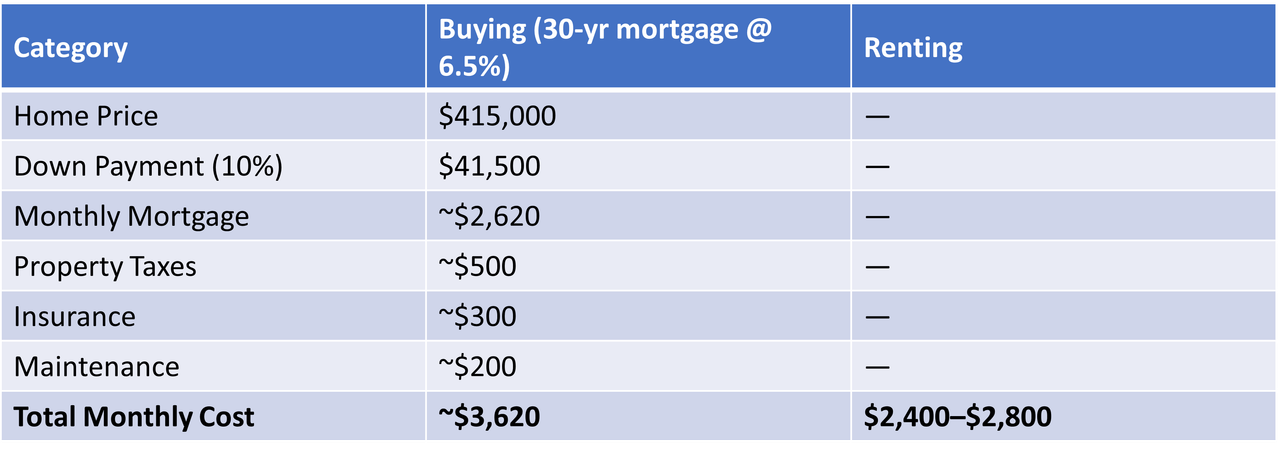
Cost Comparison: Renting vs. Buying in Florida (2025)
Let’s compare monthly costs for a typical single-family home:
Note: Rental prices vary by city. Miami and Naples tend to be higher, while Ocala and Lakeland are more affordable.
Regional Considerations
South Florida (Miami, Fort Lauderdale)
High property values and insurance costs
Strong rental demand
Buying may be viable for long-term residents or investors
Central Florida (Orlando, Tampa)
Balanced market conditions
Growing job market
Good mix of affordable rentals and homes
North Florida (Jacksonville, Tallahassee)
Lower home prices
Less volatility
Buying is more accessible for first-time buyers
What the Experts Say
Florida Realtors Chief Economist Dr. Brad O’Connor notes that “single-family homes ended 2024 still just barely in a seller’s market at 4.7 months of supply, while condos and townhouses are now firmly in buyer’s market territory, at 8.2 months’ supply”.
Meanwhile, Norada Real Estate predicts a “robust recovery” in home prices by 2030, driven by population growth and economic expansion.
Common Issues & FAQs
Can a buyer waive the mortgage contingency?
Yes, but it’s risky unless the buyer is paying all cash or has guaranteed financing.
Is an appraisal part of the mortgage contingency?
Yes. The lender must receive an appraisal satisfactory to them. If the appraisal is too low, the buyer may not get loan approval.
What happens if the buyer doesn’t notify the seller in time?
If the buyer fails to terminate the contract before the deadline, they may be obligated to proceed or forfeit their deposit.
Final Thoughts: Which Is Better?
The answer depends on your goals:
– Buy if you plan to stay for 5+ years, want to build equity, and can afford the upfront costs.
– Rent if you value flexibility, are unsure about your future, or want to avoid high insurance and maintenance costs.
In 2025, Florida’s market is more balanced than it’s been in years. That means buyers have more negotiating power, and renters have more options. Whether you’re eyeing a beachfront condo or a suburban bungalow, understanding the numbers is key.
Want personalized assistance? Visit our 'Contact Us' tab and leave your information with one of our experts.
About Us
A group of like-minded seasoned veterans came together to create a company with an employee-focused culture. A culture that values its members both personally and professionally and a company built on the idea that the customer comes first!
We do not share data with third parties for marketing/promotional purposes.
By submitting your phone number to Level Mortgage, you are authorizing a representative of our company to send you text messages and notifications. Message frequency may vary. Message/data rates apply. Reply STOP to unsubscribe to a message sent from us, and HELP to receive help.
Ave Maria’s 2025 New Home Sales Surge Mid-Year: A Testament to Resilience and Demand
Nestled in Eastern Collier County, Florida, Ave Maria continues to defy national housing market headwinds with a robust performance in new home sales through the first half of 2025. As a professional in the mortgage and real estate industry, it’s clear that Ave Maria’s success is not just a local anomaly—it’s a case study in strategic community planning, diversified housing options, and lifestyle-driven demand..
Mid-Year Sales Snapshot: 318 New Homes Sold
As of July 2025, Ave Maria recorded the sale of 318 new homes in the first six months of the year. This performance has earned the community the #18 spot on the prestigious RCLCO Top-Selling Master-Planned Communities in the U.S. list. Despite broader market challenges, including rising interest rates and inventory constraints, Ave Maria’s numbers reflect a healthy appetite for new construction in Southwest Florida.
Total Sales and Build-Out Vision
To date, Ave Maria has sold 5,500 new homes, with a projected total of 11,000 residences at full build-out. This milestone places the development halfway through its long-term vision, which includes not only residential expansion but also 1.8 million square feet of retail, office, and business park space across 5,000 acres.
Market Dynamics: Pricing and Inventory
According to Redfin and Realtor.com data:
– Median listing price: $468,000 (July 2025)
– Median sold price: $398,200
– Median price per square foot: $234
– Sale-to-list price ratio: 95.07%
– Average days on market: 78 days (up from 46 days in 2024)
While prices have dipped slightly—down 5.4% year-over-year—the community remains attractive to buyers seeking value, lifestyle, and long-term growth potential.
Builders Driving Growth
Ave Maria’s success is powered by four major residential builders:
– CC Homes
– Del Webb Naples
– Lennar
– Pulte Homes
These builders offer a wide range of housing options, including:
– Condominiums
– Attached villas
– Single-family homes
Prices range from the mid-$200,000s to the $800,000s, with over 25 designer-furnished model homes available for daily tours.
Why Buyers Choose Ave Maria
Michelle Mambuca, marketing and PR manager for the community, attributes the strong sales to Ave Maria’s “vibrant lifestyle, family-friendly amenities, conveniences, and variety of new home options”. Here’s what makes Ave Maria stand out:
Amenities Galore
– Water park
– Soccer and baseball fields
– Fitness center
– Amphitheater
– Dog park
– Walking paths
– Championship golf
– Bocce, pickleball, and tennis courts
– Town Center with 75+ businesses, including Publix and Mobil
Education Excellence
– Ave Maria Elementary School (opening August 2026, capacity: 900 students)
– Private schools from preschool through university
– Zoned for A-rated Collier County public schools
Retail and Employment
– 1.8 million sq. ft. of commercial space planned
– On-site retail and dining
– Local employment opportunities
Migration Trends: Who’s Moving In?
Between February and April 2025, migration data shows:
– 60% of buyers searched to stay within the Ave Maria metro area
– 40% looked to move out
– Top inbound metros: Miami (3,331 searches), Chicago (1,949), New York (1,138)
This influx from major urban centers suggests that Ave Maria is increasingly viewed as a refuge for buyers seeking affordability, space, and community.
Market Challenges and Resilience
Despite national trends showing cooling demand and longer time on market, Ave Maria’s performance is notable:
– Median sale price down 21.3% YoY to $380K
– Average days on market increased to 116 days
– Yet, home sales in June 2025 rose to 30, up from 23 in June 2024
This resilience is a testament to the community’s appeal and the strategic efforts of its developers and planners.
Recognition and Awards
Ave Maria’s accolades include:
– Top 20 Master-Planned Community in the U.S. (2015–2024)
– Community of the Year
– Top Selling Single-Family Home Community in Southwest Florida
– Blue Zones Certified Community
– Del Webb Naples named a Top 20 Place to Retire
Additionally, Ave Maria was named one of the Top 100 Places to Live by Ideal Living Magazine in 2025.
Outlook for the Second Half of 2025
With 318 homes sold mid-year and continued demand from out-of-state buyers, Ave Maria is poised to exceed 600 new home sales by year-end, matching or surpassing its 2024 performance. The upcoming opening of Ave Maria Elementary and continued commercial development will likely fuel further interest.
Final Thoughts
Ave Maria’s mid-year performance in 2025 is more than just a bright spot—it’s a blueprint for how master-planned communities can thrive in uncertain markets. With a balanced mix of affordability, amenities, and strategic growth, Ave Maria is not just selling homes—it’s selling a lifestyle.
For mortgage professionals, investors, and homebuyers alike, Ave Maria represents a compelling opportunity in Florida’s evolving real estate landscape.
Want personalized assistance? Visit our 'Contact Us' tab and leave your information with one of our experts.
About Us
A group of like-minded seasoned veterans came together to create a company with an employee-focused culture. A culture that values its members both personally and professionally and a company built on the idea that the customer comes first!
We do not share data with third parties for marketing/promotional purposes.
By submitting your phone number to Level Mortgage, you are authorizing a representative of our company to send you text messages and notifications. Message frequency may vary. Message/data rates apply. Reply STOP to unsubscribe to a message sent from us, and HELP to receive help.